Introduction: The System Behind Your Electricity Bill
Every month, an electricity bill arrives at your factory, your warehouse, or your office. You pay it — possibly grimacing at the number — and move on. But very few industrial energy buyers in India have ever paused to ask a deceptively simple question: how did that electricity actually get here?
Not physically, through wires — that part is obvious. But commercially and institutionally: who generated it, who decided how much to generate and when, who transported it across hundreds of kilometres of high-voltage cable, who distributed it to your area, who set the price you pay, and who regulates all of it?
The answer to that question is India’s electricity market — a system of extraordinary complexity that has evolved from a fully government-controlled monopoly in the 1990s to a partially liberalised, multi-participant market operating under a sophisticated regulatory framework and generating over 1,800 billion units of electricity per year.
Understanding this market matters directly and practically to industrial energy buyers. The structure of the electricity market determines which costs appear on your DISCOM bill and why. It determines whether you can bypass your DISCOM to source cheaper renewable power directly from a generator. It determines who you need to talk to when your open access application is delayed. It tells you why your factory pays ₹7.50/kWh for industrial power while a neighbouring state’s factories pay ₹5.50/kWh. And it tells you what is likely to change about your energy costs over the next decade — and how to position your business ahead of those changes.
This guide explains the entire Indian electricity market — from the moment a photon hits a solar panel in Rajasthan to the moment it powers a CNC machine in Coimbatore — in language that a CFO, a plant manager, and a finance controller can all read and use.
What you will learn in this guide:
- The four segments of India’s electricity market and how each earns its revenue
- The generation segment: who generates power in India and how they sell it
- The transmission segment: how high-voltage grids move power across the country
- The distribution segment: what DISCOMs do, why they matter, and why many are financially stressed
- Retail supply and open access: how C&I consumers can bypass DISCOMs for cheaper renewable power
- India’s wholesale electricity markets: IEX, DAM, RTM, Green Markets, and the 2026 market coupling reform
- How renewable energy fits into the market structure
- Regulatory bodies: MoP, MNRE, CERC, SERCs, CEA — who does what
- Tamil Nadu electricity market deep-dive: TANGEDCO, HT tariffs, open access charges
- The future of India’s electricity market: where it is headed by 2030
The Four Segments of India’s Electricity Market
India’s electricity sector operates across four distinct segments, each with a different function, different participants, different revenue models, and different regulatory oversight. Understanding these four segments — and how they relate to each other — is the foundation of understanding the entire market.
Segment 1 — Generation: Power plants that produce electricity. Revenue model: selling electricity under long-term PPAs or on short-term markets.
Segment 2 — Transmission: High-voltage networks that move bulk electricity from generation sites to load centres. Revenue model: regulated transmission charges paid by those using the grid.
Segment 3 — Distribution: The network that takes electricity from the transmission grid and delivers it to the end consumer’s premises. Revenue model: retail electricity tariffs set by state regulators.
Segment 4 — Retail Supply / Open Access: The commercial arrangements through which end consumers access electricity — either from DISCOMs (the default) or directly from generators through open access.
Each segment is governed by different regulations, operated by different entities, and creates different cost components that ultimately determine what an industrial consumer pays for electricity. The classic electricity bill of an HT industrial consumer in Tamil Nadu contains costs from all four segments — embedded in the DISCOM tariff and the open access charge stack.
The Generation Segment: Who Produces India’s Electricity
India’s total installed power generation capacity stood at approximately 618.99 GW in 2026, growing at a CAGR of 7.62% and on track to reach 893 GW by 2031. The non-fossil fuel share of installed capacity crossed 51% for the first time in 2025, with renewable energy (274.68 GW as of March 2026) now forming the majority of new capacity being added.
The generation segment includes several categories of participants:
Central GENCOs
Government-owned central generating companies — primarily NTPC (National Thermal Power Corporation), NHPC (National Hydroelectric Power Corporation), SJVN, THDC, and NEEPCO — operate large-scale power plants (thermal, hydro, and increasingly renewable) on behalf of the central government. NTPC alone has an installed capacity exceeding 70 GW and is the largest single power generator in India.
Central GENCOs sell their electricity to state DISCOMs through long-term Power Purchase Agreements (PPAs), with tariffs regulated by the Central Electricity Regulatory Commission (CERC). Their tariffs are cost-of-service based — recovering capital costs, O&M costs, and a regulated return on equity — rather than market-determined.
State GENCOs
State government-owned generation companies — such as TNGENCO (Tamil Nadu Generation Corporation), MAHAGENCO (Maharashtra), APGENCO (Andhra Pradesh), and similar entities in each state — operate thermal, hydro, and some renewable power plants on behalf of their state governments. State GENCOs supply electricity to their state DISCOMs under long-term PPAs at tariffs regulated by their respective State Electricity Regulatory Commissions (SERCs).
Private Sector IPPs
Independent Power Producers are private sector companies that develop, own, and operate power generation assets and sell electricity under PPAs or on the open market. As detailed in our companion article on the IPP business model, IPPs are responsible for the overwhelming majority of India’s new renewable energy capacity being added — from utility-scale solar giants like Adani Green Energy (19.3 GW operational portfolio) and ReNew Power (13+ GW) to C&I-focused developers like NST Solar & Wind Energy serving Tamil Nadu’s industrial sector.
IPPs earn revenue through long-term PPAs (with DISCOMs, central agencies like SECI, or directly with C&I consumers), merchant power sales on the IEX, Renewable Energy Certificate (REC) trading, and emerging carbon credit and green premium revenue streams.
Captive Power Generators
Industrial companies that generate electricity for their own consumption — either through their own plants (conventional captive) or through group captive arrangements (where multiple consumers collectively own at least 26% equity in a generating company) — are captive power generators. Captive generation is a significant segment of India’s total electricity supply, with large industrial consumers in energy-intensive sectors (steel, aluminium, cement, textiles) operating their own generation assets to avoid DISCOM tariffs.
How Generators Sell Their Power
Generators in India access buyers through multiple channels:
- Long-Term PPAs (>7 years): The backbone of most IPP revenue — fixed or escalating tariff contracts with DISCOMs or C&I consumers, providing 15–25 years of contracted revenue.
- Medium-Term PPAs (1–7 years): Less common, bridging the gap between long-term contracting and short-term market access.
- Short-Term bilateral contracts: Direct contracts between generators and buyers for durations of up to 1 year, typically through licensed electricity traders.
- Power exchanges (IEX, PXIL, HPX): Day-ahead, real-time, and term-ahead market trading — the “spot market” of India’s electricity sector.
The Transmission Segment: The Highways of India’s Power Grid
Once electricity is generated, it must travel from the generation site to the area where it will be consumed. For large-scale generation (utility-scale solar farms in Rajasthan, wind farms in Tamil Nadu, hydro plants in Himachal Pradesh), this means transporting bulk power over hundreds or thousands of kilometres — a task that requires high-voltage transmission infrastructure.
India’s transmission network operates at two levels:
Inter-State Transmission System (ISTS)
The national high-voltage transmission network — operated primarily by Power Grid Corporation of India Limited (PGCIL, also called POWERGRID) — connects states and regions, enabling power to flow from surplus generation zones to deficit consumption zones across the country. ISTS operates at Extra High Voltage (EHV) levels: 765 kV, 400 kV, and 220 kV.
PGCIL has been expanding its network rapidly to accommodate India’s renewable energy capacity growth. In 2025 alone, the Ministry of Power added 6,511 circuit kilometres of new transmission lines and boosted transformation capacity by 1,00,368 MVA. The Central Electricity Authority’s National Electricity Plan (Transmission) targets the addition of 114,687 circuit kilometres of lines by 2027, creating one of the largest infrastructure build programmes in India’s history.
The cost of using the ISTS is the ISTS transmission charge — a per-unit fee paid by those who use the national grid to move electricity. For renewable energy projects, a significant policy support has been the ISTS charge waiver, which exempts solar and wind projects commissioned within specified windows from paying ISTS charges. As of April 2026, this waiver applies to projects commissioned before June 30, 2028 — making commissioning before this deadline a significant economic priority for renewable IPPs accessing inter-state markets.
State Transmission System (STS)
Within each state, the State Transmission Utility (STU) — in Tamil Nadu, this is TANTRANSCO (Tamil Nadu Transmission Corporation) — operates the intra-state high-voltage network, connecting the ISTS entry points to the state distribution network. The STS operates at lower voltages than the ISTS (typically 110 kV and 33 kV), distributing bulk power from the national grid across the state’s geographic area.
Transmission charges for using the state transmission system are regulated by the SERC (TNERC in Tamil Nadu) and form part of the open access charge stack that C&I consumers must pay when sourcing renewable power from off-site locations.
Why transmission matters to industrial energy buyers: If you are sourcing solar power from a plant located 200 km from your factory through an open access PPA, your electricity is using both the state transmission system (for intra-state movement) and potentially the ISTS (for inter-state movement) to reach you. The transmission and wheeling charges associated with this movement directly affect your effective cost of solar power — and must be factored into any open access PPA economics calculation.
Calculate Your Industry’s Savings Potential
Request a customized industrial electricity savings analysis from our renewable energy experts.
The Distribution Segment: What DISCOMs Do and Why They Matter
The distribution segment is the one most industrial consumers interact with most directly — and understand least.
A DISCOM (Distribution Company) is the entity that:
1. Takes bulk electricity from the transmission grid (at the 33 kV or 11 kV level)
2. Steps it down further to the voltage levels used by end consumers (LT consumers at 415 V, HT consumers at 11 kV, 33 kV, or 110 kV)
3. Distributes it through local networks of distribution lines, transformers, and metering infrastructure to each connected consumer
4. Bills consumers at the retail tariff determined by the state regulator
5. Procures the electricity it supplies through long-term PPAs with GENCOs and IPPs, medium-term contracts, and short-term market purchases
In Tamil Nadu, TANGEDCO (Tamil Nadu Generation and Distribution Corporation) performs both the generation and distribution functions — it owns both thermal generation assets and the distribution network, unlike states where generation and distribution are separate entities.
How DISCOMs Procure Power
A DISCOM’s job is to ensure that the electricity it receives at any moment equals the electricity being consumed by its consumers at that moment — a continuous balancing act across millions of connection points. To do this, it maintains a portfolio of power procurement contracts:
Long-term PPAs (>7 years): The bulk of a DISCOM’s power comes from long-term PPAs with central GENCOs (NTPC, NHPC), state GENCOs, and increasingly from renewable IPPs (through SECI/NTPC tenders and direct state tenders). These PPAs provide capacity certainty and price predictability but also lock the DISCOM into fixed obligations even if its actual demand is lower.
Medium and short-term contracts: DISCOMs supplement their long-term portfolio with medium and short-term bilateral purchases — buying from generators with surplus capacity not already contracted under long-term PPAs.
Power exchange purchases: DISCOMs use the IEX’s Day-Ahead Market and Real-Time Market to balance their portfolios — buying extra power on high-demand days, selling surplus on low-demand days.
The Financial Health Crisis of Indian DISCOMs
One of the most significant structural challenges in India’s electricity market is the financial distress of many state DISCOMs. This matters for every participant in the electricity value chain — from generators waiting to be paid to industrial consumers evaluating the reliability of their supply.
The core problem: DISCOMs face a structural revenue shortfall. They buy power at cost-based rates from GENCOs and sell it at retail tariff rates — but in most states, the retail tariffs (particularly for domestic and agricultural consumers, who pay well below the actual cost of supply) are subsidised. The subsidy is supposed to be compensated by state governments, but these payments are often delayed or insufficient, leaving DISCOMs in a chronic cash deficit.
The resulting consequences cascade through the entire system: DISCOMs delay payments to generators (affecting IPP cash flows and debt service), defer capital investment in distribution infrastructure (causing power quality and reliability issues), and resist approving open access applications from large industrial consumers (since every consumer who leaves the DISCOM pool reduces the cross-subsidy revenue that helps cover domestic and agricultural supply costs).
Recent solutions: The Revamped Distribution Sector Scheme (RDSS) provides central government funding for DISCOM capital investment and operational improvement. The late payment surcharge rule requires DISCOMs to pay surcharges on delayed generator payments, improving payment discipline. Market coupling reforms (discussed later) are intended to improve price discovery and reduce the volatility of short-term procurement costs. But DISCOM financial health remains a structural challenge that will take years to resolve — and is a key reason why C&I consumers in states with financially stressed DISCOMs are accelerating their shift to open access renewable PPAs.

Retail Supply and Open Access: How C&I Consumers Bypass the DISCOM
The default electricity supply arrangement for any Indian consumer — large or small — is to purchase power from the local DISCOM at the tariff determined by the state regulator. For most residential and small commercial consumers, this remains the only practical option.
But for large commercial and industrial consumers, India’s regulatory framework provides an alternative: open access.
What Is Open Access?
Open access is the right of eligible consumers to use the existing electricity transmission and distribution infrastructure — owned by TANGEDCO, TANTRANSCO, or PGCIL — to source electricity from a generator of their choice, rather than (or in addition to) purchasing from the DISCOM.
Under open access, an industrial factory in Coimbatore can contract directly with a solar IPP whose plant is located in Tirunelveli — and have the solar electricity transported over TANTRANSCO’s grid to their factory. The factory pays the solar IPP a PPA tariff, and pays TANGEDCO/TANTRANSCO for the use of their grid (wheeling charge) and other applicable charges, but avoids paying the DISCOM’s full retail tariff rate on the open access units.
The Electricity Act 2003 established open access as a legal right for eligible consumers. The Green Energy Open Access Rules 2022 issued by the Ministry of Power significantly expanded this right by reducing the minimum consumption threshold for renewable energy open access from 1 MW to 100 kW — making open access accessible to a much wider range of industrial and commercial consumers, including medium-scale factories, hospitals, commercial complexes, and educational institutions.
The Open Access Charge Stack in Tamil Nadu
For a consumer in Tamil Nadu accessing solar power through open access, the effective cost of that power is not simply the PPA tariff. Several additional charges apply, each set by TNERC under its tariff orders:
Wheeling charge: The fee for using TANGEDCO/TANTRANSCO’s grid infrastructure to carry electricity from the generator’s injection point to the consumer’s premises. The wheeling charges for HT consumers in Tamil Nadu for FY 2026–27 are ₹1.03/kWh.
Cross-Subsidy Surcharge (CSS): The most significant additional charge for open access consumers — levied to compensate TANGEDCO for the cross-subsidy it provides to lower-tariff consumer categories (domestic, agricultural). The cross-subsidy surcharge for HT industrial consumers in Tamil Nadu for FY 2025–26 is ₹1.99/kWh, increasing to ₹2.06/kWh for FY 2026–27. Under the Green Energy Open Access Rules 2022, renewable energy open access consumers are entitled to a concession on CSS.
Additional Surcharge (AS): A charge covering the fixed costs TANGEDCO has committed to in its long-term PPA portfolio, which remain fixed regardless of how many consumers move to open access. In December 2024, the Tamil Nadu Electricity Regulatory Commission set the additional surcharge for open access consumers at ₹0.54/kWh.
Banking charge: Tamil Nadu permits solar generators to bank surplus energy with TANGEDCO for later drawdown. Under Tamil Nadu’s 2025 Green Energy Open Access Regulations, banking charges are levied in kind at 8% of banked energy — meaning TANGEDCO retains 8 units for every 100 units banked as a service fee. Banking is permitted within the same billing cycle; carry-forward beyond one month is not permitted under the new regulations (except for legacy wind projects).
Transmission losses: A percentage deduction applied to account for the physical energy lost in transmission and distribution between the generation point and the consumer’s meter. Loss percentages are set by TNERC for each voltage level and transmission distance.
The effective open access cost equation:
Effective cost (₹/kWh) = PPA tariff + Wheeling charge + CSS (net of concession) + Additional surcharge + Banking charge (amortised) + T&D loss adjustment
For a typical Tamil Nadu HT-I industrial consumer (factories, manufacturing plants) accessing solar power through open access in FY 2026:
| Cost Component | Approximate Value (₹/kWh) |
|---|---|
| Solar PPA tariff (C&I, ground mount) | ₹3.50 – ₹4.50 |
| Wheeling charge (HT level) | ₹1.03 |
| Cross-subsidy surcharge (with GEOA concession) | ₹1.00 – ₹1.50 (estimated net of concession) |
| Additional surcharge | ₹0.54 |
| T&D losses (est. 5–8% of PPA tariff) | ₹0.18 – ₹0.36 |
| Banking charge (amortised, if applicable) | ₹0.10 – ₹0.20 |
| Effective total cost | ₹6.35 – ₹8.13/kWh |
Compare this to the applicable TANGEDCO HT-I tariff: the tariff for industrial category consumers in Tamil Nadu was increased by 3.4% to ₹7.50/kWh in FY 2026, from ₹7.25/kWh in FY 2025, with demand charges increasing to ₹608/kVA/month. With the additional 25% peak hour surcharge on HT consumers (applicable during 6–10 AM and 6–10 PM), the effective blended rate for many HT industrial consumers substantially exceeds the base tariff.
The savings from open access solar PPAs are real and material — but they require careful cost modelling that accounts for the full open access charge stack, not just the headline PPA tariff.
NST’s team provides detailed open access cost modelling for Tamil Nadu industrial consumers as part of our no-obligation consultation — [contact us here](#).
India’s Wholesale Electricity Markets: The IEX and the Short-Term Trading Ecosystem
Beyond the long-term PPAs that form the backbone of India’s electricity procurement, a sophisticated short-term electricity market operates through power exchanges — allowing generators and buyers to transact electricity on a daily and real-time basis.
The Indian Energy Exchange (IEX)
The Indian Energy Exchange is India’s premier electricity exchange, dominating with over 90% market share and trading approximately 110 billion units (BU) of electricity in FY 2023–24, growing 14% year-on-year. IEX operates as a nationwide automated trading platform for physical delivery of electricity, renewable energy certificates (RECs), and energy saving certificates (ESCs), under the supervision of CERC.
Three exchanges now operate in India: IEX, PXIL (Power Exchange India Limited), and the newer Hindustan Power Exchange (HPX). Each historically discovered its own market-clearing price through independent auctions.
Market Segments on the IEX
Day-Ahead Market (DAM): A short-term electricity market where power is traded for delivery on the next day. Operates through 96 time blocks of 15 minutes each, covering a full 24-hour period. Uses a double-sided closed auction mechanism for price discovery, resulting in a uniform market clearing price (MCP) for each time block. The DAM is the most liquid market segment and is widely used by DISCOMs and large industrial consumers for daily power balancing.
Real-Time Market (RTM): Near-real-time trading for dispatching electricity within the current operating hour, enabling generators and buyers to cover last-minute imbalances between scheduled and actual generation or consumption. RTM prices are more volatile than DAM prices, reflecting true supply-demand conditions at each 15-minute interval.
Green Day-Ahead Market (GDAM): A dedicated renewable energy market where solar and wind generators can sell their output — and DISCOMs and consumers seeking green power can purchase it — in a separate auction that discovers a “green premium” price. GDAM allows renewable energy to trade separately, providing price signals that reflect the specific supply-demand dynamics of the green power market.
Green Term-Ahead Market (GTAM): Term contracts from one week to one month for renewable energy, allowing buyers to secure green power commitments over a longer horizon than the DAM without committing to a multi-year PPA.
High Price Day-Ahead Market (HP-DAM): A separate auction segment for electricity that clears at prices above the standard DAM price cap, enabling generators to offer higher-cost but genuinely available capacity to the market during periods of shortage.
REC Market: The Renewable Energy Certificate trading platform on IEX and PXIL, where generators sell certificates representing 1 MWh of renewable generation to obligated entities seeking to meet their Renewable Purchase Obligations.
The 2026 Market Coupling Reform: A Structural Turning Point
One of the most significant regulatory developments in India’s electricity market in 2025–26 has been the introduction of market coupling — a reform that will fundamentally change how prices are discovered on India’s power exchanges.
In July 2025, the CERC issued a suo motu order to roll out market coupling under its Power Market Regulations, 2021 — the plan being to synchronise the Day-Ahead Market across all power exchanges using a round-robin system by January 2026, while the RTM and TAM coupling would be tested later via shadow pilots.
Market coupling is a mechanism through which buy and sell bids from all power exchanges are aggregated and centrally matched to arrive at a single, uniform market clearing price — meaning that instead of IEX, PXIL, and HPX each discovering their own independent prices, a centralised matching engine will determine one national price for each time block.
The move is expected to introduce uniform prices across exchanges, improve price discovery, enhance market liquidity, and create a more level playing field for participants.
For industrial consumers and IPPs, market coupling has several practical implications:
- More accurate price signals: A single national clearing price reflects the true aggregate supply-demand balance better than three separate exchange prices, which can diverge due to participant fragmentation across exchanges.
- Improved liquidity: Aggregating bids across all exchanges into a single pool increases the market’s depth, reducing the risk of price spikes from thin liquidity on any single exchange.
- Impact on open access consumers: Industries that purchase power from the exchange (rather than through a PPA) may see more stable, less manipulable prices as the market becomes deeper and more unified.
CERC has also proposed in April 2026 that Grid India (the national grid operator) serve as the Market Coupling Operator — centralising price discovery under the transmission system operator rather than any of the competing commercial exchanges. This proposal is still under regulatory review, with stakeholder feedback being collected through May 2026.
Electricity Derivatives: A New Hedging Tool for 2025–26
In July 2025, the Securities and Exchange Board of India approved the launch of monthly baseload electricity derivatives on the Multi Commodity Exchange and the National Stock Exchange. The MCX launched its contracts on July 10, 2025, followed by the NSE on July 14, 2025.
Electricity derivatives allow large consumers, generators, and traders to hedge their electricity price exposure — locking in a price for future delivery without needing a physical PPA. For industrial consumers with significant exposure to spot market electricity prices, derivatives provide a new risk management tool that was previously unavailable in India.
How Renewable Energy Fits Into the Market Structure
Renewable energy has moved from a policy-driven add-on to the structural centre of India’s electricity market. Understanding how renewables interact with each layer of the market structure is essential for anyone operating in or buying from India’s energy sector.
Must-run status: Solar and wind plants have must-run status under CERC regulations — grid operators cannot curtail their output based on economic merit order, only for genuine grid stability reasons. This ensures that renewable generators are dispatched ahead of higher-cost thermal plants whenever they generate, reducing overall system costs.
Renewable Purchase Obligations (RPO): DISCOMs, open access consumers, and captive power users must source a minimum percentage of their electricity from renewable sources. RPO targets are set by the central government and implemented by SERCs. The RPO framework creates a mandatory demand for renewable energy certificates and directly-sourced renewable power — underpinning the economics of the entire renewable IPP and REC market.
Green Energy Open Access Rules 2022: As discussed above, the 100 kW threshold enables medium and small C&I consumers to participate in green open access — dramatically expanding the potential market for C&I-focused renewable IPPs.
Wind Renewable Consumption Obligation (Wind RCO): A separate wind-specific obligation requiring large consumers to source a percentage of their electricity specifically from wind power — not substitutable by solar. This creates distinct demand for wind IPPs and wind RECs beyond the general RPO framework.
ISTS charge waiver for renewables: The exemption of renewable projects commissioned before June 2028 from ISTS charges makes inter-state renewable energy trade economically viable, enabling solar farms in Rajasthan and Gujarat to supply power to industrial consumers in Tamil Nadu and Maharashtra through national grid infrastructure.
Green Hydrogen Mission: India’s National Green Hydrogen Mission targets 5 million metric tonnes of annual green hydrogen production by 2030 — all requiring renewable electricity. This creates a new, potentially massive demand segment for renewable generators: dedicated electricity supply to green hydrogen electrolysers, at scale and at low cost. The LCOE of renewable electricity is the primary cost driver for green hydrogen production, making low-cost renewable IPP projects directly investable by the hydrogen sector.
The Regulatory Architecture: Who Governs What in India’s Power Sector
India’s electricity sector is governed by a layered regulatory structure spanning central ministries, statutory regulatory commissions, and specialised technical authorities.
Ministry of Power (MoP): The central government ministry responsible for overall electricity policy — setting the legislative and policy framework within which the sector operates. MoP issues the National Electricity Policy, the Tariff Policy, the National Electricity Plan, and key regulatory directives (including the Green Energy Open Access Rules 2022 and the late payment surcharge rules). MoP does not set tariffs directly — that is the role of CERC and SERCs.
Ministry of New & Renewable Energy (MNRE): Responsible specifically for renewable energy policy — solar, wind, hydro (small), biomass, and emerging technologies. MNRE issues the competitive bidding guidelines under which SECI tenders are conducted, the ISTS charge waiver notifications, the National Green Hydrogen Mission framework, and the PM Surya Ghar (rooftop solar subsidy) programme. MNRE’s April 2026 directive centralising all new RE bids under SECI is the most significant recent MNRE policy action.
Central Electricity Regulatory Commission (CERC): The independent statutory regulator for the central electricity sector. CERC determines tariffs for central GENCOs (NTPC, NHPC, etc.) and PGCIL transmission charges, regulates the IEX and other power exchanges, approves inter-state open access applications, sets REC market rules, issues grid codes and connectivity regulations, and adjudicates disputes between central sector participants. CERC’s market coupling order (July 2025) and the subsequent market coupling operator proposal (April 2026) are recent examples of CERC’s market reform role.
State Electricity Regulatory Commissions (SERCs): The independent statutory regulators for each state’s electricity sector — TNERC in Tamil Nadu, MERC in Maharashtra, APERC in Andhra Pradesh, and so on. SERCs set retail tariffs for DISCOMs (determining what industrial, commercial, and domestic consumers pay), regulate open access charges (wheeling, CSS, AS, banking charges), approve state-level renewable energy tenders, and adjudicate disputes involving state sector participants. For C&I consumers and renewable IPPs operating within a single state, the SERC is the most directly relevant regulator.
Central Electricity Authority (CEA): The technical wing of the Ministry of Power — responsible for overall electricity planning (National Electricity Plan), setting technical standards for generation and grid connectivity, and maintaining the national electricity database. CEA’s approval is required for power stations above a specified capacity threshold. The CEA is not a price regulator; it is a technical planning body.
Power System Operation Corporation (POSOCO) / Grid India: The national grid operator — responsible for operating the national grid on a real-time basis, managing frequency and voltage, coordinating between regional load despatch centres (RLDCs) and state load despatch centres (SLDCs), and ensuring grid stability. Grid India is also the proposed Market Coupling Operator under CERC’s 2026 proposal. In each state, the SLDC (State Load Despatch Centre) manages state-level grid operations — in Tamil Nadu, this is TANTRANSCO’s load despatch function.
Appellate Tribunal for Electricity (APTEL): The statutory appellate body that hears appeals against orders of CERC and SERCs. Parties aggrieved by regulatory decisions can approach APTEL, whose orders can in turn be appealed to the Supreme Court of India.
Tamil Nadu Electricity Market Deep-Dive: TANGEDCO, Tariffs, and Open Access in 2026
For industrial consumers in Tamil Nadu — the market NST knows most deeply — the electricity market has several distinctive features that set it apart from most other Indian states.
TANGEDCO’s Structure
Tamil Nadu Generation and Distribution Corporation (TANGEDCO) is an unusually integrated utility — it operates both the state’s thermal and renewable generation assets (through its generation subsidiary TNGENCO and related entities) and the entire distribution network across Tamil Nadu. This integration distinguishes Tamil Nadu from states like Andhra Pradesh or Maharashtra where generation and distribution have been more fully separated.
TANGEDCO is the counterparty for electricity supply to all consumers in Tamil Nadu not accessing power through open access. It is also the counterparty (through TANTRANSCO) for wheeling and banking services to open access consumers.
HT Tariffs in Tamil Nadu FY 2026
Tamil Nadu’s HT industrial tariffs, governed by TNERC’s multi-year tariff framework, have risen steadily under the 2022 multi-year tariff order which allows annual inflation-indexed revisions capped at 6%.
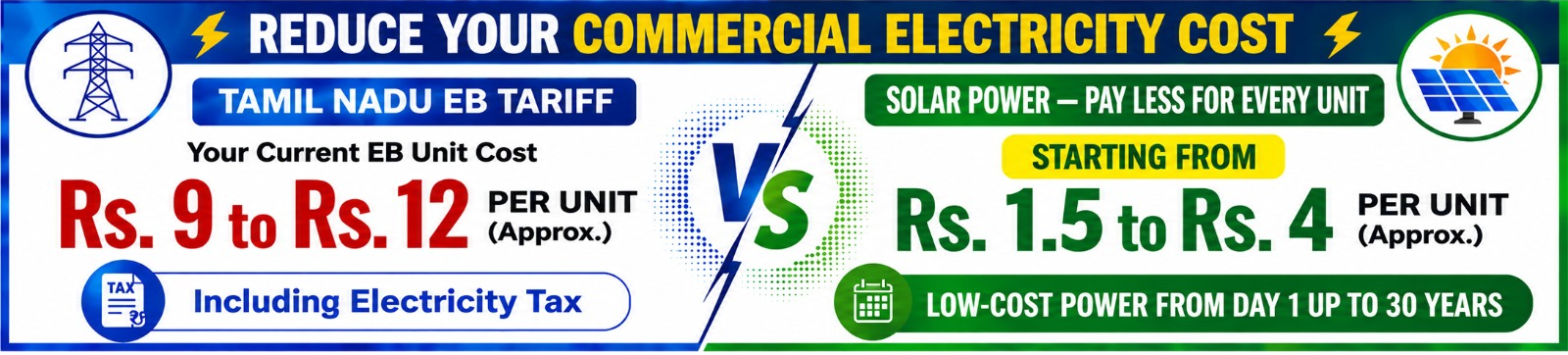
From July 1, 2025, TNERC hiked electricity tariffs by 3.16% overall. The tariff for industrial category consumers increased by 3.4% to ₹7.50/kWh, from ₹7.25/kWh in FY 2025. Demand charges increased to ₹608/kVA/month from ₹589/kVA/month.
Commercial consumers saw a 3.3% tariff increase to ₹9.40/kWh from ₹9.10/kWh in FY 2025, with the same demand charge increase to ₹608/kVA/month.
Additionally, HT-I (industrial), HT-II-A (excluding lift irrigation), HT-II-B, and HT-III consumers face a 25% additional charge on energy consumed during peak hours (6–10 AM and 6–10 PM), and a 5% rebate for consumption during night hours (10 PM–5 AM). For manufacturers running multi-shift operations where peak hour consumption is unavoidable, the effective blended HT tariff is meaningfully higher than the base ₹7.50/kWh headline rate.
These tariff levels — among the highest for industrial consumers in India — are a primary driver of C&I solar open access adoption in the state and the fundamental reason why a well-structured open access solar PPA from NST can deliver substantial, quantifiable savings for Tamil Nadu manufacturers.
Tamil Nadu’s Open Access Market Maturity
As noted in our companion article on IPPs in India’s renewable energy market, approximately 80% of the solar and wind installed in Tamil Nadu operates through open access — with at least 95% of that open access power being green energy. Tamil Nadu is by far the most open-access-mature state in India.
TANGEDCO has implemented a first-of-its-kind automatic meter reading (AMR) system at scale for open access billing and real-time monitoring of wind, solar, and thermal generators — giving the state’s open access market a level of metering and billing infrastructure sophistication that most other states have not yet achieved.
Tamil Nadu’s Green Energy Open Access Regulations 2025 provide a clear, structured framework for solar and wind open access in the state — defining eligibility, charge structures, banking rules (8% banking charge in kind, monthly banking cycle, no carry-forward), deviation settlement, and nodal agency structures. This regulatory clarity — while not perfect — provides a more predictable operating environment for C&I IPPs than many competing states.
The Future of India’s Electricity Market: Where It Is Heading by 2030
India’s electricity market in 2030 will look substantially different from today’s market — shaped by the ongoing energy transition, market reforms, and new demand categories.
From variable to dispatchable renewables: The next frontier of India’s renewable market is not simply adding more solar and wind megawatts, but learning to deliver renewable energy in a predictable, scheduled form. FDRE (Firm and Dispatchable Renewable Energy) and Round-the-Clock (RTC) renewable projects — combining solar, wind, and battery storage to deliver a guaranteed generation profile at any time of day — are the fastest-growing tender category in SECI’s pipeline. This shift reflects grid operators’ need for reliability, not just cheap generation.
Battery Energy Storage Systems (BESS) at scale: India’s Ministry of Power has mandated BESS integration into new renewable projects above specified thresholds, and SECI has been floating standalone BESS tenders. The rapid cost decline of lithium-ion batteries (driven by global manufacturing scale) is making grid-scale storage commercially viable without subsidy — transforming the economics of hybrid renewable projects and enabling round-the-clock renewable supply.
Market coupling and electricity derivatives: The market coupling reform and the introduction of electricity derivatives (discussed above) represent a structural maturation of India’s electricity market — moving from a primarily PPA-based procurement model toward a more liquid, price-signal-driven market that enables more efficient dispatch and better price discovery.
PM Surya Ghar and distributed generation: The PM Surya Ghar: Muft Bijli Yojana programme — targeting 1 crore household rooftop solar installations with a government subsidy of up to ₹78,000 per household — is expected to add significant distributed solar capacity at the residential level by FY 2026–27. This will further reshape DISCOM load profiles (reducing net load during solar hours, increasing net load during evening peak) and accelerate the need for grid-level storage and demand response.
Green Hydrogen’s electricity demand: India’s 5 MMTPA green hydrogen production target by 2030 requires approximately 25,000 MW of dedicated renewable electricity capacity — creating a new, potentially enormous demand segment for renewable IPPs operating dedicated generation assets for hydrogen producers. Tamil Nadu has positioned itself as a key green hydrogen manufacturing hub given its coastal location (for hydrogen export), industrial base, and renewable resources.
DISCOM financial restructuring: The structural reform of India’s DISCOMs — through the RDSS, potential privatisation of distribution in select circles, and progressive tariff rationalisation — will gradually improve DISCOM financial health and reduce the cross-subsidy burden that has historically been the primary reason for high HT industrial tariffs in states like Tamil Nadu. As DISCOM finances improve and cross-subsidy burdens reduce, CSS charges for open access consumers may gradually decrease — changing the relative economics of open access vs DISCOM supply over the PPA term.

How NST Operates Within India’s Electricity Market Structure
NST Solar & Wind Energy operates at the intersection of the generation and retail supply segments of India’s electricity market — as a C&I-focused IPP and RESCO in Tamil Nadu and South India.
We generate solar (and wind) electricity through projects we develop and own, and supply it directly to industrial consumers under long-term PPAs and BOOT agreements, using TANGEDCO/TANTRANSCO’s open access framework to wheel power from our generation sites to our clients’ premises.
Our role is to absorb the complexity of navigating India’s electricity market on behalf of our clients:
Regulatory navigation: Open access applications, TNERC filings, SLDC scheduling registration, net metering approvals, banking account management — we handle all of this so our clients focus on their core operations.
Full open access cost modelling: Before any PPA is signed, we model the complete effective cost for our client — PPA tariff, wheeling charges, CSS (net of GEOA concession), additional surcharge, banking charges, T&D losses, and residual TANGEDCO demand charges — so there are no surprises in Year 3 of a 20-year contract.
Performance accountability: Because we own and operate the generation asset, our revenue depends entirely on how much electricity our plant produces. This aligns our interests with our clients’ interests more completely than any EPC or equipment supply arrangement can.
Long-term partnership: The electricity market will change over the next 20 years — tariffs will rise, open access regulations will evolve, new demand categories will emerge. We stay alongside our clients through these changes, helping them navigate regulatory developments and adapt their energy strategies as the market shifts.
Request Your Free Energy Market Assessment →
If you are an industrial consumer in Tamil Nadu who wants to understand what India’s electricity market structure means for your specific energy costs — and how an NST solar or wind PPA would interact with your existing TANGEDCO supply — our team is ready to provide a detailed, no-obligation analysis.
Frequently Asked Questions About India’s Electricity Market Structure
A DISCOM (Distribution Company) is the state-owned utility that distributes electricity to end consumers in a geographic area. For most consumers, the DISCOM is their only electricity supplier and the entity they pay their electricity bill to. For solar buyers, the DISCOM matters for two reasons: first, the DISCOM’s tariff is the baseline from which open access solar savings are calculated — higher DISCOM tariffs mean larger savings from solar PPAs. Second, for open access solar buyers, the DISCOM (through its SLDC) must approve and process the open access application, and the DISCOM charges (wheeling, CSS, AS, banking) form a significant portion of the total effective cost of open access solar power.
The Indian Energy Exchange (IEX) is India’s largest electricity exchange, operating under CERC’s supervision, where generators and buyers trade electricity through Day-Ahead, Real-Time, and Term-Ahead market segments. Yes, eligible industrial consumers (holding an open access consent from their DISCOM) can purchase electricity from the IEX directly — either through the DAM, RTM, or GTAM segments. Exchange-purchased power is typically used for balancing (filling gaps in a consumer’s PPA portfolio during periods of higher consumption or PPA underperformance) rather than as a primary supply source.
Must-run status means that grid operators (SLDCs and RLDCs) must dispatch solar and wind plants whenever they are generating — they cannot curtail them based on economic merit order (the ranking of plants from cheapest to most expensive, used to decide which plants run when demand is lower than total available capacity). Only solar and wind plants have must-run status in India; conventional thermal plants are subject to merit order dispatch. This status protects renewable IPPs’ revenue by ensuring their output is used, not curtailed for economic reasons.
The DSM is the regulatory framework governing what happens when a generator’s actual output or a consumer’s actual consumption deviates from their scheduled amounts in a given 15-minute time block. For open access solar consumers, their solar plant’s actual generation will never exactly match their pre-submitted schedule (due to cloud cover, temperature, equipment variability). These deviations are settled at DSM rates — which can be significantly higher or lower than the PPA tariff, depending on whether the grid is in surplus or deficit at that moment. Effective open access management requires accurate day-ahead scheduling to minimise deviation exposure.
CERC (Central Electricity Regulatory Commission) is the central-level regulator, covering inter-state electricity transactions, central generation companies (NTPC, NHPC), and national power exchanges (IEX). SERCs (State Electricity Regulatory Commissions) are state-level regulators — in Tamil Nadu, this is TNERC. TNERC sets the retail tariffs that TANGEDCO charges you, and determines the open access charges (wheeling, CSS, AS, banking) that apply to your open access solar PPA. For most industrial consumers, TNERC is the regulator that directly determines their electricity costs.
HT (High Tension) supply is electricity supplied to the consumer at 11 kV, 33 kV, or higher voltage levels — requiring the consumer to own and maintain a substation and HT metering equipment on their premises. LT (Low Tension) supply is at 415 V (three-phase) or 230 V (single-phase), managed entirely by TANGEDCO’s distribution infrastructure to the consumer’s meter. HT supply is for larger consumers (typically above 100 kW connected load) and carries lower per-unit energy charges than LT supply, since the consumer bears some of the grid infrastructure cost internally. Most industrial consumers above 100 kW contracted demand are on HT supply categories (HT-I for industries, HT-II for other categories).
Net metering is the arrangement for rooftop solar consumers — the solar plant is installed on the consumer’s premises, electricity is generated directly into the consumer’s internal wiring, and any surplus (generation exceeding consumption at any moment) is exported to the TANGEDCO grid. The exported units are credited against the consumer’s future consumption, up to the net amount consumed from the grid during the billing period. Net metering does not involve wheeling or open access charges; it is a simpler, lower-cost arrangement for smaller on-site installations (typically under 1 MW). Open access is for off-site generation (a solar plant located away from the consumer’s premises), transported through the grid under a formal open access arrangement with full charge obligations.
PM Surya Ghar: Muft Bijli Yojana (Free Electricity Scheme) is a central government programme providing subsidies for rooftop solar installation in residential households — targeting 1 crore installations across India by FY 2026–27 with a total outlay of ₹75,021 crore. The subsidy covers up to ₹78,000 per household for systems of 2–3 kW capacity, significantly reducing the capital cost of rooftop solar for homeowners. The scheme is specifically for residential consumers and is not applicable to commercial or industrial consumers, who access rooftop solar benefits through TNERC’s net metering regulations rather than central subsidies.
Yes, in principle — through inter-state open access under CERC’s ISTS framework. The factory would source electricity from the Rajasthan solar farm, transport it through PGCIL’s ISTS (paying ISTS transmission charges, unless the project qualifies for the ISTS charge waiver), enter Tamil Nadu’s grid at the ISTS entry point, and have it delivered to the factory through TANTRANSCO’s intra-state network (paying state transmission and wheeling charges). In practice, inter-state open access is more complex and costly than intra-state arrangements — most Tamil Nadu industrial consumers find intra-state open access from Tamil Nadu or neighbouring state solar and wind projects to be more economical.
Market coupling — the CERC reform introducing a single national clearing price across all power exchanges from January 2026 — primarily affects consumers who purchase electricity from the exchange (IEX, PXIL, HPX) rather than through long-term PPAs. For exchange buyers, coupling should produce more accurate, less volatile, and more transparent prices by aggregating bids from all exchanges into a single pool. For long-term PPA buyers (the majority of large industrial consumers), market coupling has no direct effect on their contracted tariff — but may affect the price of supplementary exchange power they use for balancing, and will influence the evolution of long-term tariff benchmarks over time.
Conclusion: The Market Structure Is the Strategy
Most industrial companies in India experience the electricity market through two things: a monthly DISCOM bill and an occasional conversation with a solar salesperson. The market’s full complexity — generation, transmission, distribution, wholesale trading, open access regulation, CERC and SERC oversight — sits largely invisible behind these two touchpoints.
But the structure of the market determines everything about your energy options, your costs, and your strategic choices.
Understanding that your DISCOM tariff is not the cost of electricity itself — it is the cost of an entire value chain of generation, transmission, and distribution, cross-subsidising multiple other consumer categories, bearing the financial inefficiencies of a historically under-invested distribution system — helps you see why open access renewable PPAs are so compelling. The cross-subsidy you are currently paying to subsidise agricultural and domestic consumers in Tamil Nadu is not unavoidable; it is partially recaptureable through a well-structured open access arrangement.
Understanding the wholesale market — IEX, market coupling, electricity derivatives — tells you that India is building the institutional infrastructure for a genuinely competitive electricity market, one where the long-term direction of electricity costs is upward for DISCOM supply and competitive (through renewable PPAs) for those who choose to access the market directly.
And understanding the regulatory bodies — TNERC, CERC, MNRE, MoP — tells you who sets the rules, where they can change, and how to factor regulatory risk into a 20-year energy procurement decision.
NST Solar & Wind Energy brings this understanding of India’s electricity market to every engagement with industrial clients in Tamil Nadu. We do not just install solar panels. We help our clients navigate the electricity market intelligently — choosing the right procurement structure, modelling the full cost stack, managing the regulatory process, and delivering contracted energy performance over decades.
Get Your Free Electricity Market Assessment →
The best starting point is a conversation about your current TANGEDCO bill and what the market has available for your specific situation.