
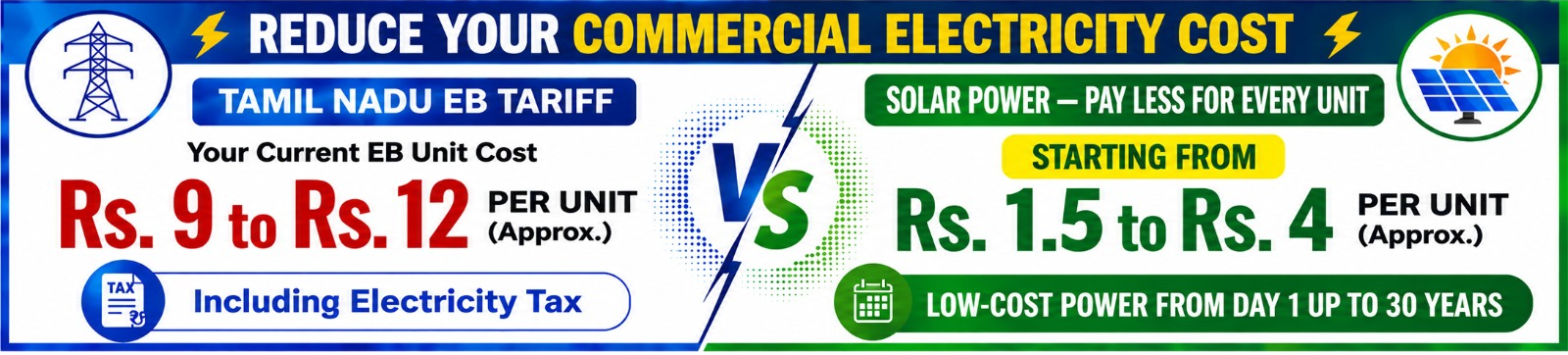
Open Access Solar in Tamil Nadu
Reduce Your Electricity Cost with Open Access Solar Solutions
Power your business with clean, reliable, and cost-effective solar energy through Open Access Solar. NST Global Solar & Wind Energy helps industries, commercial establishments, and high-energy consumers navigate the complete Open Access process—from feasibility assessment and TANGEDCO approvals to commissioning and ongoing support.
Why Businesses Choose Open Access Solar
- ✓ Lower Electricity Costs
- ✓ TANGEDCO Compliance Assistance
- ✓ End-to-End Project Management
- ✓ Captive & Group Captive Solar Solutions
- ✓ Expert Regulatory Guidance
Open Access Solar in Tamil Nadu - Complete Guide to Open Access Solar Power for Industries
Quick Answer
Open Access Solar allows eligible electricity consumers to purchase solar power directly from a solar power plant using the existing electricity transmission and distribution network. Businesses benefit from significantly lower energy costs while supporting sustainability goals. In Tamil Nadu, Open Access projects are regulated by TANGEDCO and the applicable electricity regulatory framework, requiring approvals, compliance with eligibility criteria, and payment of applicable network charges such as wheeling, banking, and cross subsidy surcharge where applicable.
What is Open Access Solar?
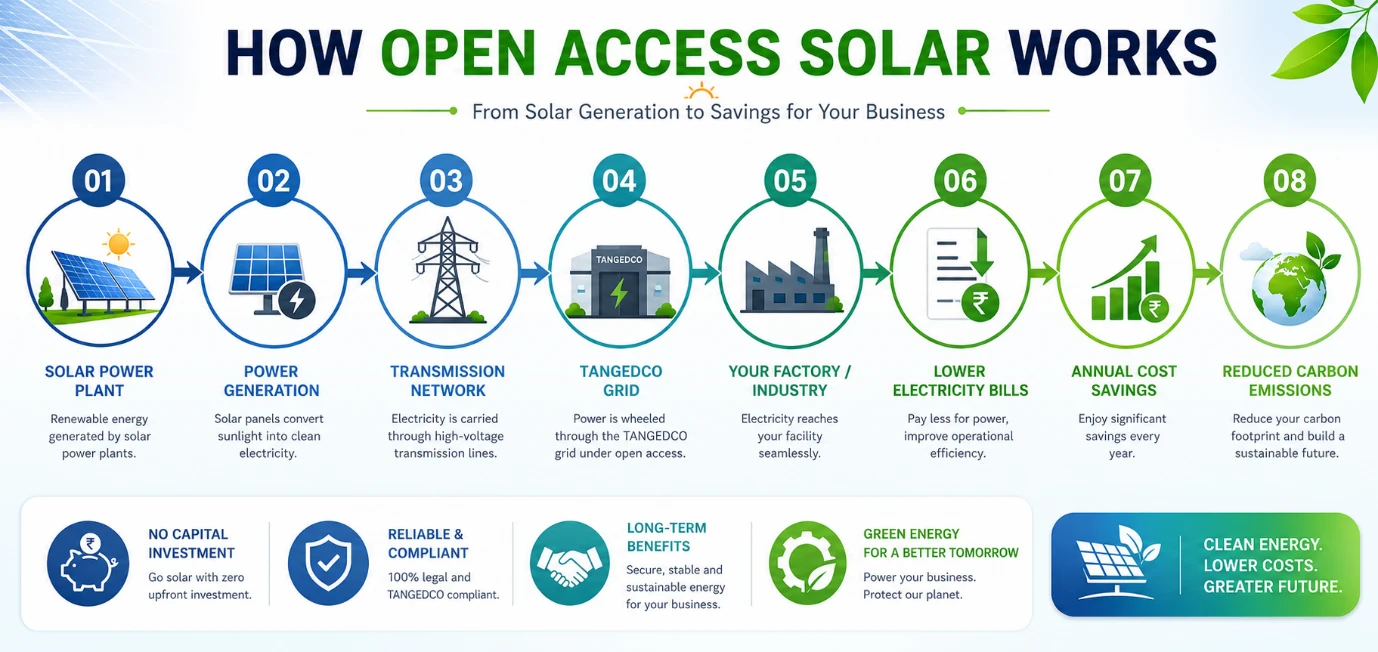
Open Access Solar is a mechanism that enables eligible electricity consumers to procure solar power directly from an off-site solar power plant instead of purchasing their entire electricity requirement from the local distribution utility. The generated electricity is transmitted through the existing power grid to the consumer's premises under approved regulatory provisions.
This model provides businesses with access to renewable energy without requiring sufficient rooftop space for solar panel installation. By leveraging the state transmission and distribution network, organizations can source clean energy from dedicated solar projects located elsewhere.
Open Access Solar has become one of the most effective strategies for reducing electricity expenses while achieving sustainability targets. Industries with high electricity consumption can significantly lower their operational costs through long-term renewable energy procurement.
How Open Access Solar Works
Why Businesses are Switching to Open Access Solar
Electricity represents one of the highest recurring operational expenses for many industrial and commercial facilities. Rising utility tariffs, increasing energy demand, and sustainability commitments have encouraged businesses to adopt alternative energy procurement models.
Open Access Solar offers several strategic advantages:
- Lower energy procurement costs
- Stable long-term electricity pricing
- Reduced dependence on tariff increases
- Access to renewable energy without rooftop limitations
- Improved environmental performance
- Enhanced ESG reporting
- Better corporate sustainability credentials
- Long-term operational savings
For energy-intensive sectors such as manufacturing, textiles, automotive, pharmaceuticals, IT campuses, healthcare, and educational institutions, Open Access Solar provides both financial and environmental value.
Key Benefits of Open Access Solar
Significant Reduction in Electricity Bills
Businesses can achieve considerable savings on electricity expenses by sourcing solar power at competitive rates compared to conventional utility tariffs.
Predictable Energy Costs
Long-term power purchase agreements help stabilize electricity costs, protecting businesses from future tariff increases.
Sustainability and ESG Compliance
Using renewable energy contributes to carbon emission reduction and supports environmental, social, and governance (ESG) initiatives.
No Rooftop Space Requirement
Unlike rooftop solar systems, Open Access Solar enables organizations to benefit from solar energy without needing large roof areas.
Reliable Long-Term Energy Supply
Solar power projects are designed for operational lifespans exceeding 25 years, ensuring long-term energy availability.
Competitive Business Advantage
Reducing energy costs improves profitability and strengthens competitiveness across various industries.
Industries That Benefit Most
Open Access Solar is particularly suitable for:
Manufacturing Industries
Textile Mills
Automobile Manufacturing Units
Engineering Industries
Food Processing Plants
Hospitals
Educational Institutions
Software Parks
Data Centres
Commercial Complexes
Warehouses
Hotels and Resorts
Pharmaceutical Companies
Industrial Estates
Logistics Parks
Organizations with high annual electricity consumption often realize the greatest financial benefits from adopting Open Access Solar.
Who is Eligible for Open Access Solar in Tamil Nadu?
Open Access Solar is generally available to eligible High Tension (HT) and other qualifying electricity consumers who meet the applicable regulatory requirements in Tamil Nadu. Eligibility depends on the prevailing regulations, sanctioned demand, connected load, and the applicable framework issued by the relevant electricity authorities.
Before investing in an Open Access Solar project, businesses should conduct a technical and regulatory feasibility assessment to determine the most suitable project structure.
Check Your Open Access Solar Eligibility in Minutes
Not sure whether your industry qualifies for Open Access Solar? Our experts will evaluate your electricity consumption, sanctioned demand, and project feasibility at no obligation.
- ✔ Eligibility Assessment
- ✔ Estimated Annual Savings
- ✔ Suitable Open Access Model
- ✔ Regulatory Guidance
📞 Call: +91 90876 50009
Businesses Commonly Eligible
Open Access Solar is commonly adopted by:
These organizations generally have substantial and consistent electricity consumption, making Open Access Solar financially attractive.
Eligibility Checklist
Before initiating an Open Access Solar project, businesses should verify:
- Applicable regulatory eligibility
- Suitable electricity connection category
- Consistent annual power consumption
- Financial viability
- Availability of a qualified solar developer
- Grid connectivity feasibility
- Compliance with applicable TANGEDCO and regulatory requirements
A detailed feasibility study helps identify the optimal project size, expected energy generation, estimated savings, and regulatory obligations.
Types of Open Access Solar
Selecting the right ownership model is one of the most important decisions in an Open Access Solar project. The three most common models are Captive, Group Captive, and Third-Party Open Access.
Captive Open Access Solar
Captive Open Access is suitable for businesses that wish to own or co-own the solar power plant supplying their electricity.
Best suited for
- Large manufacturing industries
- Industrial groups
- Companies with long-term energy requirements
Advantages
- Greater control over power generation
- Lower long-term energy costs
- Potential regulatory benefits under applicable provisions
- Improved sustainability credentials
- Long asset life
Group Captive Solar
Group Captive Solar enables multiple consumers to jointly invest in a solar power project while sharing the generated electricity according to applicable regulations.
Suitable for
- Multiple industrial units
- Business groups
- Companies seeking lower capital investment individually
Benefits
- Shared project investment
- Economies of scale
- Competitive power pricing
- Long-term electricity cost savings
- Renewable energy compliance
Third-Party Open Access
Under the Third-Party model, the consumer purchases electricity from an independently owned solar power producer through a Power Purchase Agreement (PPA). The consumer does not own the solar plant.
Suitable for
- Businesses preferring zero ownership responsibility
- Companies with limited capital expenditure budgets
- Organizations seeking predictable electricity pricing
Benefits
- No investment in plant ownership
- Professional plant operation and maintenance
- Long-term fixed or indexed tariffs
- Simplified renewable energy procurement
Comparison of Open Access Models
| Feature | Captive | Group Captive | Third Party |
|---|---|---|---|
| Plant Ownership | Consumer | Multiple Consumers | Solar Developer |
| Initial Investment | High | Medium | Low |
| O&M Responsibility | Owner / EPC | Shared | Developer |
| Long-Term Savings | Excellent | Excellent | Very Good |
| Suitable For | Large Industries | Business Groups | Commercial Consumers |
Choosing the right model depends on your energy demand, investment capacity, business objectives, and regulatory considerations.
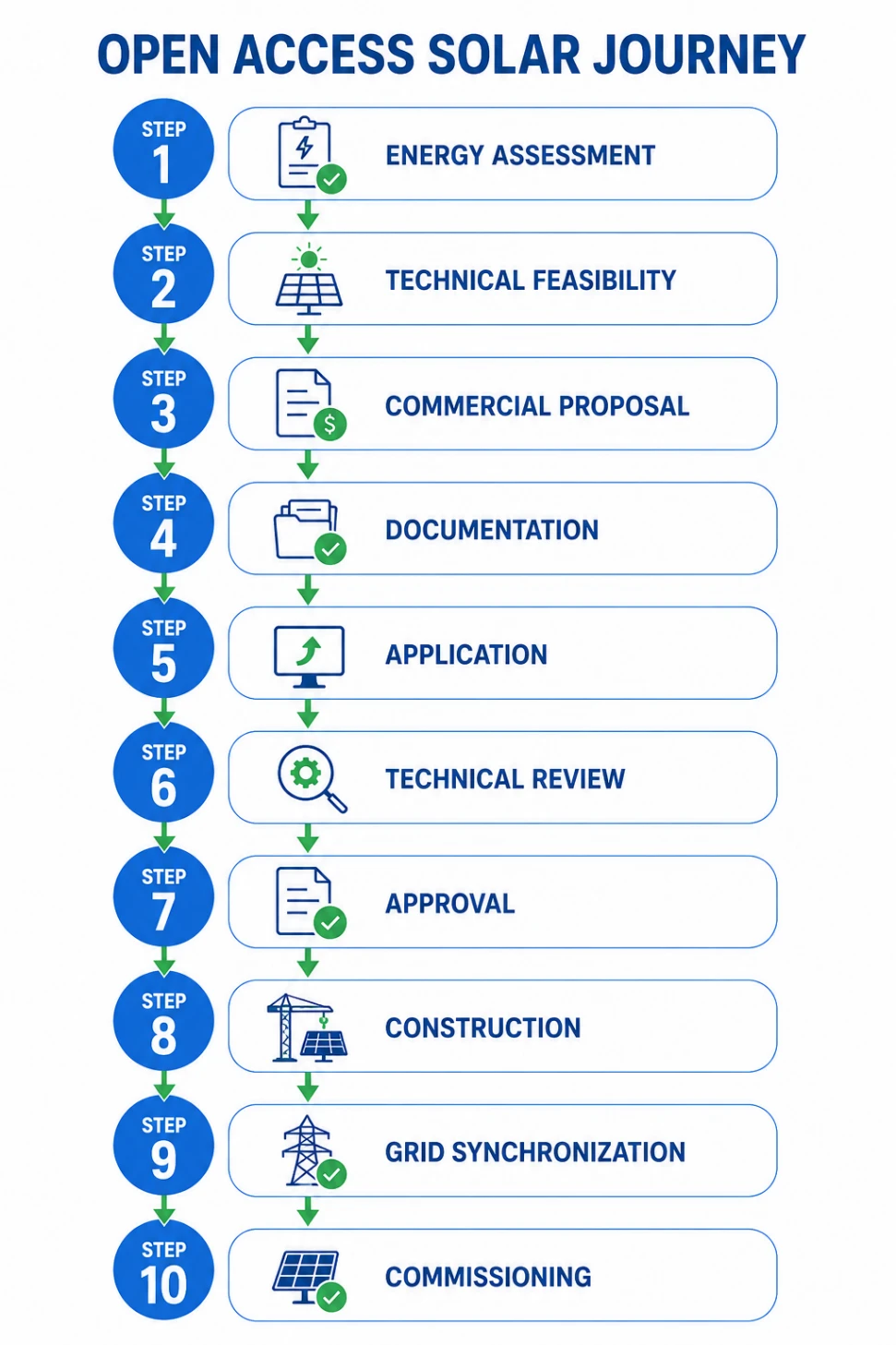
Complete Open Access Solar Process
A successful Open Access Solar project involves multiple technical, commercial, and regulatory stages. Careful planning at each step helps minimize delays and ensures compliance.
Energy Consumption Analysis
The project begins with a comprehensive analysis of:
- Monthly electricity bills
- Maximum demand
- Load profile
- Annual energy consumption
- Future expansion plans
- Existing tariff category
Technical Feasibility Study
Engineers evaluate:
- Required solar capacity
- Expected annual generation
- Transmission availability
- Grid connectivity
- Project location
- Transmission losses
- Financial viability
Commercial Proposal
The proposal generally includes:
- Recommended project capacity
- Estimated investment
- Power tariff
- Savings projection
- Project timeline
- Contract structure
- Payment terms
Regulatory Documentation
Once approved internally, the required applications and supporting documents are prepared. Typical documentation may include:
- Electricity service details
- Company registration documents
- Authorized signatory documents
- Technical drawings
- Single Line Diagram (SLD)
- Project specifications
- Land-related documents (where applicable)
- Required declarations and undertakings
Application Submission
Applications are submitted to the relevant authorities as required for:
- Open Access approval
- Grid connectivity
- Energy scheduling
- Transmission arrangements
- Power evacuation
- Applicable regulatory clearances
Technical Review
The submitted application undergoes technical evaluation, which may include:
- Grid impact assessment
- Network availability verification
- Protection system review
- Metering arrangements
- Evacuation feasibility
- Compliance verification
Approval and Agreement Execution
Following successful technical evaluation, the necessary approvals and agreements are completed. Depending on the project, these may include:
- Open Access approval
- Wheeling agreement
- Banking arrangement (where applicable)
- Power Purchase Agreement (PPA)
- Energy accounting arrangements
- Metering approvals
Solar Plant Construction
Project execution typically includes:
- Site preparation
- Civil works
- Module installation
- Inverter installation
- Cabling
- Protection systems
- SCADA and monitoring systems
- Testing and quality inspections
Grid Synchronization
After installation:
- Electrical testing is completed
- Protection systems are verified
- Metering systems are commissioned
- Grid synchronization is carried out in accordance with approved procedures
Commercial Operation (Commissioning)
The project enters commercial operation once all required approvals, testing, and synchronization activities are successfully completed.
Let Our Experts Handle the Entire Open Access Approval Process
From feasibility study to TANGEDCO approvals, documentation, project execution and commissioning—we manage everything while you focus on your business.
Need immediate assistance? +91 90876 50009
Open Access Solar Journey
Why Professional Project Management Matters
Open Access Solar projects involve coordination among multiple stakeholders, including engineering teams, regulatory authorities, transmission entities, equipment suppliers, and project developers. Working with an experienced consultant helps:
Open Access Charges Explained
One of the most common questions businesses ask is: "What are the charges applicable under Open Access Solar?"
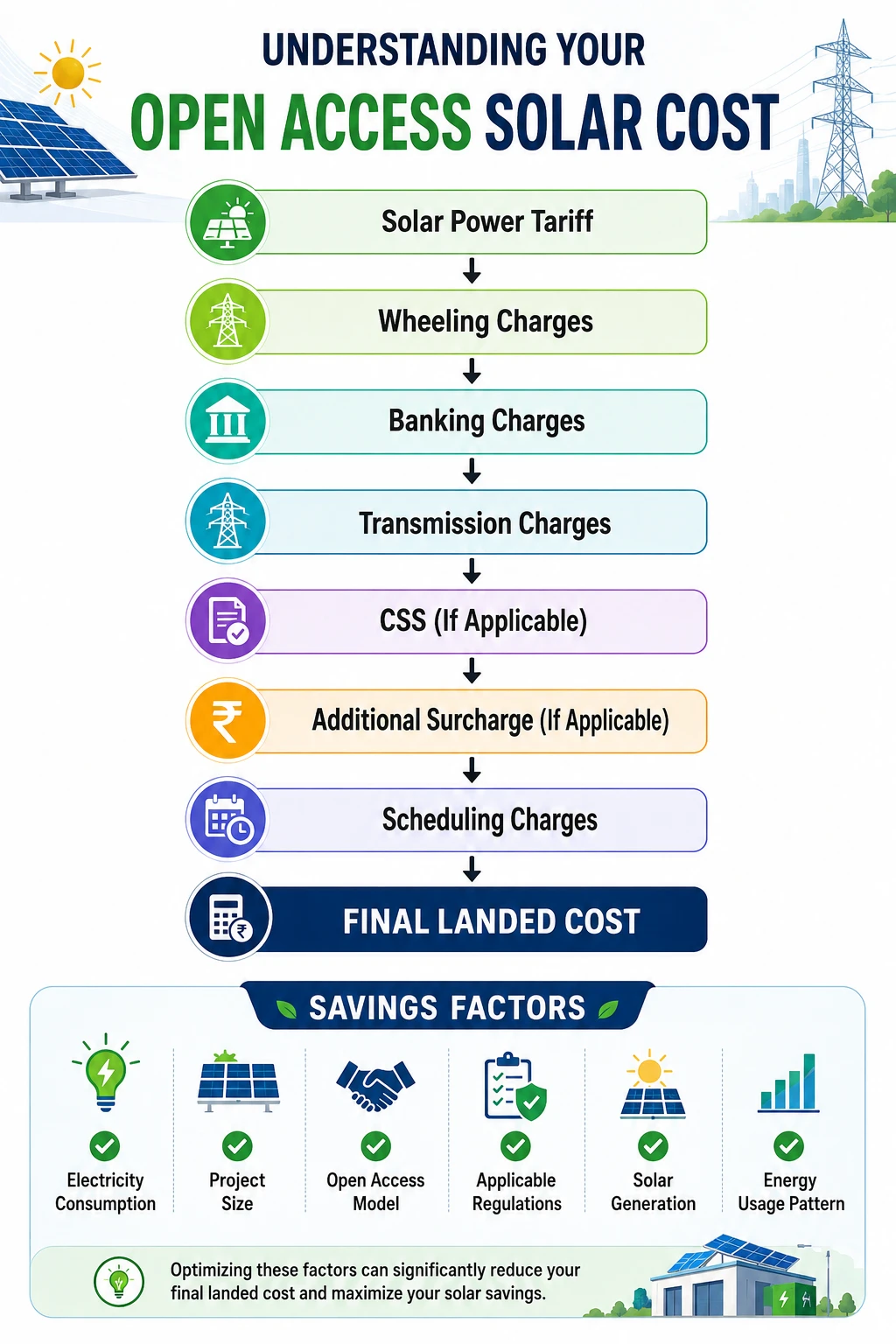
The final cost of Open Access Solar is influenced not only by the solar power tariff but also by the applicable transmission, distribution, and regulatory charges. These charges are determined by the prevailing regulations and may change over time based on orders issued by the relevant authorities.
Understanding these components helps businesses accurately estimate project savings and evaluate the financial viability of an Open Access Solar project.
1 Wheeling Charges
What are Wheeling Charges?
Wheeling Charges are the fees paid for transporting electricity from the solar power plant to the consumer's premises through the transmission and distribution network. Since the electricity generated at the solar plant uses the existing grid infrastructure, the network operator charges a fee for this service.
Wheeling Charges Cover
- Use of transmission infrastructure
- Distribution network utilization
- Grid operation and maintenance
- Network management
These charges are determined under the applicable regulatory framework and may vary depending on voltage level, network category, and project structure.
Why Wheeling Charges Exist
The power generated from a solar plant may travel several kilometres before reaching the consumer. The transmission and distribution network must be maintained, monitored, protected, and upgraded. Wheeling Charges contribute to maintaining the reliability and availability of this infrastructure.
2 Banking Charges
What is Energy Banking?
Solar energy generation varies throughout the day and across seasons. At times, the solar plant may generate more electricity than the consumer immediately requires. Energy Banking allows eligible consumers to inject surplus electricity into the grid and draw it later, subject to the applicable banking provisions and regulatory framework.
Benefits of Banking
- Better utilization of solar generation
- Reduced energy wastage
- Improved energy management
- Increased renewable energy usage
- Better financial returns
Banking provisions, settlement periods, and applicable charges depend on the prevailing regulations.
3 Cross Subsidy Surcharge (CSS)
What is CSS?
Cross Subsidy Surcharge (CSS) is a regulatory charge that may apply when eligible consumers procure electricity from a source other than their local electricity distribution utility. The purpose of CSS is to compensate the distribution utility for the cross-subsidy component built into retail electricity tariffs.
The applicability and amount of CSS depend on factors such as
- Consumer category
- Open Access model
- Applicable regulations
- Regulatory exemptions (if any)
A professional assessment is recommended to determine whether CSS applies to a specific project.
4 Additional Surcharge
Additional Surcharge may be applicable under certain regulatory conditions to recover fixed costs incurred by the distribution utility.
Its applicability depends on
- Consumer category
- Existing power procurement obligations
- Regulatory orders
- Open Access framework
Not every project attracts an Additional Surcharge. The applicable rules should be evaluated during the project feasibility stage.
5 Transmission Charges
Where electricity is transmitted through the state transmission system, applicable transmission charges may be payable as specified under the prevailing regulatory framework.
These charges support
- Grid infrastructure
- Network reliability
- Power evacuation
- System operation
6 Scheduling and System Operation Charges
Open Access projects generally require energy scheduling, accounting, and coordination with grid operators.
Applicable charges may include
- Scheduling charges
- System operation fees
- Energy accounting charges
- Metering-related charges
These ensure accurate recording and settlement of energy transactions.
How Are Total Open Access Costs Calculated?
The overall landed cost of Open Access Solar typically includes:
- Solar power tariff
- Wheeling charges
- Banking charges (where applicable)
- Transmission charges
- CSS (if applicable)
- Additional Surcharge (if applicable)
- Scheduling and system operation charges
- Metering and regulatory costs
A detailed financial model should consider all applicable charges before estimating project savings.
Important
Charges are subject to periodic revision by the applicable regulatory authorities. Businesses should always rely on the latest notified regulations and tariff orders before making investment decisions.
Typical Approval Timeline
How Long Does an Open Access Solar Project Take?
The timeline depends on project size, documentation quality, regulatory approvals, grid availability, and construction requirements. A typical project progresses through the following stages:
The actual duration varies based on project complexity, regulatory processing times, land readiness, equipment availability, and grid conditions.
Common Reasons for Approval Delays
Many projects experience delays due to avoidable issues rather than technical complexity. Common reasons include:
- Incomplete documentation
- Incorrect application details
- Technical drawing errors
- Delayed responses to regulatory queries
- Grid capacity constraints
- Land-related issues
- Metering discrepancies
- Contractual delays
Early planning and experienced project management can significantly reduce these risks.
Best Practices for Faster Project Execution
Businesses can improve approval efficiency by:
- Conducting a detailed feasibility study before applying
- Preparing complete and accurate documentation
- Selecting the appropriate Open Access model
- Engaging experienced engineering and regulatory consultants
- Monitoring application status proactively
- Addressing technical observations promptly
- Coordinating effectively with all project stakeholders
Financial Benefits of Open Access Solar
Open Access Solar is not only an environmental initiative—it is also a long-term financial strategy. Potential benefits include:
Lower Electricity Costs
Competitive renewable energy pricing can reduce long-term electricity expenditure.
Protection Against Tariff Escalation
Long-term power procurement agreements help reduce exposure to future tariff increases.
Improved Budget Predictability
Stable energy costs support more accurate financial planning and operational budgeting.
Enhanced Sustainability Performance
Using renewable energy supports corporate sustainability goals and environmental reporting.
Long-Term Asset Value
Depending on the project model, businesses may benefit from long-term ownership or access to renewable energy assets.
Find Out How Much Your Business Can Save
Every industry has a different electricity consumption pattern. Our consultants prepare a customized savings report based on your actual electricity bills.
You'll Receive
- Estimated Annual Savings
- ROI Analysis
- Payback Period
- Best Open Access Model
- Capacity Recommendation
Required
✔ Last 12 Months Electricity Bills
✔ Contract Demand Details
📞 +91 90876 50009
Is Open Access Solar Right for Your Business?
Open Access Solar is particularly beneficial for organizations with:
- High and consistent electricity consumption
- Long-term operational plans
- Sustainability or ESG objectives
- A need to reduce energy costs
- Limited rooftop space for on-site solar installations
A professional feasibility assessment can determine the most suitable project structure based on your energy profile and business goals.
Ready to Explore Open Access Solar?
Whether you are evaluating Captive, Group Captive, or Third-Party Open Access, expert guidance can help you understand the applicable regulations, estimate savings, and plan a compliant, cost-effective project.
Our team can assist with:
- Preliminary feasibility assessment
- Regulatory guidance
- Project structuring
- Financial evaluation
- Documentation support
- End-to-end project execution
Why Choose NST Global Solar & Wind Energy for Open Access Solar?
Selecting the right Open Access Solar partner is just as important as choosing the right project model. A successful project requires expertise in engineering, regulatory compliance, financial planning, and long-term operational support.
NST Global Solar & Wind Energy provides end-to-end guidance, helping businesses transition to renewable energy with confidence.
End-to-End Project Support
We manage every stage of the project lifecycle, including:
- Initial energy assessment
- Project feasibility study
- Financial analysis
- Regulatory guidance
- Documentation support
- Vendor coordination
- Project execution
- Testing and commissioning
- Post-commissioning assistance
Technical Expertise
Our engineering team evaluates:
- Energy consumption patterns
- Load profile
- Demand analysis
- Solar plant sizing
- Grid connectivity
- Energy yield estimation
- Project optimization
This helps ensure that each solution is designed to maximize long-term value.
Regulatory Guidance
Open Access projects involve compliance with applicable electricity regulations and coordination with relevant authorities. Our team assists clients in understanding:
- Eligibility requirements
- Applicable approvals
- Documentation processes
- Regulatory obligations
- Project structuring
Customized Solutions
Every business has unique energy requirements. We recommend the most suitable approach based on:
- Industry
- Annual electricity consumption
- Capital investment preference
- Sustainability goals
- Operational requirements
- Long-term energy strategy
Transparent Project Planning
We believe businesses should make informed decisions. Our proposals include:
- Estimated savings
- Project scope
- Financial assumptions
- Timeline
- Key project milestones
- Applicable regulatory considerations
Long-Term Partnership
Our relationship does not end after commissioning. We continue supporting clients through:
- Performance monitoring
- Technical guidance
- Expansion planning
- Renewable energy consulting
- Future energy optimization opportunities
Frequently Asked Questions
Key Takeaways
Ready to Reduce Your Electricity Costs?
Whether you are exploring Open Access Solar for the first time or planning to expand your renewable energy portfolio, our specialists can help you evaluate the right solution for your business.