Solar PPA — Zero Investment Energy for Your Business
Pay nothing upfront. Save from Day One.
Under the RESCO model, NST Global Solar & Wind Energy Pvt. Ltd. finances, installs, owns, operates, and maintains the solar system. Your business simply pays for the electricity generated — at a lower agreed tariff.
Why Businesses Choose Solar PPA
- ✓Zero Capital Investment Required
- ✓Lower Electricity Tariffs from Day One
- ✓Long-Term Price Stability
- ✓Complete Operation & Maintenance Included
- ✓No Technology or Equipment Risk
- ✓Real-Time Performance Monitoring
- ✓Improved ESG & Sustainability Goals
Table of Contents
Why Solar PPA Matters for Businesses in Tamil Nadu
Electricity is one of the largest recurring operational expenses for commercial and industrial businesses in Tamil Nadu. With increasing grid tariffs, demand charges, and fluctuating energy costs, many organizations are actively seeking reliable solutions to reduce long-term electricity expenditure without affecting daily operations.
The Challenge with Owning a Solar Plant
Installing a rooftop or ground-mounted solar power system is an excellent way to reduce electricity costs. However, purchasing a solar plant requires a substantial capital investment, ongoing maintenance, technical expertise, and long-term asset management. For many businesses, allocating significant funds toward solar infrastructure may not align with their financial priorities. This is where a Solar Power Purchase Agreement (Solar PPA) offers a practical alternative.
A Practical Alternative
A Solar PPA enables businesses to benefit from clean, renewable solar energy without purchasing or owning the solar system. Under the Renewable Energy Service Company (RESCO) model, the solar developer invests in the project, installs the system, owns the assets, performs routine maintenance, monitors system performance, and ensures reliable electricity generation throughout the contract period. Instead of paying for the solar plant, your organization purchases only the electricity generated at an agreed tariff, which is often lower than conventional grid electricity rates — allowing businesses to reduce operational expenses while preserving working capital for core business activities.
Our Role
For industries operating in Tamil Nadu, including manufacturing facilities, textile units, warehouses, hospitals, commercial buildings, IT parks, educational institutions, and industrial campuses, Solar PPA provides an effective path toward energy cost optimization, sustainability compliance, and long-term financial stability. At NST Global Solar & Wind Energy Pvt. Ltd., we help organizations evaluate their energy consumption, determine project feasibility, and implement customized Solar PPA solutions designed to maximize savings while minimizing investment risk.
Quick Summary: Solar PPA (RESCO Model)
A snapshot of what a Solar Power Purchase Agreement looks like for your business.
| Feature | Solar PPA (RESCO Model) |
|---|---|
| Initial Investment | ₹0 |
| Solar Plant Ownership | Solar Developer |
| Installation Cost | Developer |
| Operation & Maintenance | Included |
| Equipment Replacement | Included |
| Performance Monitoring | Included |
| Contract Duration | Typically 15–25 Years |
| Electricity Payment | Pay Only for Units Consumed |
| Technology Upgrades | Managed by Developer |
| Business Risk | Significantly Reduced |
What is a Solar Power Purchase Agreement?
A Solar Power Purchase Agreement (Solar PPA) is a long-term energy contract in which a solar developer installs, owns, operates, and maintains a solar power plant at the customer's premises. Instead of purchasing the solar system, the customer only pays for the electricity generated at a pre-agreed tariff — eliminating the need for any upfront capital investment.
The Agreement
A legally binding long-term energy contract between your business and NST Solar. You agree to purchase the solar electricity generated at a fixed tariff.
- Pre-agreed electricity tariff
- Typically 15–25 year contracts
- Clear rights and responsibilities
- Performance guarantees included
The Solar System
NST Solar finances, designs, installs, and owns the entire solar power plant at your premises — rooftop or ground-mounted.
- Developer-funded capital investment
- Expert design & engineering
- Quality panels, inverters & infra
- Commissioned to highest standards
The Electricity
Your facility receives clean solar electricity directly. You pay only for the units consumed, at the agreed tariff — lower than conventional grid rates.
- Pay per kWh consumed
- Solar power offsets grid use
- Real-time monitoring included
- Developer handles all O&M
Why is Solar PPA Important?
Many commercial and industrial businesses face rising electricity costs that directly affect operating expenses and profitability. Solar PPA provides an alternative by replacing a significant portion of grid electricity with lower-cost solar energy — while avoiding the financial burden of purchasing and maintaining a solar plant.
How Does a Solar PPA Work?
The process is straightforward and is managed end-to-end by NST Solar.
- 1. The customer's energy consumption is evaluated.
- 2. The developer designs a customized solar solution.
- 3. A long-term PPA agreement is signed.
- 4. The developer finances the complete project.
- 5. The solar system is installed.
- 6. Electricity generation begins.
- 7. The customer pays only for the electricity consumed.
- 8. The developer manages operation, maintenance, monitoring, repairs, and system performance throughout the contract period.
Key Components of a Solar PPA
A typical Solar Power Purchase Agreement bundles the following services into a single agreement, simplifying project management for the customer.
Feasibility Assessment
Project feasibility assessment
Plant Design
Solar plant design
Engineering & Procurement
Engineering and procurement
Installation
Installation and commissioning
Grid Synchronization
Grid synchronization
Remote Monitoring
Remote monitoring
Preventive Maintenance
Preventive maintenance
Corrective Maintenance
Corrective maintenance
Equipment Replacement
Equipment replacement (as applicable)
Performance Guarantees
Performance guarantees
Metering & Billing
Metering and billing
Operational Support
Long-term operational support
Understanding the RESCO Model
RESCO stands for Renewable Energy Service Company. Under this model, a specialized company like NST Solar invests in, owns, and operates the solar plant — while your business benefits from the electricity it generates.
🏢 What RESCO Means for You
As the customer, you receive clean solar electricity without any ownership responsibility. Your business focuses on its core operations while NST Solar manages everything related to the solar plant.
🔧 Developer Responsibilities
NST Solar takes on all technical and operational responsibilities for the lifetime of the agreement — from financing and installation through to day-to-day maintenance.
Responsibilities Under the RESCO Model
| Solar Developer | Customer |
|---|---|
| Project Investment | No Investment Required |
| Solar Plant Ownership | No Ownership Responsibility |
| Engineering & Design | Provide Site Access |
| Installation | Purchase Electricity Generated |
| Maintenance | Pay Monthly Electricity Invoice |
| Performance Monitoring | Continue Normal Operations |
| Repairs & Component Replacement | Benefit from Lower Tariffs |
| Regulatory Compliance Support | Utilize Clean Energy |
Why the RESCO Model is Growing Rapidly
Businesses today prefer preserving working capital for production expansion, technology upgrades, hiring, inventory, and business growth — instead of investing heavily in utility infrastructure. The RESCO model transforms solar adoption from a capital-intensive project into a predictable operational expense, enabling organizations to enjoy renewable energy benefits without diverting funds from their core activities.
Rising Electricity Costs Are Impacting Business Profitability
Electricity is no longer just a utility expense — it has become a strategic business cost. In Tamil Nadu, manufacturing industries, commercial buildings, hospitals, educational institutions, and IT parks rely heavily on uninterrupted power for daily operations. As electricity tariffs continue to evolve, businesses face increasing pressure to control operational expenses without compromising productivity.
Unpredictable Pricing
Unlike many operational costs that can be negotiated or optimized internally, electricity prices are influenced by regulatory changes, fuel costs, infrastructure investments, and demand patterns. This uncertainty makes long-term budgeting more challenging. A Solar PPA addresses this challenge by allowing businesses to source a significant portion of their electricity from solar energy at a pre-agreed tariff, providing greater pricing stability over the contract period.
The Biggest Challenge with Conventional Solar
Although owning a rooftop solar plant offers long-term benefits, many organizations hesitate because of the significant upfront investment required. These concerns often delay renewable energy adoption, even when businesses recognize the potential savings.
High Capital Expenditure
Significant funds tied up in infrastructure rather than core operations.
Long Approval Cycles
Internal budget sign-off can delay renewable energy adoption.
Budget Allocation Constraints
Solar infrastructure competing with other capital priorities.
Technology Selection Risks
Choosing the right modules, inverters, and configuration.
Equipment Performance Uncertainty
Concerns about long-term output and degradation.
Maintenance Responsibilities
Ongoing upkeep and servicing become the owner's burden.
Future Replacement Costs
Components eventually need replacement at owner expense.
Resource Allocation for O&M
Internal staff time diverted to monitoring and operations.
How Solar PPA Solves These Challenges
The RESCO model removes almost every major obstacle associated with purchasing a solar plant. Instead of investing in infrastructure, businesses can immediately begin using clean energy while the solar developer assumes responsibility for financing, installation, operation, maintenance, and performance management — allowing organizations to focus on their core business while benefiting from renewable energy.
Major Advantages of Zero Investment Solar
Solar PPA removes almost every major obstacle associated with purchasing a solar plant, enabling immediate access to clean energy benefits.
1. No Capital Expenditure (CAPEX)
The developer invests in all solar panels, inverters, mounting structures, electrical infrastructure, and commissioning. Your organization preserves capital for business expansion, machinery upgrades, and working capital.
2. Immediate Cost Reduction
Instead of waiting years to recover an investment, Solar PPA allows businesses to start saving from the first electricity bill generated under the agreement — at a lower unit energy cost.
3. Predictable Energy Pricing
The pre-agreed tariff provides greater pricing visibility over the entire contract period, making long-term financial planning more reliable for your finance team.
4. No Maintenance Responsibility
The developer manages all preventive maintenance, reactive repairs, cleaning, and performance management for the full contract period. Your team has zero operational involvement.
5. Technology Risk Minimized
Equipment selection, performance risk, and future replacement decisions rest with the developer — who employs specialists experienced in solar system design and management.
6. Better Cash Flow Management
By avoiding a large initial investment, businesses can maintain stronger liquidity, improve working capital, reduce borrowing requirements, and strengthen financial flexibility.
7. Supports ESG & Sustainability Goals
Solar PPA contributes to reduced carbon emissions, increased renewable energy adoption, ESG reporting, sustainability certifications, and green corporate branding.
Business Problems Solved by Solar PPA
Solar PPA directly addresses the most common energy-related challenges faced by commercial and industrial businesses.
| Common Business Challenge | How Solar PPA Helps |
|---|---|
| High electricity bills | Lower energy tariff under PPA agreement |
| Large upfront investment required | Zero CAPEX — developer funds the project |
| Budget allocation constraints | Operational expense model with predictable payments |
| Maintenance concerns | Developer manages all O&M for contract duration |
| Technology selection uncertainty | Expert-designed solution by experienced professionals |
| Equipment replacement costs | Developer responsibility — no cost to customer |
| Tariff volatility & unpredictability | Pre-agreed tariff structure for greater pricing stability |
| Sustainability & ESG goals | Renewable energy adoption supports green objectives |
Solar PPA vs Purchasing a Solar Plant
Many organizations wonder whether they should purchase a solar plant outright or opt for a Solar Power Purchase Agreement. The right choice depends on financial priorities, capital availability, and long-term business strategy.
| Feature | ☀ Solar PPA (RESCO) | Self-Owned Solar Plant |
|---|---|---|
| Initial Investment | ₹0 | High Capital Investment |
| Ownership | Developer | Customer |
| Installation Cost | Developer | Customer |
| Operation & Maintenance | Included in PPA | Customer Responsibility |
| Performance Monitoring | Included | Customer Responsibility |
| Equipment Replacement | Developer (per agreement) | Customer Responsibility |
| Technical Expertise Required | Minimal | High |
| Financial Risk | Lower | Higher |
| Cash Flow Impact | Positive — no outflow | Significant Initial Outflow |
| Electricity Payments | Pay per unit consumed | No per-unit cost after recovery |
Solar PPA vs TANGEDCO Electricity
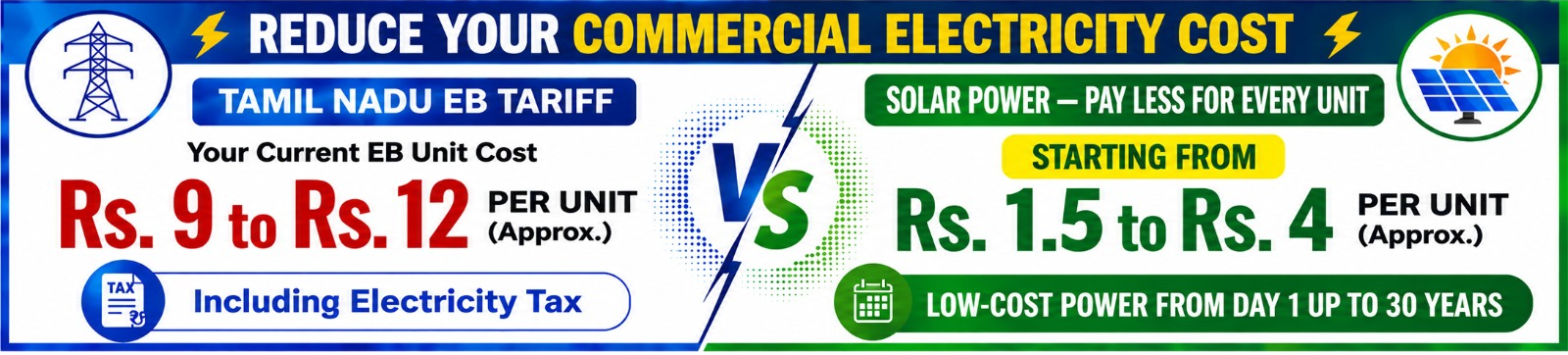
Solar PPA can help eligible businesses reduce dependence on grid electricity by purchasing solar power at an agreed tariff under a long-term contract. Unlike conventional grid tariffs that may change over time, a Solar PPA provides greater pricing visibility.
Understanding the Difference
Electricity from the grid is supplied based on regulated tariffs and billing structures that may change periodically, and businesses have limited control over these revisions. With a Solar PPA, electricity is generated from a dedicated solar system and supplied under a long-term commercial agreement — rather than purchasing electricity entirely from the grid, businesses use solar power generated specifically for their facility.
| Parameter | ☀ Solar PPA | TANGEDCO Supply |
|---|---|---|
| Energy Source | Solar Energy | Grid Electricity |
| Initial Investment | None | None |
| Tariff Basis | Contractual tariff | Regulated tariff |
| Tariff Stability | Pre-agreed structure | Subject to periodic revisions |
| Carbon Emissions | Renewable energy | Higher grid mix |
| Maintenance | Developer responsibility | Not applicable to customer |
| Solar Asset Ownership | Developer | None |
| Long-Term Cost Planning | More predictable | Less predictable |
Illustrative Savings Example
Note: The following example is for illustration only. Actual savings depend on electricity consumption, tariff structure, project size, agreement terms, solar generation, and regulatory conditions.
| Parameter | Without Solar PPA | With Solar PPA |
|---|---|---|
| Monthly Consumption | 500,000 kWh | 500,000 kWh |
| Grid Dependency | 100% | Reduced through solar generation |
| Upfront Investment | ₹0 | ₹0 |
| Electricity Source | Grid only | Grid + Solar PPA |
| Long-Term Cost Planning | Subject to tariff changes | Improved energy cost planning |
Financial Benefits of Solar PPA
Beyond energy cost savings, Solar PPA delivers broader financial advantages that strengthen your business's overall financial health.
Lower Operating Costs
Electricity savings contribute directly to reducing operational expenditure, improving business competitiveness over time.
Better Budget Forecasting
With greater tariff predictability, finance teams can prepare more reliable annual and multi-year budgets.
Improved Return on Business Capital
Instead of locking funds into infrastructure, businesses can invest in activities that directly support growth and revenue generation.
Reduced Financial Risk
The developer assumes responsibility for system performance, maintenance, and operational management, reducing the customer's exposure to technical and maintenance-related risks.
Solar PPA Eligibility Criteria
A Solar PPA is best suited for commercial and industrial businesses with significant electricity consumption and suitable installation conditions. Here are the primary eligibility requirements.
Electricity Consumption
Businesses with approximately 100 kW or higher connected electrical load are typically eligible. Higher consumption leads to better project economics.
Suitable Installation Area
Rooftop, ground-mounted, or carport space adequate for the required system capacity. Off-site solar options may apply where applicable.
Creditworthiness
The business must demonstrate financial stability and the ability to honor long-term payment commitments under the PPA contract.
Long-Term Occupancy
PPA agreements typically run 15–25 years. Businesses must have long-term occupancy or ownership of the facility.
Solar Resource Availability
Tamil Nadu has excellent solar irradiation levels, making most commercial and industrial locations suitable for solar generation.
Where Can a Solar PPA System Be Installed?
A solar plant requires adequate space for installation. The most suitable approach depends on your facility.
Rooftop
Suitable for facilities with adequate roof area and structural strength.
- Factories
- Warehouses
- Commercial buildings
- Educational campuses
- Hospitals
- Retail complexes
Ground-Mounted Systems
Suitable when land is available and rooftop area is limited.
- Land is available within the premises
- Rooftop area is insufficient
- Future expansion is planned
Off-Site Solar (Where Applicable)
Depending on the project structure and applicable regulations, certain businesses may also benefit from off-site solar arrangements.
- Determined after technical assessment
- Subject to regulatory approval
- Useful when on-site space is limited
Solar PPA Eligibility Checklist
- ✔ Monthly electricity bill exceeds ₹5 Lakhs or consumption exceeds 1 Lakh kWh
- ✔ Connected electrical load of 100 kW or above
- ✔ Rooftop, ground, or carport area available for installation
- ✔ Business operates from owned or long-term leased premises
- ✔ Organization has stable financials and creditworthiness
- ✔ Commitment to a 15–25 year energy supply agreement
- ✔ Located in Tamil Nadu or applicable jurisdiction
Is Solar PPA Right for Small Businesses?
Small businesses with modest electricity consumption may find that other solar financing models are more appropriate. The most suitable option depends on monthly electricity consumption, available installation space, investment capacity, business objectives, and applicable policies. A professional feasibility assessment can help identify the most appropriate solution.
Industries That Benefit Most from Solar PPA
Solar PPA is suited for any commercial or industrial facility with significant electricity consumption and suitable installation space. These sectors benefit most.
Manufacturing
Motors, compressors, production lines
Textile Industry
Looms, dyeing, processing units
Food Processing
Refrigeration, packaging, conveyors
Pharmaceuticals
Clean rooms, HVAC, laboratories
Hospitals
Medical equipment, HVAC, lighting
Educational Institutions
Large rooftops, budget optimization
Hotels & Hospitality
HVAC, kitchens, laundry, lighting
IT Parks & Offices
Data centers, HVAC, office equipment
Warehouses & Logistics
Lighting, cooling, EV charging
Automotive Industry
Assembly lines, paint shops, robotics
Retail & Commercial
Malls, lighting, HVAC, escalators
How Solar PPA Supports Each Industry
Industries with high daytime electricity consumption, continuous operations, and long-term energy requirements often benefit the most from Solar PPAs because they can maximize the use of solar-generated electricity while improving cost predictability.
Manufacturing Industries
Manufacturing facilities often operate machinery, compressors, process equipment, conveyors, and production lines throughout the day. A Solar PPA can support lower operating expenses, better production cost control, improved sustainability reporting, and reduced dependence on conventional electricity. Examples include engineering, automotive, electronics, steel fabrication, chemicals, and FMCG manufacturing.
Textile Industry
Tamil Nadu is one of India's leading textile hubs. Textile units typically consume substantial electricity for spinning, weaving, dyeing, processing, and finishing. Solar PPA can help reduce energy costs while supporting environmental commitments.
Food Processing Industry
Food processing plants often operate refrigeration, packaging systems, conveyor lines, and production equipment. Solar PPA supports energy cost optimization, operational efficiency, and sustainability initiatives.
Pharmaceutical Industry
Pharmaceutical facilities require reliable power for clean rooms, HVAC systems, manufacturing equipment, and quality laboratories. Solar PPA contributes to improved cost management without requiring capital investment.
Hospitals
Hospitals operate around the clock and rely on electricity for medical equipment, operation theatres, HVAC systems, diagnostic equipment, lighting, and water systems. Solar energy can offset a portion of daytime electricity consumption while supporting sustainability objectives.
Educational Institutions
Schools, colleges, universities, and training campuses often have large rooftop areas suitable for solar installations. Benefits include lower utility expenses, environmental education, and budget optimization.
Hotels & Hospitality
Hotels require electricity for air conditioning, kitchens, laundry, lighting, water heating, and elevators. Solar PPA helps reduce recurring operational costs while supporting eco-friendly branding.
IT Parks & Commercial Offices
Commercial buildings generally have predictable daytime electricity demand, with major loads from HVAC, data centers, lighting, office equipment, and elevators. Solar PPA can contribute to lower operating costs and improved ESG performance.
Warehouses & Logistics Parks
Modern logistics facilities often have expansive rooftops and daytime operational loads. Suitable applications include warehouse lighting, material handling equipment, office operations, and cold storage where applicable.
Typical Business Scenarios
A look at how different organizations typically use a Solar PPA.
Scenario 1: Manufacturing Plant
A manufacturing company with consistently high daytime electricity usage wants to reduce operational expenses but prefers not to allocate significant capital to a solar project. A Solar PPA allows the business to benefit from renewable energy while preserving funds for production expansion and equipment upgrades.
Scenario 2: Hospital
A multi-specialty hospital aims to improve sustainability and manage electricity costs without diverting capital from medical infrastructure. Through a Solar PPA, the hospital can source a portion of its electricity from solar energy while the developer manages system ownership and maintenance.
Scenario 3: Textile Factory
A textile unit experiences substantial daytime electricity consumption and seeks long-term cost predictability. A Solar PPA provides access to solar-generated electricity under a contractual tariff structure without requiring the factory to purchase or maintain the solar system.
Common Myths About Solar PPA
Clearing up frequent misconceptions businesses have about the Solar PPA model.
| Myth | Reality |
|---|---|
| Solar PPA is only for very large corporations. | Many medium and large commercial or industrial consumers may also qualify, subject to feasibility. |
| The customer owns the solar plant. | Under the RESCO model, the developer owns the system during the agreement period. |
| The customer must maintain the plant. | Operation and maintenance are generally handled by the developer. |
| Solar PPA requires a large upfront payment. | A defining feature of the model is that there is typically no upfront capital investment for the solar plant. |
| The agreement is the same for every project. | Contract terms are customized based on technical, commercial, and regulatory considerations. |
Decision Checklist
Your organization may be a good candidate for a Solar PPA if you answer "Yes" to most of the following questions.
- ✓Do you have high monthly electricity consumption?
- ✓Is your connected load around 100 kW or more?
- ✓Do you want to reduce electricity costs without investing in a solar plant?
- ✓Do you prefer to preserve capital for your core business?
- ✓Do you have suitable rooftop or land space?
- ✓Are you looking for predictable long-term energy costs?
- ✓Is sustainability an important business objective?
If your answer is "Yes" to most of these questions, a professional feasibility assessment is the next logical step.
Find Out If Your Business Qualifies for a Solar PPAStep-by-Step Solar PPA Process
A Solar Power Purchase Agreement follows a structured process that begins with an energy assessment and ends with long-term operation and maintenance by the solar developer. Each stage is designed to ensure the project is technically feasible, commercially viable, compliant with applicable regulations, and capable of delivering reliable energy generation over the contract period.
Initial Consultation
Our team gathers information on business operations, industry type, facility location, electricity consumption pattern, connected electrical load, future expansion plans, and sustainability objectives to determine whether a Solar PPA is likely to be a suitable solution.
Electricity Bill Analysis
Our engineers review monthly electricity consumption, maximum demand, load profile, tariff category, power factor, seasonal variations, and daytime energy usage — forming the basis of the preliminary feasibility assessment.
Site Survey
A technical survey evaluates rooftop area, structural condition, orientation, shading, and accessibility, or ground space, soil condition, cable routing, future expansion, and safety considerations — to determine the most suitable installation approach.
Technical Feasibility Study
The assessment covers solar generation potential, available installation capacity, equipment selection, structural considerations, electrical integration, grid connectivity, safety requirements, and project economics.
Commercial Proposal
A customized proposal is prepared, including proposed system capacity, estimated annual energy generation, expected project timeline, commercial terms, indicative tariff structure, agreement duration, and scope of services.
Solar PPA Agreement
Both parties finalize the Power Purchase Agreement, covering contract duration, tariff methodology, billing process, performance obligations, O&M scope, metering arrangements, safety responsibilities, and commercial terms.
Engineering & System Design
Detailed engineering activities begin, including electrical design, structural design, module layout, inverter selection, cable sizing, protection systems, earthing design, and monitoring architecture.
Procurement
High-quality components are sourced, including solar PV modules, grid-tied inverters, mounting structures, DC/AC cables, junction boxes, safety equipment, and monitoring systems.
Installation
Experienced project teams install the complete solar power system — mounting structures, modules, inverters, electrical wiring, protection equipment, earthing, cable management, and system integration.
Testing & Commissioning
Comprehensive testing is performed, including electrical safety tests, equipment verification, protection testing, performance checks, synchronization testing, and monitoring system validation.
Electricity Generation Begins
Following successful commissioning, the solar plant starts generating electricity. The customer begins consuming solar energy while paying only for the electricity generated — savings begin from the first billing cycle under the PPA.
Long-Term Operation & Maintenance
The developer remains responsible for operating and maintaining the solar plant throughout the contract period — preventive and corrective maintenance, performance monitoring, panel cleaning, equipment inspections, inverter servicing, fault diagnosis, component replacement, remote monitoring, and performance reporting.
Solar PPA Project Timeline
Every project is unique. Actual timelines depend on project size, engineering complexity, approvals, procurement, and site conditions.
| Stage | Typical Activities |
|---|---|
| Initial Consultation | Requirement gathering |
| Bill Analysis | Energy assessment |
| Site Survey | Technical inspection |
| Feasibility Study | Engineering & commercial evaluation |
| Proposal | Commercial offer |
| Agreement | PPA execution |
| Engineering | Detailed design |
| Procurement | Equipment sourcing |
| Installation | System construction |
| Commissioning | Testing & synchronization |
| Commercial Operation | Electricity generation |
| O&M | Long-term maintenance |
Why Choose NST Global Solar & Wind Energy Pvt. Ltd.?
Choosing the right Solar PPA partner is as important as selecting the financing model itself. A reliable developer brings together engineering expertise, quality equipment, transparent communication, and long-term operational support to help businesses achieve dependable energy savings.
Customer-Centric Approach
Every business has unique energy requirements. We begin by understanding your operational needs before recommending a solution that aligns with your technical, commercial, and sustainability objectives.
Experienced Engineering Team
Our professionals evaluate energy consumption, solar generation potential, structural suitability, electrical integration, project feasibility, and long-term operational performance to ensure a practical, scalable solution.
End-to-End Project Management
We support clients throughout the project lifecycle — initial consultation, technical evaluation, proposal preparation, project coordination, installation oversight, commissioning support, and operation & maintenance.
Quality-Driven Execution
We emphasize engineering best practices, appropriate equipment selection, safety, performance optimization, and long-term system reliability.
Transparent Communication
We believe businesses should clearly understand how the model works, commercial considerations, responsibilities of each party, project scope, and agreement structure — clear communication helps build long-term trust.
Focus on Long-Term Relationships
A Solar PPA is typically a long-term partnership. Our objective is not simply to complete a project but to support customers throughout the operational life of the agreement.
Service Areas
We support eligible commercial and industrial customers across Tamil Nadu, including:
Project feasibility depends on site-specific technical and commercial evaluation.
Industries That Benefit Most from Solar PPA
Solar PPA is suited for any commercial or industrial facility with significant electricity consumption and suitable installation space. These sectors benefit most.
Manufacturing
Motors, compressors, production lines
Textile Industry
Looms, dyeing, processing units
Food Processing
Refrigeration, packaging, conveyors
Pharmaceuticals
Clean rooms, HVAC, laboratories
Hospitals
Medical equipment, HVAC, lighting
Educational Institutions
Large rooftops, budget optimization
Hotels & Hospitality
HVAC, kitchens, laundry, lighting
IT Parks & Offices
Data centers, HVAC, office equipment
Warehouses & Logistics
Lighting, cooling, EV charging
Automotive Industry
Assembly lines, paint shops, robotics
Retail & Commercial
Malls, lighting, HVAC, escalators
Which Solar Financing Model is Right for Your Business?
The ideal solution depends on your organization's financial priorities, capital availability, and long-term business strategy. There is no one-size-fits-all solution.
Why Choosing the Right Solar Financing Model Matters
One of the first decisions businesses face is how to invest in solar. While all models aim to reduce electricity costs and increase renewable energy usage, they differ significantly in terms of ownership, investment, operational responsibility, and financial commitment. Selecting the right financing model helps align your energy strategy with your business priorities.
Solar PPA (RESCO)
Best for: Businesses seeking zero investment and operational simplicity
- Zero upfront capital required
- Developer owns and operates the system
- Pay only for electricity consumed
- No maintenance responsibility
- Long-term price predictability
Self-Owned Solar (CAPEX)
Best for: Businesses with available capital seeking full ownership
- Significant upfront investment required
- Full ownership of the solar asset
- Long-term control over infrastructure
- Customer manages all maintenance
- Technology selection decisions remain with owner
OPEX Solar Model
Best for: Businesses seeking flexible operational expense financing
- Lower initial financial commitment
- Service-based payment structure
- Maintenance typically handled by provider
- Focus on operational savings
- Flexible contract structures available
Group Captive Solar
Best for: Large industrial consumers with substantial electricity demand
- Shared ownership structure
- Renewable energy sourcing
- Potential long-term cost optimization
- Regulatory and commercial expertise required
- Professional guidance strongly recommended
Open Access Solar
Best for: High-energy commercial and industrial consumers located away from available installation space
- Access to solar power generated at an off-site location
- Reduced dependence on local rooftop availability
- Scalable renewable energy sourcing
- Eligibility depends on regulatory requirements
- Suitable for organizations eligible under applicable regulations
Solar Leasing
Best for: Businesses looking for a simplified financing option with fixed payments
- Fixed contractual lease payments
- Simplified financing structure
- No equipment ownership
- Payments not directly tied to electricity generated
- Preferred by businesses wanting predictable fixed costs
Commercial Solar Financing Comparison
| Feature | Solar PPA | CAPEX | OPEX | Group Captive | Open Access |
|---|---|---|---|---|---|
| Upfront Investment | None | High | Low | Moderate | Varies |
| Solar Plant Ownership | Developer | Customer | Provider | Shared | Third Party |
| Maintenance | Provider | Customer | Provider | Shared | Provider |
| Capital Requirement | None | High | Low | Moderate | Moderate |
| Long-Term Commitment | Yes | Asset Ownership | Contract Based | Yes | Contract Based |
| Suitable for High Electricity Users | ✔ | ✔ | ✔ | ✔ | ✔ |
Which Solar Financing Model is Right for Your Business?
| Business Objective | Recommended Model |
|---|---|
| Zero Investment | Solar PPA |
| Full Ownership | CAPEX |
| Shared Renewable Investment | Group Captive |
| Off-Site Solar Power | Open Access |
| Operational Expense Model | OPEX |
There is no one-size-fits-all solution. A detailed energy assessment helps determine the most appropriate model based on your electricity consumption, financial objectives, and operational requirements.
Why Many Businesses Prefer Solar PPA
Among the available commercial solar financing options, Solar PPA has become increasingly popular because it combines renewable energy adoption with minimal financial risk. Organizations can preserve capital, reduce electricity costs, avoid ownership responsibilities, receive professional O&M, and focus on core business activities. For businesses that prioritize cash flow and operational simplicity, Solar PPA often provides the most attractive balance between financial flexibility and long-term energy savings.
Key Takeaways
The essential points to remember about Solar PPA.
- ✓Solar PPA enables businesses to adopt solar energy without purchasing the solar plant.
- ✓The RESCO model transfers ownership, operation, and maintenance responsibilities to the developer.
- ✓Businesses pay only for the electricity generated under the agreement.
- ✓Capital can be preserved for core business activities rather than infrastructure investment.
- ✓Long-term tariff structures can improve budgeting and energy cost planning.
- ✓Commercial and industrial facilities with significant electricity consumption are often well suited to this model.
- ✓Professional feasibility studies help determine technical and commercial suitability.
- ✓Solar PPA supports renewable energy adoption and broader sustainability initiatives.
Frequently Asked Questions
Everything you need to know about Solar PPA for your business.
01.What is a Solar PPA and how does it work?+
02.What is the minimum electricity consumption required for Solar PPA?+
03.Is there any upfront investment required?+
04.Who is responsible for maintenance of the solar system?+
05.How long does a Solar PPA agreement last?+
06.What happens to the solar system at the end of the PPA?+
07.Can Solar PPA work for leased premises?+
08.Does Solar PPA work for all industries?+
09.How is the Solar PPA tariff determined?+
10.What is the difference between Solar PPA and rooftop solar ownership?+
11.What happens if the solar plant generates less electricity?+
12.Can Solar PPA be installed on existing factory buildings?+
13.How long does implementation take?+
14.What information is required for a Solar PPA assessment?+
15.Why should businesses choose NST Global Solar & Wind Energy?+
Ready to Reduce Your Electricity Costs?
Receive a free assessment to determine whether your facility qualifies for a Zero Investment Solar PPA. Our experts will evaluate your electricity consumption, site conditions, and financial objectives.
A Smarter Path to Clean Energy
For many commercial and industrial organizations, electricity represents one of the largest recurring operating expenses. At the same time, committing substantial capital to energy infrastructure may not align with broader business priorities.
A Solar Power Purchase Agreement (Solar PPA) offers an alternative approach. By allowing a specialized developer to finance, own, operate, and maintain the solar power system, businesses can access renewable energy without making an upfront investment in the plant itself.
This model combines operational simplicity with long-term energy planning. Organizations can focus on production, growth, and customer service while relying on experienced professionals to manage the solar infrastructure.
If your facility has significant electricity consumption and suitable installation conditions, a Solar PPA may be an effective way to reduce reliance on conventional electricity sources, improve cost predictability, and support your sustainability objectives.
We Can Help You:
- ✔ Review your electricity consumption
- ✔ Assess rooftop or land suitability
- ✔ Conduct a preliminary feasibility study
- ✔ Explain the RESCO model
- ✔ Estimate potential energy generation
- ✔ Discuss commercial considerations
- ✔ Recommend the most suitable solar solution