
Introduction
India’s electricity sector is entering a phase where the biggest competitive advantage will not come from owning capacity alone, but from operating within the rules that govern capacity. In 2025–2026, the shift is increasingly visible across market design, scheduling discipline, exchange participation, and Green Open Access compliance—areas that decide whether procurement plans translate into reliable execution, billing stability, and operational continuity.
For corporate solar buyers and renewable energy investors, this is not an abstract regulatory update. It is a practical change in the “system interface” between:
- renewable generation and the grid,
- buyers and scheduling/settlement logic,
- open access procedures and real-world timelines,
- and compliance documentation and dispute outcomes.
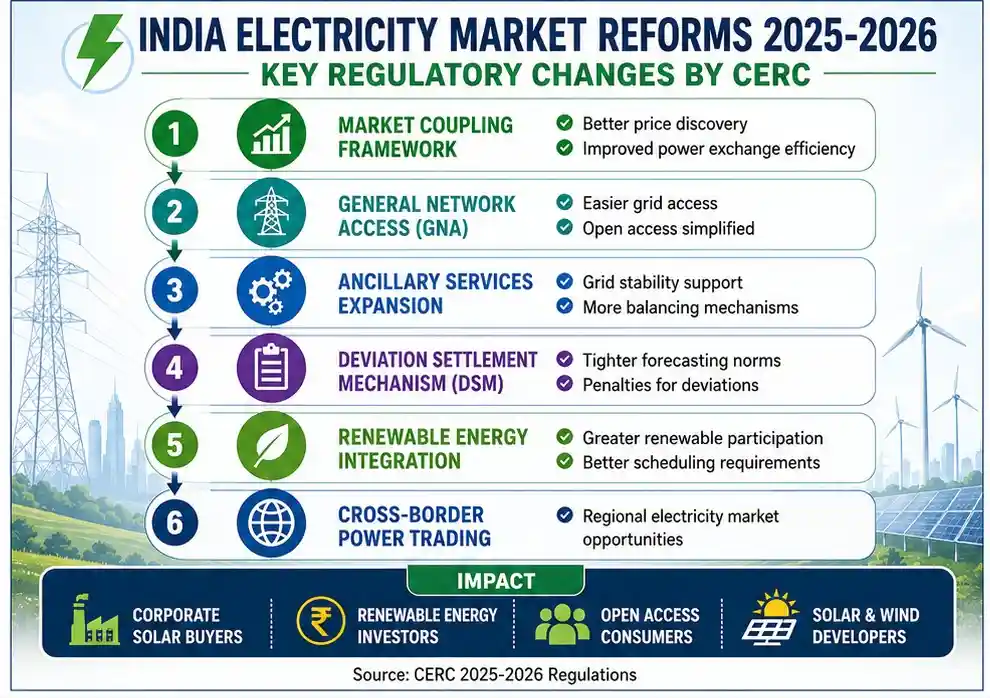
At the center of these changes is the Central Electricity Regulatory Commission (CERC), which sets key regulatory and market frameworks that influence how electricity is traded, scheduled, and settled across India’s grid-connected ecosystem. CERC’s reform direction in the 2025–2026 window strengthens market mechanisms and increases the compliance expectations associated with participation—especially for entities engaging through Green Open Access and exchange routes such as GTAM and STAM.
The Thesis (Why this matters now)
In 2026, success isn’t only about signing contracts, securing offtake intent, or mobilizing capital. For corporate buyers and renewable investors, it will increasingly depend on whether you are prepared for the CERC-aligned execution reality—the operational steps, procedural workflows, scheduling and forecasting discipline expectations, and the documentation standards that determine whether your project or procurement plan stays “grid-ready” and “settlement-safe.”
This pillar explains the reforms through a 360-degree lens: the big structural shifts, how they affect corporate solar buyers, how they affect renewable investors and developers, and what a practical 2026 compliance and execution checklist should look like—without turning into financial modeling or technical component comparisons.
The Big Picture: Key Structural Shifts in the 2025–2026 Regulatory Framework
A useful way to understand market reforms is to look at how they affect three core layers:
- Market architecture (where and how electricity is bought/sold)
- Operational discipline (how schedules and deviations are handled)
- Compliance workflow (how approvals, eligibility, documentation, and reporting work)
CERC’s reform direction reinforces all three, but the operational and compliance layers are what create the most risk for buyers and investors during transition.
1) Expansion of Real-Time and Short-Term Market Relevance
Even when procurement is planned in advance, grid realities—especially renewable variability—require mechanisms that can rebalance the system. The 2025–2026 reforms strengthen the operational role of short-term and real-time market interventions and the settlement logic attached to deviations and operational mismatches.
What changes in practice?
- Scheduling discipline becomes more visible in compliance and settlement outcomes.
- Operational deviations are increasingly treated as something that must be managed through proper participation, reporting, and readiness.
- Buyers and investors need to align their internal processes with how the grid expects schedules to be made and managed.
Why corporate buyers should care Corporate solar buyers often focus on contracting (supply intent, delivery expectations, and compliance targets). But in an increasingly market-driven environment, the “real execution” layer includes operational readiness and evidence consistency—especially if there are any execution gaps in scheduling, communication, or open access operational alignment.
2) Evolution of Green Exchanges (GDAM & GTAM)
Green procurement is evolving from a purely administrative or bilateral expectation into a more market-tradable compliance pathway, with exchange mechanisms increasingly used to strengthen liquidity, standardization, and price discovery for green attributes.
In discussions around GDAM (Green Day Ahead Market) and GTAM (Green Term Ahead Market), the direction is toward improved operational usability and clearer market participation structures.
What changes in practice?
- Green procurement increasingly ties to how you participate in exchange products and how reporting and compliance evidence are mapped internally.
- For buyers, exchange procurement is not “just purchase”—it becomes a compliance mechanism that must be tracked and explained within regulatory reporting logic.
- For developers/investors, market participation readiness matters: your project must remain operationally aligned with eligibility and participation requirements.
3) The Push for “One Nation, One Grid, One Frequency” (Operational Uniformity)
Grid integration is now treated less as a conceptual goal and more as an operational requirement. The reforms direction supports tighter alignment of grid discipline across regions—meaning the system’s scheduling, dispatch discipline, operational interfaces, and state-level coordination become more consistently enforced.
What changes in practice?
- Cross-boundary operational expectations strengthen.
- Entities that depend on smooth interface handling across SLDC/RLDC workflows face more scrutiny in operational alignment and reporting consistency.
- Buyers and investors must ensure that procurement and project operations are consistent with grid expectations.
Why this affects corporate buyers When operational interfaces are standardized more strongly, the procurement route you choose (open access vs exchange vs other participation structures) should be evaluated not only on contracting terms, but on execution feasibility through the grid’s operational interfaces.

What CERC’s New Rules Mean for Corporate Solar Buyers (Open Access)
For corporate solar buyers, the regulatory impact in 2025–2026 concentrates around Green Open Access, including procedural expectations, cost and settlement interpretation, and categorization requirements.
1) Green Open Access 2.0: Procedural Changes & Timelines
Green Open Access is increasingly treated as a workflow with measurable procedural expectations, not merely a “permission” step. During 2025–2026, reforms emphasize process discipline: approvals, portal steps, coordination checkpoints, and internal readiness.
Key operational implication for buyers Your organization should treat Green Open Access as a project-like process, not a passive administrative task. This is because procurement calendars are built around execution milestones, and any procedural delay can create compliance and delivery discontinuities.
What buyers should do now
- Align your procurement timeline with expected workflow realities.
- Ensure your internal stakeholders (legal, compliance, operations, and procurement) share a single execution calendar.
- Prepare the documents and evidence required for the lifecycle, not just for initial submission.
2) Navigating Cross-Subsidy Surcharge (CSS) & Standby Charges (Regulatory Methodology Focus)
Many buyers experience CSS/standby-related uncertainty during transition periods because the risk is not only “whether charges apply,” but how regulatory methodology and eligibility conditions are interpreted—especially when reforms update the regulatory framework.
Your priority should be regulatory methodology understanding, not financial ROI math. This includes:
- how charges are framed under the prevailing interpretation,
- what documentation or evidence must be maintained for billing and reconciliation,
- and how to handle change-in-law situations contractually and operationally.
Why this matters for lead conversion (and for compliance outcomes) In real corporate execution, CSS and standby-related friction usually arises from documentation or operational mismatch, not from the buyer’s intent. A reliable implementation approach reduces the probability of billing disputes and compliance gaps.
3) Group Captive vs Third-Party Open Access: Regulatory Distinctions That Affect Compliance
Corporate buyers may structure procurement through different pathways, including:
- Group Captive
- Third-party open access
In 2025–2026, regulators increasingly emphasize that these routes are not interchangeable from an eligibility and compliance responsibility standpoint. Correct categorization affects:
- what approvals or procedures apply,
- what documentation is required,
- and how compliance evidence must be prepared and defended.
Execution risk Misclassification or late-stage switching can cause:
- rework of documentation,
- delays in operational readiness,
- and uncertainty in compliance reporting.
What to do
- Validate the pathway early.
- Ensure contracts, operational execution steps, and compliance reporting expectations align with the selected structure.
Calculate Your Industry’s Savings Potential
Request a customized industrial electricity savings analysis from our renewable energy experts.
Impact on Renewable Energy Investors and Developers
For investors and developers, 2025–2026 reforms increase the operational significance of participation discipline. Even when projects are commercially secured, compliance and operational readiness determine whether eligibility and participation remain intact.
1) Stricter Forecasting and Scheduling Regulations (Deviation Settlement Mechanisms)
Renewables naturally vary in output. As a result, regulatory frameworks increasingly require:
- disciplined forecasting behavior,
- structured scheduling practices,
- and readiness to handle deviation settlement mechanics.
Non-financial implication In the reforms direction, forecasting isn’t just an operational improvement. It becomes part of compliance readiness:
- how forecasts are made,
- how schedules are communicated,
- and how deviations (if any) are managed within settlement logic.
What investors should implement
- forecasting and scheduling governance: clear ownership and escalation paths,
- evidence trails: so that internal compliance can explain deviations and response processes,
- contract alignment: ensure agreements and change-in-law clauses account for evolving scheduling and participation rules.
2) Enforcement of “Must-Run” Status and Back-down Protection (Eligibility-Contingent)
The concept of “must-run” protection is designed to prevent arbitrary operational curtailments or back-down practices that harm renewable viability. In the reform direction of 2025–2026, the emphasis remains on protecting eligible renewable projects—but within defined compliance and eligibility conditions.
What changes for investors
- “Must-run” becomes more defensible when eligibility and operational compliance are properly documented.
- Investors should treat compliance evidence as a core project deliverable.
- Developers should ensure their operational communication processes support eligibility defense and dispute handling if back-down issues arise.
Practical risk reduction A project that is eligible on paper but inconsistent in operational evidence is more exposed during disputes. Reforms increase the value of documentation discipline and operational logs.
3) Waiver of ISTS Charges for Green Energy: Status, Timelines, and Compliance Checkpoints
Inter-State Transmission System (ISTS) charge waivers for green energy (where applicable under the prevailing framework) are compliance-dependent. During 2025–2026, the operational reality is that waiver continuity often depends on:
- meeting eligibility conditions,
- meeting documentation requirements,
- and meeting timelines for approvals, evidence submissions, and portal acknowledgments.
Investor takeaway Treat charge waiver continuity as an ongoing compliance program, not a one-time milestone.
Hedging and Procurement Strategies Under the New Regime
As reforms increase market participation relevance, procurement strategies also evolve. Corporate buyers are increasingly looking at exchange-based procurement to meet sustainability obligations and operational continuity needs.
1) Using Power Exchanges to Meet RPO Obligations (GTAM/STAM as Procurement Pathways)
Renewable Purchase Obligations (RPO) require obligated entities to procure renewable power/attributes in line with regulatory requirements. When physical procurement pathways face procedural constraints, exchange procurement can become a structured alternative.
Why GTAM/STAM matter for corporate procurement Exchange products provide:
- standardized participation structures,
- clearer settlement logic inside exchange frameworks,
- and more traceable evidence routes for compliance demonstration.
What corporate buyers must get right Exchange procurement still requires internal compliance mapping:
- ensure your compliance evidence aligns with how exchange purchases are treated under RPO reporting expectations,
- ensure governance exists to track purchases and maintain auditable records.
2) The Rise of Green Term Ahead Market (GTAM) for Round-the-Clock (RTC) Power
Round-the-clock renewable procurement (and RTC-style expectations) increasingly pushes the market toward structured procurement solutions. GTAM structures are often discussed as a pathway to support time-aligned green procurement logic.
Execution implication For buyers and investors, RTC procurement is not only a contract question—it is an execution question. You must ensure:
- procurement and operational scheduling logic align,
- reporting and compliance evidence are consistent,
- and any operational deviations are handled through proper participation discipline.
Explore Customized Renewable Energy Procurement Models
Get state-wise group captive regulatory guidance and customized proposals from NST Solar & Wind Energy experts.
A 2026 Compliance Checklist for Market Participants (Actionable)
This checklist is designed to support lead generation and business conversion because it enables buyers/investors to self-diagnose execution readiness. It is not a financial model; it is an operational compliance map.
A) Corporate Solar Buyers: Open Access + Market Participation Readiness
- Update your Green Open Access execution calendar
- align procurement milestones with workflow expectations,
- build internal buffer for portal-dependent steps.
- Strengthen operational interface readiness
- verify that scheduling and operational reporting interfaces align with the grid’s discipline expectations,
- ensure your compliance team and operations team operate from a single “evidence + timeline” framework.
- Re-check CSS and standby charge interpretation readiness
- ensure documentation and billing reconciliation processes are prepared for regulatory methodology changes,
- create an internal change-in-law response mechanism.
- Validate Group Captive vs Third-party Open Access classification alignment
- confirm contracts and documentation reflect the selected pathway,
- avoid late-stage switching unless compliance/legal teams are aligned on the consequences.
- If using exchange procurement routes, set up compliance mapping
- define how GTAM/STAM purchases will be tracked for RPO compliance,
- ensure auditable evidence flows from procurement to compliance reporting.
- Contract review for evolving grid and market rules
- ensure force majeure and change-in-law clauses allow for regulatory adjustments,
- ensure dispute escalation procedures exist for operational compliance disagreements.
B) Renewable Investors & Developers: Forecasting, Scheduling, and Eligibility Continuity
- Forecasting governance
- assign clear ownership for forecasting accuracy and operational scheduling discipline,
- establish escalation for forecast-schedule gaps.
- DSM and deviation readiness
- ensure the project can respond to deviation-related settlement logic through structured processes,
- maintain evidence trails to explain deviations and mitigation actions.
- Must-run eligibility evidence discipline
- build operational documentation habits that support dispatch protection claims,
- maintain logs and communication records consistently.
- ISTS waiver continuity compliance
- track eligibility persistence requirements and portal checkpoints,
- ensure documentation submissions are on schedule and consistent.
- Nodal workflow readiness and participation compliance
- ensure registrations and operational workflows align with the latest portal/market framework expectations,
- prevent operational mismatches that cause rejection or delays.
- Contractual alignment
- review agreements to ensure change-in-law accommodates CERC-driven operational changes,
- define operational responsibilities clearly across stakeholders.

What Corporate Buyers and Investors Should Expect (Realistic Outcomes in 2025–2026)
To help conversion, it’s useful to clarify what reforms tend to “feel like” in execution, so readers recognize the relevance quickly.
For corporate solar buyers
- Expect procurement timelines to become more workflow-dependent.
- Expect more emphasis on documentation consistency and internal evidence mapping.
- Expect exchange routes (GTAM/STAM) to become more strategically relevant when physical open access faces operational constraints.
- Expect that charges and billing interpretation will require stronger compliance readiness.
For renewable investors and developers
- Expect stricter operational discipline around forecasting, scheduling, and deviation handling.
- Expect eligibility-based protections (like must-run) to depend heavily on evidence consistency and compliance readiness.
- Expect that transmission charge waiver continuity requires proactive timeline management and portal discipline.
Conclusion: The 2025–2026 reforms reward compliance-led execution
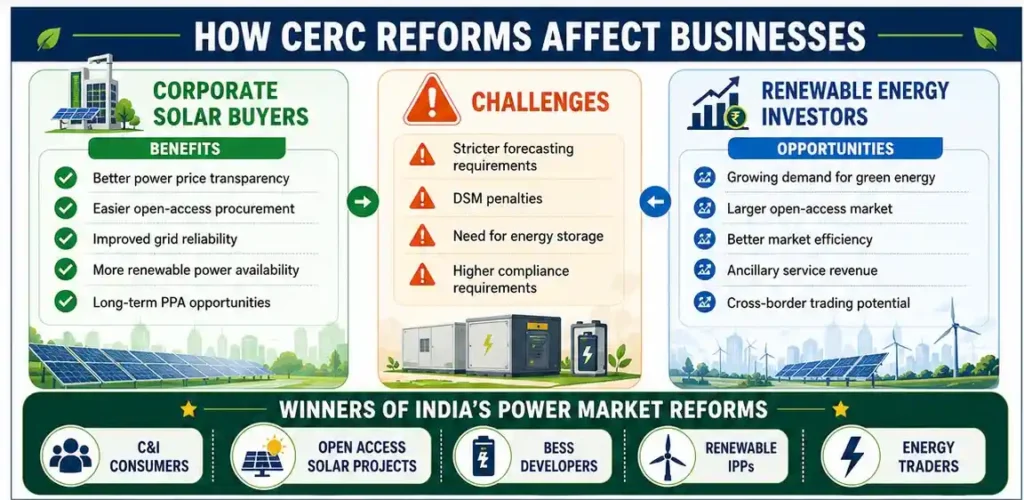
India’s electricity market reforms for 2025–2026 are making the ecosystem more structured, more transparent, and more compliance-driven. CERC’s direction strengthens market mechanisms and increases the operational significance of scheduling, forecasting, deviation settlement readiness, and Green Open Access procedural workflows.
For corporate solar buyers, the reforms shift the emphasis from “contracting intent” to “execution readiness”—particularly around Green Open Access procedural compliance, CSS/standby methodology interpretation, and correct pathway classification, and increasingly around exchange procurement routes like GTAM/STAM for structured renewable compliance outcomes.
For renewable investors and developers, the reforms emphasize operational discipline and eligibility continuity—especially through forecasting/scheduling governance, deviation readiness, must-run evidence discipline, and ISTS waiver continuity checkpoints.
Call to Action (Business Conversion for NST Solar Wind)
If you want smoother execution in 2026—without regulatory surprises—book a consultation or call with NST Solar Wind.
What to expect from the consultation:
- A compliance-first readiness review based on your procurement route (Green Open Access and/or exchange participation).
- A practical roadmap for aligning regulatory documentation, operational workflows, and execution handover expectations.
- Actionable next steps so your team can stay “grid-ready” for evolving CERC requirements.
If you want smoother execution in 2026—without regulatory surprises—book a consultation or call with NST Solar Wind. →
call with NST Solar Wind today to discuss your pan-India project and compliance readiness for 2025–2026 reforms.
FAQ: CERC Electricity Market Reforms 2025–2026 (Lead-Generating, Compliance-First)
The reforms focus on strengthening market mechanisms, improving operational discipline through market participation frameworks, and tightening compliance workflows related to open access and renewable participation.
They are relevant to both. Corporate buyers face execution and compliance impacts through Green Open Access workflows, scheduling alignment, and billing interpretation. Investors/developers face operational readiness requirements around forecasting, scheduling, eligibility evidence, and settlement discipline.
It means that rules increasingly influence how electricity is scheduled, settled, and documented—so organizations must align procurement planning and operational execution with evolving CERC-aligned compliance expectations.
It refers to a trend of more structured and workflow-managed open access processing, with clearer procedural expectations and stronger reliance on portal and coordination mechanisms—making timeline discipline more important.
Because the risk often arises from how regulatory methodology is applied, how evidence is maintained, and how billing reconciliation is handled—not just from whether charges exist.
Yes. These routes carry different regulatory compliance implications. Correct classification early helps prevent delays, rework, and documentation mismatches.
Exchange procurement routes such as GTAM/STAM can provide structured ways to fulfill renewable compliance needs, provided organizations set up internal evidence mapping and reporting aligned with regulatory expectations.
No. Exchange procurement still requires operational readiness and compliance mapping—especially around reporting evidence, purchase tracking, and adherence to participation requirements.
Because deviation settlement logic and operational enforcement mechanisms make forecasting/scheduling governance more visible. Investors need to ensure their operational systems and evidence trails can support compliance outcomes.
Must-run expectations are eligibility-contingent and linked to compliance. The practical success factor is maintaining evidence discipline and operational alignment, so protections remain defensible if issues arise.
No. Waiver continuity typically depends on meeting eligibility and compliance checkpoints over time, including evidence submission and portal workflow discipline.
Start by aligning your procurement calendar and documentation workflow with Green Open Access procedural timelines, and ensure operational interface readiness for scheduling and evidence mapping.
Strengthen forecasting and scheduling governance, establish deviation-related readiness processes, and implement evidence discipline for eligibility and operational compliance claims.
There is no one-size-fits-all. The decision depends on your operational feasibility, open access workflow timelines, compliance evidence mapping needs, and your reporting strategy. A consultation can help identify the most execution-safe pathway.
NST Solar Wind supports a compliance-first approach to project and operational readiness—helping organizations align execution, grid-code readiness expectations, and commissioning readiness with evolving CERC requirements.
Book a consultation / call with NST Solar Wind and share your intended procurement route and high-level timeline. We’ll outline the execution checkpoints your team should align early for smoother 2025–2026 outcomes.