
Reduce Long-Term Electricity Costs with Group Captive Solar
Shared ownership. Renewable electricity. End-to-end expertise.
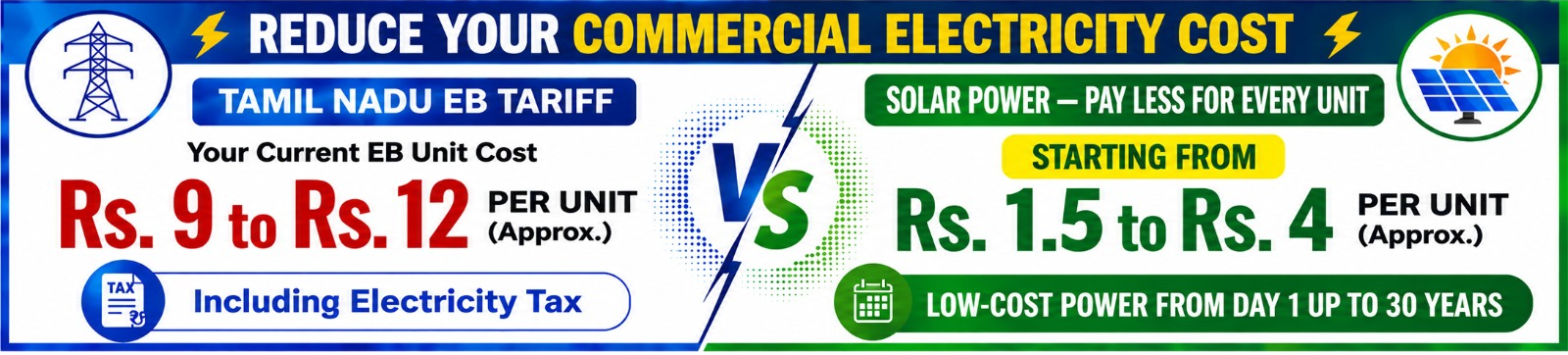
Industrial electricity costs continue to rise, making energy one of the largest operating expenses for manufacturing facilities and commercial enterprises. NST Global Solar & Wind Energy helps eligible businesses transition to Group Captive Solar—enabling them to procure renewable electricity through a shared ownership model while optimising long-term power procurement costs, subject to applicable regulations and project feasibility.
Why Businesses Choose NST Global Solar & Wind Energy
- ✓End-to-end Group Captive project development
- ✓Energy consumption and feasibility assessment
- ✓SPV structuring support
- ✓Regulatory and Open Access coordination
- ✓Engineering, Procurement & Construction (EPC)
- ✓Performance monitoring and O&M
- ✓Tailored solutions for industrial & commercial consumers
Table of Contents
A Smarter Way to Procure Renewable Energy
Group Captive Solar is a renewable energy procurement model that allows multiple eligible industrial or commercial consumers to jointly participate in a solar power project and receive electricity through Open Access. By sharing project ownership and complying with applicable regulatory requirements, participating businesses can evaluate a long-term renewable energy strategy that supports cost optimisation, operational efficiency, and sustainability goals.
Many businesses want to transition to renewable energy but face practical challenges such as high upfront investment, land availability, project development complexity, and regulatory compliance. Group Captive Solar addresses these challenges by allowing multiple eligible businesses to collaborate in a single solar power project, jointly investing in a professionally developed project rather than building individual captive power plants—enabling businesses to focus on their core operations while leveraging a professionally managed renewable energy solution.
What it Is
A shared ownership model where multiple eligible businesses jointly participate in a solar power project and procure renewable electricity through Open Access—without each company building its own captive plant.
- Shared solar asset
- Open Access electricity supply
- Compliant ownership structure
- Utility-scale renewable energy
How it Differs
Unlike a conventional captive installation, Group Captive Solar enables multiple businesses to collaborate in a single project, making utility-scale renewable energy more accessible and commercially viable for eligible participants.
- Collaborative investment model
- Shared project entity (SPV)
- Lower individual capital outlay
- Professionally managed project
Who it's For
Manufacturing plants, textile mills, engineering units, pharmaceutical facilities, automobile factories, warehouses, commercial campuses, and other high-electricity consumers evaluating long-term renewable energy strategies.
- Manufacturing industries
- Industrial parks & clusters
- Commercial campuses
- Institutions & IT parks
Is Group Captive Solar Right for Your Business?
Group Captive Solar is generally suitable for organisations that meet the following profile. If your organisation matches these characteristics, a detailed technical, commercial, and regulatory feasibility study is the recommended next step.
✅ Qualifying Characteristics
- ✓Have significant and consistent electricity consumption
- ✓Want to reduce long-term dependence on conventional grid electricity
- ✓Are planning long-term manufacturing or commercial operations
- ✓Have renewable energy or ESG commitments
- ✓Are willing to participate in a shared investment model
- ✓Want expert support to navigate regulatory and project development requirements
🏢 Industries That Commonly Evaluate This Model
Rather than viewing renewable energy solely as an environmental initiative, many organisations now recognise it as an important component of long-term business strategy.
See if Your Organisation Qualifies
See if your organisation qualifies for our shared investment model and start optimising your energy costs.
Why Businesses Trust NST Global Solar & Wind Energy
Choosing the right renewable energy partner is just as important as choosing the right energy procurement model. Our multidisciplinary approach combines engineering expertise, commercial analysis, project execution, and regulatory coordination.
Electricity Consumption Analysis
We begin with a thorough review of your monthly bills, connected load, contract demand, and future expansion plans to build an accurate energy profile.
- Monthly bill analysis
- Connected load assessment
- Future growth planning
Renewable Energy Feasibility Assessment
Technical, commercial, and regulatory feasibility is evaluated before any investment commitment, ensuring the project structure aligns with your objectives.
- Technical feasibility
- Commercial evaluation
- Regulatory review
Financial & Commercial Evaluation
Our experts model the long-term commercial implications of Group Captive participation, providing clear visibility into procurement economics.
- Long-term cost modelling
- Investment structuring
- Risk assessment
Group Captive Project Structuring
We design the project structure—including SPV formation and ownership framework—to align with applicable regulations and business objectives.
- SPV coordination
- Ownership structuring
- Compliance planning
Open Access Coordination
We coordinate the technical documentation, application support, and utility interactions required to secure Open Access approvals for participating consumers.
- Technical documentation
- Utility coordination
- Grid-related requirements
EPC Implementation
NST manages the complete Engineering, Procurement & Construction lifecycle—from site identification and design through to grid synchronisation.
- Site identification
- Equipment procurement
- Grid synchronisation
Operations & Maintenance
Long-term performance optimisation through professional O&M services, ensuring the asset delivers reliably throughout its operational life.
- Performance monitoring
- Preventive maintenance
- Long-term optimisation
Business Benefits at a Glance
Group Captive Solar addresses key business objectives across energy procurement, sustainability, investment, and operational efficiency.
| Business Objective | How Group Captive Solar Can Help |
|---|---|
| Manage long-term electricity costs | Structured renewable energy procurement strategy |
| Reduce exposure to tariff volatility | Greater long-term cost visibility, subject to project economics |
| Meet sustainability goals | Increased use of renewable electricity |
| Support ESG initiatives | Contribute to broader environmental objectives |
| Improve energy planning | Long-term electricity procurement strategy |
| Share investment | Collaborative participation through a Group Captive model |
| Focus on core business | End-to-end project support from NST Global Solar & Wind Energy |
Ready to Transition to Renewable Energy?
Let our experts guide you through a detailed technical and commercial feasibility study.
How Group Captive Solar Works
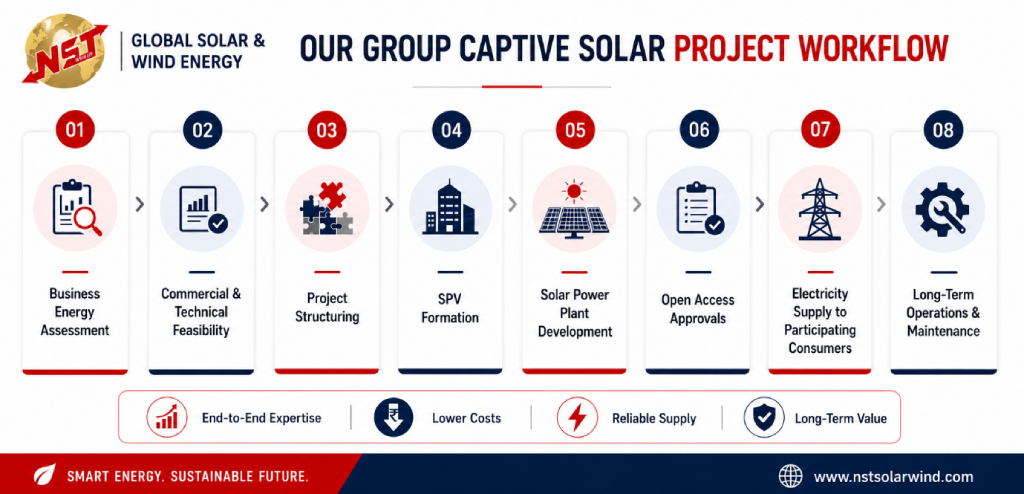
The overall process is straightforward when managed by an experienced renewable energy partner. NST Global Solar & Wind Energy acts as a single point of responsibility throughout the project lifecycle—coordinating every critical activity from initial assessment to long-term operations.
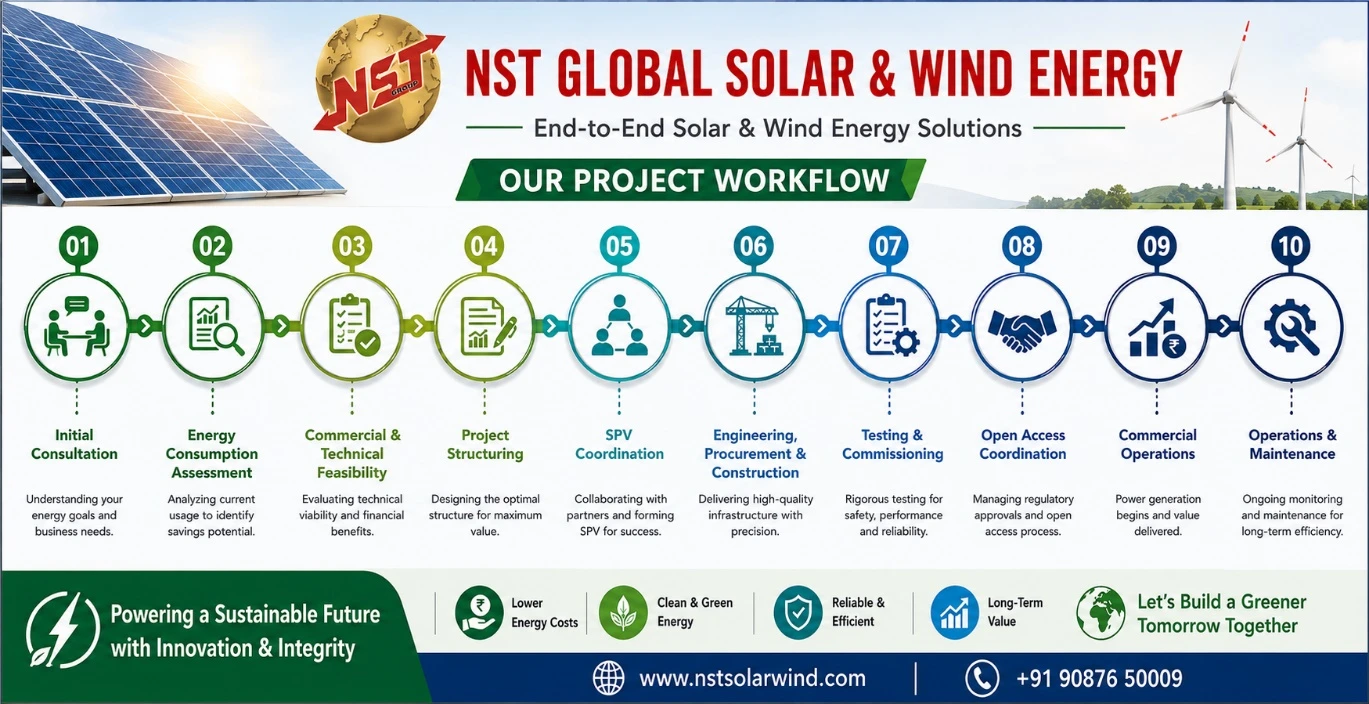
Understand Your Energy Requirement
The process begins with a detailed assessment of your organisation's electricity consumption profile.
- Monthly electricity bills analysis
- Connected load & contract demand review
- Annual energy consumption mapping
- Future expansion plan evaluation
- Existing power procurement strategy assessment
Identify the Right Project Structure
NST recommends an appropriate Group Captive structure aligned with your operational and commercial objectives.
- Project capacity evaluation
- Number of participating consumers
- Energy allocation framework
- Commercial feasibility modelling
- Long-term scalability planning
Formation of the Project Entity (SPV)
Most Group Captive Solar projects are developed through a Special Purpose Vehicle (SPV) that holds the asset and coordinates compliance. Participating consumers become shareholders in the SPV according to the agreed project structure and applicable regulations.
- Owning the solar power plant
- Coordinating project development
- Managing regulatory compliance
- Executing EPC activities
- Operating and maintaining the project
Development of the Solar Power Plant
Once the project structure is finalised, NST manages the complete EPC process to ensure quality, safety, and timely execution.
- Site identification & land coordination
- Engineering and design
- Equipment procurement
- Civil and electrical works
- Installation, testing & commissioning
- Grid synchronisation
Electricity Supply Through Open Access
After commissioning, the electricity generated is transmitted through the power grid to participating consumers using the applicable Open Access framework. Depending on the project structure and prevailing regulations, businesses continue to receive reliable electricity while increasing the share of renewable energy in their overall power procurement mix.
- Grid synchronisation & metering
- Open Access regulatory coordination
- Ongoing performance monitoring
- Long-term O&M management
- Compliance reporting support
What NST Delivers at Each Stage
Begin Step 1 Today
Let our specialists analyse your electricity consumption and recommend the best structure for you.
Benefits of Group Captive Solar for Industrial & Commercial Consumers
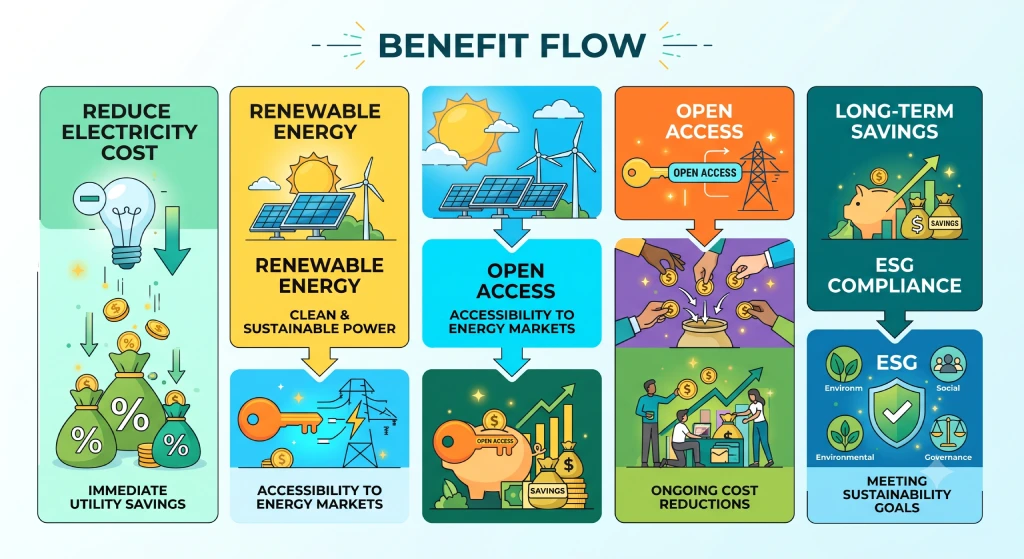
Group Captive Solar helps eligible industrial and commercial businesses optimise long-term electricity procurement, improve energy cost visibility, diversify power sourcing, and increase the use of renewable energy—subject to applicable regulations and project feasibility.
1. Optimise Long-Term Electricity Procurement Costs
For most manufacturing and commercial facilities, electricity represents one of the largest recurring operational expenses. Group Captive Solar enables eligible participants to evaluate renewable energy procurement over the project lifecycle rather than focusing solely on short-term tariff fluctuations.
2. Increase the Share of Renewable Energy
Many organisations have established renewable energy targets as part of their corporate sustainability strategy. Customers, investors, multinational supply chains, and financial institutions increasingly evaluate environmental performance alongside operational excellence.
3. Shared Investment Makes Large-Scale Projects Accessible
Developing a dedicated utility-scale solar project independently may not always be practical. Group Captive Solar addresses this through a shared participation model where eligible businesses collectively participate in the project—benefiting from a professionally managed renewable energy asset without independently developing an entire captive power plant.
4. Access Professional Project Development & Management
A successful Group Captive project requires coordination across multiple disciplines, including energy assessment, commercial feasibility, engineering design, regulatory approvals, grid coordination, EPC execution, and performance monitoring. By partnering with NST, businesses gain access to a team that manages the complete project lifecycle under one roof.
5. Improve Long-Term Energy Planning
Business expansion often depends on confidence in future operating costs. A structured renewable energy strategy supports production planning, capacity expansion, and financial forecasting—rather than reacting to changing electricity prices.
6. Potential Open Access Cost Advantages
Where applicable under prevailing regulations, Group Captive projects may enable eligible consumers to realise benefits associated with Open Access power procurement. Regulatory Note: Open Access charges, wheeling charges, transmission charges, banking provisions, cross-subsidy surcharge, and other applicable components vary by state and are subject to regulatory revisions—a detailed feasibility assessment is essential before evaluating project economics.
7. Focus on Your Core Business
Most manufacturers prefer to focus on production, quality, logistics, and customer commitments—not managing complex energy infrastructure. NST takes responsibility for the entire renewable energy project lifecycle, so your team stays focused on growth.
Benefits Across Different Business Functions
Group Captive Solar delivers value across multiple organisational functions—from the boardroom to the plant floor—creating alignment between energy strategy and business objectives.
| Business Function | Potential Value from Group Captive Solar |
|---|---|
| Managing Director / CEO | Long-term strategic energy planning and improved business competitiveness |
| Chief Financial Officer (CFO) | Better visibility into future electricity procurement costs and investment planning |
| Plant Head | Reliable integration of renewable energy into operations through a professionally managed project |
| Procurement Team | Diversified electricity procurement strategy |
| Sustainability / ESG Team | Increased renewable energy adoption to support environmental objectives |
| Operations Team | Reduced need to internally manage complex renewable energy projects |
What Businesses Need vs. How NST Delivers Value
| What Businesses Need | How NST Delivers Value |
|---|---|
| Strategic renewable energy planning | Comprehensive energy assessment and feasibility studies |
| Technical expertise | End-to-end engineering and EPC execution |
| Commercial guidance | Customised project structuring and advisory |
| Simplified implementation | Single point of coordination throughout the project |
| Long-term reliability | Professional Operations & Maintenance support |
| Business-focused solutions | Tailored recommendations aligned with operational objectives |
Understanding Group Captive Compliance Requirements
A Group Captive Solar project must satisfy specific ownership and electricity consumption requirements under the applicable regulatory framework. Two of the most important requirements are the collective ownership requirement and the collective annual electricity consumption requirement. These conditions should be carefully evaluated during project planning.
Collective Ownership Requirement
Participating captive consumers are required to collectively maintain the prescribed ownership—commonly referred to as the 26% ownership requirement—in the entity that owns the generating station. This ownership demonstrates that the participating businesses are genuine stakeholders in the power project rather than simply purchasing electricity from an independent generator.
- Supports regulatory compliance
- Defines governance responsibilities
- Establishes long-term project participation
- Aligns interests of all participating consumers
Note: The ownership structure should always be designed based on the latest applicable regulations and professional legal advice.
Annual Electricity Consumption Requirement
Participating captive consumers must collectively consume the prescribed proportion of the electricity generated by the project—commonly referred to as the 51% annual electricity consumption requirement—during the applicable assessment period. This ensures the generating station primarily serves the participating captive users rather than functioning as a third-party power supply arrangement.
- Aligns generation with actual demand
- Improves project utilisation
- Supports ongoing compliance
- Reduces operational uncertainty
Why it matters: Accurate electricity consumption analysis during the feasibility stage is essential for compliance planning.
Many businesses assume compliance begins after the solar plant is commissioned. In reality, successful Group Captive projects begin with careful planning—covering historical electricity consumption, future load growth, contract demand, operational schedules, expansion plans, consumer participation model, commercial feasibility, and regulatory considerations—well before construction starts.
✅ Compliance Checklist
Before moving forward with a Group Captive Solar project, consider the following:
- Assess your annual electricity consumption
- Evaluate long-term operational plans
- Identify participating consumers
- Review commercial feasibility
- Develop an appropriate project structure
- Understand applicable regulatory requirements
- Work with experienced renewable energy professionals
- Plan for long-term project management and compliance
Group Captive Solar vs. Other Renewable Energy Models
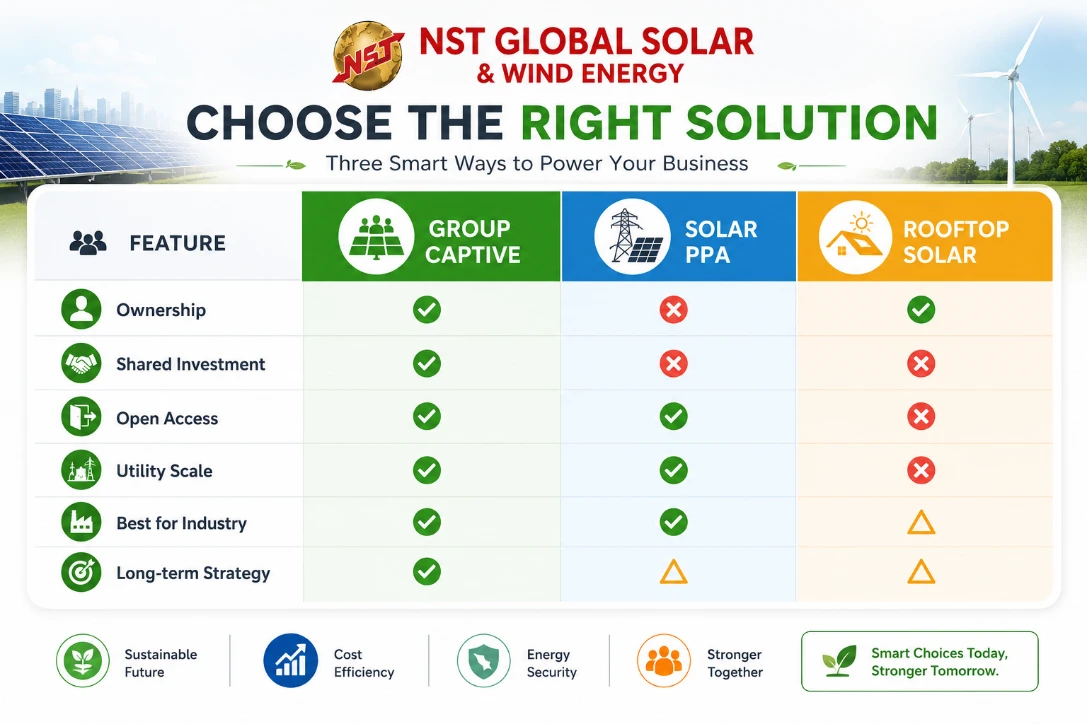
There is no single renewable energy procurement model that suits every business. The right choice depends on factors such as electricity consumption, investment preference, long-term business plans, sustainability goals, and applicable regulatory requirements. NST conducts a comprehensive feasibility assessment before recommending the most appropriate model.
vs. Solar Power Purchase Agreement (Solar PPA)
With a Solar PPA, a third-party developer typically owns, finances, and operates the solar power plant, while the consumer purchases electricity under a contractual arrangement—generally requiring little or no upfront capital investment. Group Captive Solar involves eligible consumers participating in project ownership—which may offer different commercial considerations over the long term, depending on project economics and applicable regulations.
| Feature | Group Captive Solar | Solar PPA |
|---|---|---|
| Project Ownership | Participating consumers jointly participate in project ownership | Project owned by third-party developer |
| Initial Investment | Shared equity participation | Generally minimal or no project ownership investment |
| Electricity Procurement | Through Group Captive structure and Open Access | Through a Power Purchase Agreement |
| Suitable For | Businesses with long-term renewable energy strategy | Businesses preferring an asset-light procurement model |
| Long-Term Participation | Shared involvement in the project | Electricity purchase under contractual terms |
vs. Dedicated Captive Solar Power Plant
Some organisations consider developing a dedicated captive solar plant exclusively for their own electricity consumption. While this approach may be appropriate for certain large consumers, it may not always be practical for businesses that prefer a collaborative investment model.
| Feature | Group Captive Solar | Dedicated Captive Solar |
|---|---|---|
| Ownership | Shared among eligible participants | Single business |
| Investment | Shared equity participation | Entire investment by one organisation |
| Project Scale | Shared utility-scale project | Dedicated project sized for one consumer |
| Operational Responsibility | Shared with project partners and service providers | Primarily managed by the owner |
| Best Suited For | Multiple eligible businesses in a cluster | Large organisations with dedicated project requirements |
vs. Rooftop Solar
Rooftop Solar remains an excellent option for many commercial buildings and industrial facilities with adequate roof space. However, rooftop installations are often constrained by available roof area and structural considerations. Group Captive Solar allows businesses to access electricity from a professionally developed utility-scale solar project without relying solely on rooftop availability.
| Feature | Group Captive Solar | Rooftop Solar |
|---|---|---|
| Installation Location | Utility-scale solar project (off-site) | Customer premises (on-site) |
| Land / Roof Requirement | No rooftop required at consumer's facility | Requires suitable roof space |
| Project Scale | Utility-scale | Limited by available roof area |
| Ownership Structure | Shared participation through SPV | Typically owned or leased by building owner |
| Suitable For | High-energy industrial and commercial consumers | Buildings with suitable roof space and lower load |
Which Model Is Right for Your Business?
Every organisation has unique operational priorities. The most suitable renewable energy procurement model depends on a combination of technical, commercial, and strategic factors.
☀ Group Captive Solar May Be Suitable If You:
- ✓Have substantial and consistent electricity consumption
- ✓Are planning long-term operations
- ✓Are comfortable participating in a shared investment structure
- ✓Want to increase renewable energy usage
- ✓Prefer a professionally managed utility-scale project
📄 A Solar PPA May Be Suitable If You:
- ✓Prefer an asset-light approach
- ✓Want to procure renewable electricity without project ownership
- ✓Prioritise operational simplicity over equity participation
🏭 A Dedicated Captive Solar Plant May Be Suitable If You:
- ✓Have very high electricity demand
- ✓Wish to own and control the project independently
- ✓Have the resources to manage long-term project ownership
🏠 Rooftop Solar May Be Suitable If You:
- ✓Have sufficient rooftop area
- ✓Have moderate daytime electricity consumption
- ✓Want on-site renewable generation
✅ Decision Checklist
Before selecting a renewable energy procurement model, ask:
- What is our annual electricity consumption?
- What are our long-term expansion plans?
- Do we prefer project ownership or a contractual power purchase model?
- How important are sustainability and ESG goals?
- What level of investment aligns with our financial strategy?
- Have we completed a technical, commercial, and regulatory feasibility study?
Industries Choosing Group Captive Solar
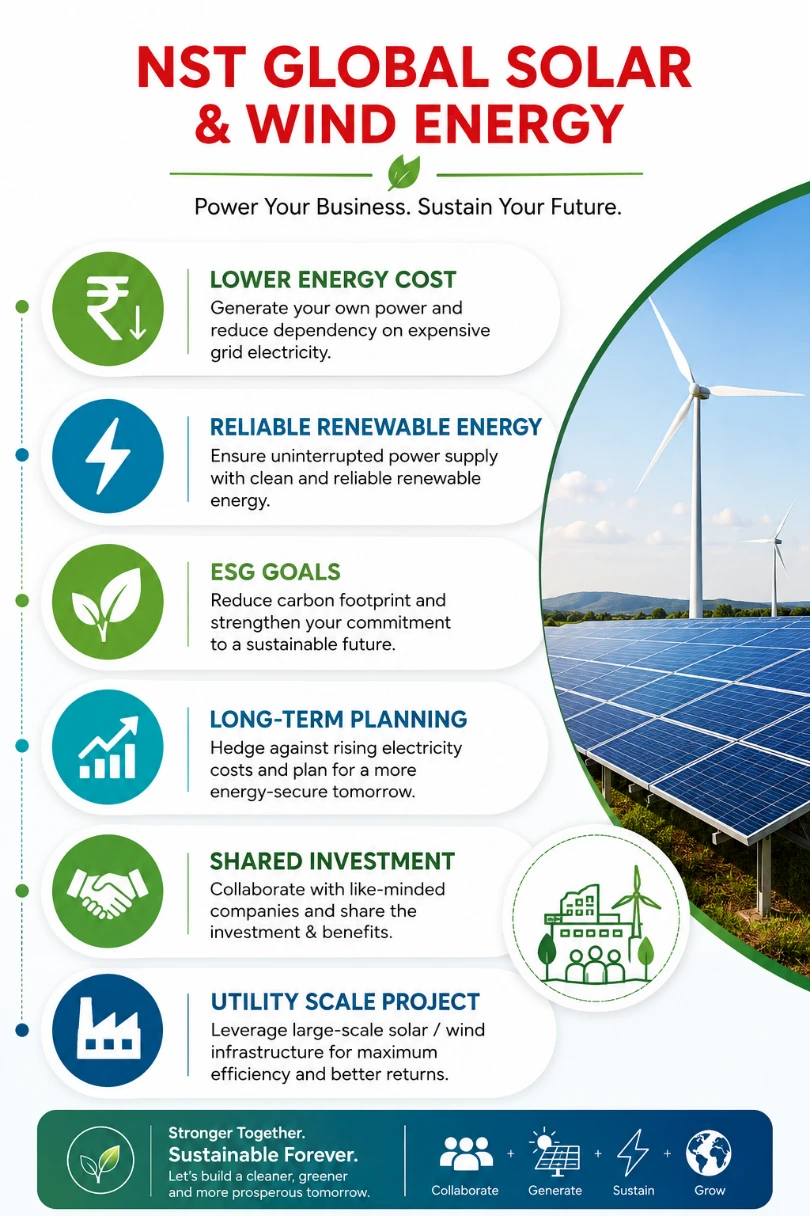
NST Global Solar & Wind Energy works with a wide range of industrial and commercial sectors, helping each organisation evaluate and implement the most suitable renewable energy procurement strategy.
Manufacturing
Large-scale production facilities
Industrial Parks
Clustered industrial units
Textile Units
Mills and weaving facilities
Automobile
OEMs and component manufacturers
Engineering
Engineering companies
Steel & Cement
Heavy, energy-intensive industries
Food Processing
Processing and cold chain
Pharmaceutical
API and formulation facilities
Warehousing
Logistics and storage
Commercial Campuses
Office and business parks
IT Parks
Technology and business process centres
Hospitals
Healthcare institutions
Educational Institutions
Universities and colleges
Multi-Location Businesses
Coordinated energy strategy across sites
Industry Suitability at a Glance
| Industry | Why Group Captive Solar May Be Considered |
|---|---|
| Manufacturing | High and consistent electricity consumption |
| Textile | Continuous production and export sustainability goals |
| Automobile | Long-term operational planning and ESG initiatives |
| Engineering | Energy-intensive manufacturing processes |
| Steel & Cement | Large-scale electricity demand |
| Pharmaceuticals | Continuous operations and environmental objectives |
| Food Processing | Energy-intensive production and cold storage |
| IT Parks | Renewable energy for commercial campuses |
| Warehouses | Growing electricity demand from automation and logistics |
| Hospitals | Long-term renewable energy planning |
| Educational Institutions | Campus sustainability and operational efficiency |
Practical Business Scenario
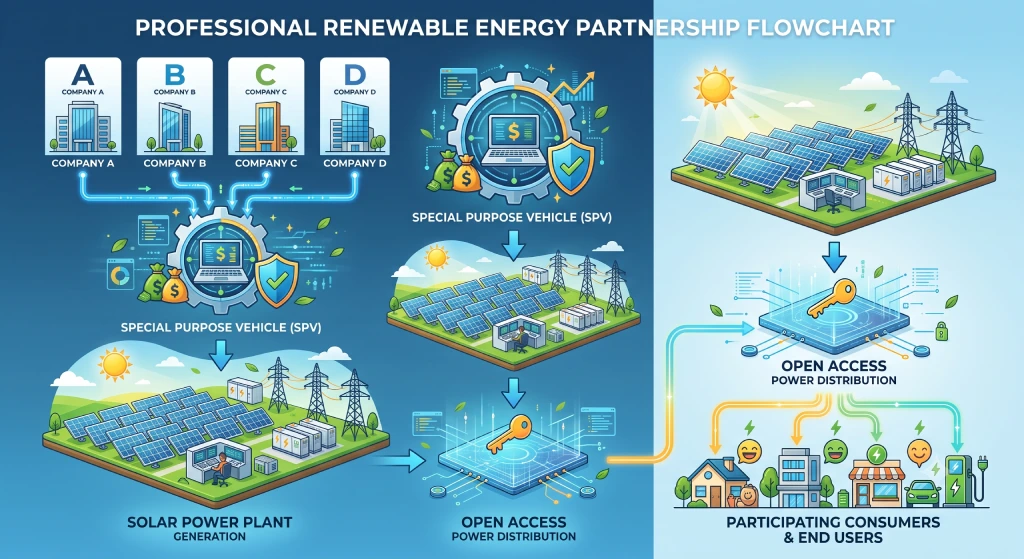
Manufacturing Cluster: A Collaborative Approach
A manufacturing cluster consists of four companies with growing electricity demand. Individually, each company finds it challenging to justify the development of a dedicated utility-scale solar project—due to capital requirements, land availability, and project management complexity.
After evaluating their combined energy requirements, NST designs a Group Captive solution where the participating businesses jointly invest in a solar power project through an SPV. NST coordinates feasibility analysis, project structuring, engineering, regulatory approvals, EPC execution, and long-term plant management—allowing the participating companies to adopt renewable energy through a professionally managed framework.
Illustrative example only. Actual project structures depend on electricity consumption, commercial arrangements, applicable regulations, and project-specific feasibility.
Why Work with NST Global Solar & Wind Energy?
Choosing Group Captive Solar is a strategic decision. Choosing the right implementation partner is equally important. Our approach is built around four core principles.
Frequently Asked Questions
Everything you need to know about Group Captive Solar for your business.
01.What is Group Captive Solar?+
02.Who can benefit from Group Captive Solar?+
03.Do I need to understand every regulation before considering Group Captive Solar?+
04.Is every Group Captive project structured the same way?+
05.What is the 26% ownership requirement?+
06.What is the 51% annual electricity consumption requirement?+
07.Can compliance be planned during the project design stage?+
08.What is an SPV in a Group Captive Solar project?+
09.What is Open Access?+
10.What makes Group Captive Solar different from simply buying renewable energy?+
11.Can multiple companies participate in the same solar project?+
12.How long does the process from assessment to commissioning typically take?+
13.Will NST handle the complete project?+
14.What happens after the solar plant is commissioned?+
15.Can Group Captive Solar support ESG and sustainability goals?+
Speak with a Renewable Energy Expert
Ready to explore Group Captive Solar? Contact NST Global Solar & Wind Energy to begin your transition with confidence and clarity. Whether you operate a single manufacturing facility or multiple industrial units, our experts can assess your electricity consumption and recommend the most suitable renewable energy procurement strategy.