
Solar for Textile Mills in Coimbatore, Tirupur & Tamil Nadu
Power Your Textile Business with High-Performance Industrial Solar Solutions
Reduce electricity costs, improve profitability, and secure long-term energy independence with customized solar power systems for spinning mills, weaving units, dyeing plants, processing houses, and garment manufacturing facilities.
Key Benefits at a Glance
- ✓Lower monthly electricity expenses
- ✓Free energy audit & customized ROI report
- ✓Rooftop, Ground Mounted & Open Access solar
- ✓24×7 SCADA monitoring & AMC support
- ✓Improved profitability & energy security
- ✓Supports ESG & sustainability goals
What is Solar for Textile Mills?
Solar for textile mills is a commercial solar energy solution designed to reduce electricity costs by generating clean power for spinning, weaving, dyeing, processing, and garment manufacturing operations. Since textile production primarily occurs during daytime, solar power aligns exceptionally well with industrial energy demand, maximizing self-consumption and improving return on investment.
Why is Solar Important for Textile Industries?
The textile industry is one of India's highest electricity-consuming manufacturing sectors. Rising power tariffs, continuous machinery operation, and increasing production costs make solar energy an effective long-term investment for reducing operational expenses and improving business competitiveness.
Who Should Install Solar?
Solar is ideal for any textile or manufacturing facility with significant daytime electricity consumption.
- Spinning & Weaving Mills
- Knitting & Dyeing Plants
- Textile Processing Units
- Garment Manufacturing Factories
- Integrated Textile Parks
- Yarn Manufacturing Facilities
Key Benefits at a Glance
- Lower Electricity Bills — Significant reduction in monthly operating expenses
- Energy Security — Reduced dependence on grid power
- Sustainable Manufacturing — Supports ESG initiatives
- Improved Profitability — Lower production cost per unit
- SCADA Monitoring — Real-time performance visibility
- Flexible Solutions — Rooftop, Ground Mounted & Open Access
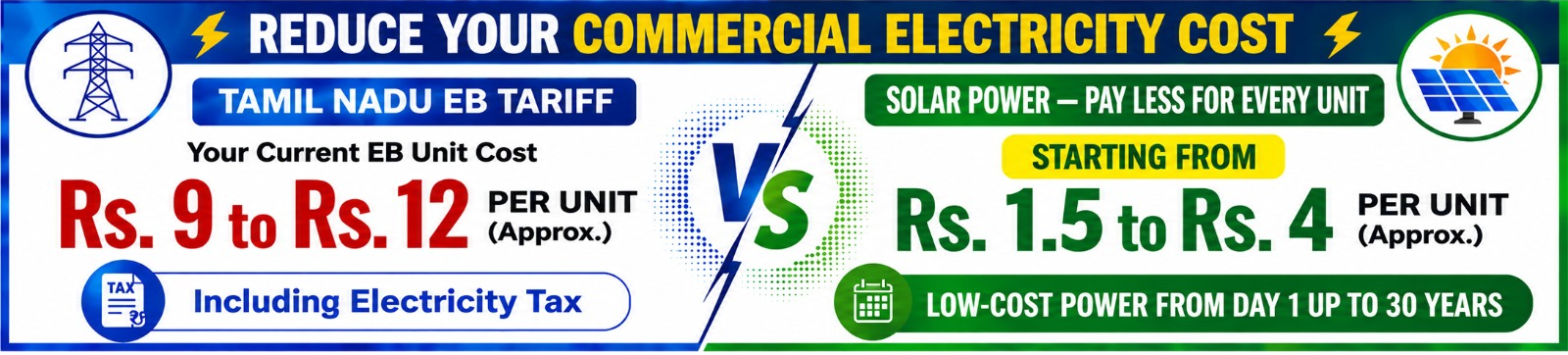
Textile Industry Power Costs Continue to Rise
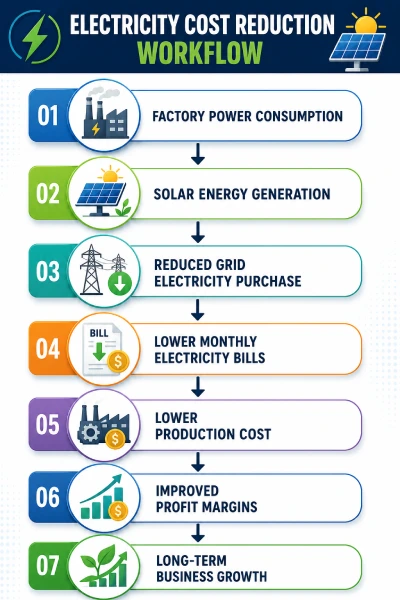
Textile manufacturers across Coimbatore, Tirupur, Erode, Karur, Salem, Palladam, and Avinashi face increasing electricity expenses that directly impact production costs and profit margins. Solar energy provides a practical solution by offsetting daytime electricity consumption with clean, renewable power generated on-site or through open access projects.
Whether your business operates a spinning mill, weaving unit, dyeing facility, or integrated textile manufacturing plant, investing in solar power can significantly reduce dependence on conventional grid electricity while providing predictable long-term energy costs.
Industrial solar installations have become an important strategic investment for textile businesses seeking improved operational efficiency, lower production costs, and enhanced sustainability.
Why Textile Mills Need Solar Energy
Textile manufacturing is highly energy intensive. Electricity is one of the largest recurring expenses in textile production — every tariff increase directly affects profitability. Solar power addresses this challenge by converting available rooftop or land space into a reliable source of clean electricity.
Lower Monthly Electricity Expenses
Generating electricity through solar reduces dependence on utility power during daytime operations, substantially cutting monthly bills while maintaining uninterrupted production.
Protection Against Tariff Increases
Electricity tariffs generally rise over time. Solar power provides a predictable source of energy for 25+ years, helping businesses stabilize production costs and improve financial planning.
Increased Business Profitability
Lower operating costs directly improve profit margins. Solar savings can be redirected toward production expansion, new machinery, automation, and working capital.
Improved Cash Flow
Lower electricity expenses improve monthly cash flow, allowing businesses to invest in growth rather than recurring utility costs.
Better Competitive Advantage
Manufacturers with lower energy costs can price products more competitively while maintaining healthier profit margins — increasingly important in competitive textile export markets.
Sustainable Manufacturing
Solar adoption reduces carbon emissions, supports ESG initiatives, and demonstrates a commitment to cleaner, responsible manufacturing practices.
Major Advantages at a Glance
- Lower monthly electricity expenses
- Better control over operating costs
- Improved production economics
- Increased competitiveness
- Long-term financial stability
- Reduced exposure to tariff hikes
- Cleaner manufacturing operations
Understanding Power Consumption in Textile Mills
The textile industry operates multiple high-load electrical systems simultaneously. These machines run continuously during production shifts, resulting in substantial energy consumption throughout the day.
🧵 Spinning Department
Spinning machinery typically operates continuously for long production hours, representing a significant portion of total energy consumption.
🔧 Weaving Department
Modern weaving operations require stable electrical supply to maintain production quality and efficiency throughout the shift.
🎨 Dyeing & Processing Units
Processing plants consume electricity through multiple high-load systems that often run alongside spinning and weaving operations.
🏢 Utility Systems
Apart from production machinery, textile factories also operate extensive utility systems that contribute substantially to total electricity consumption.
Why Solar Generation Perfectly Matches Textile Production
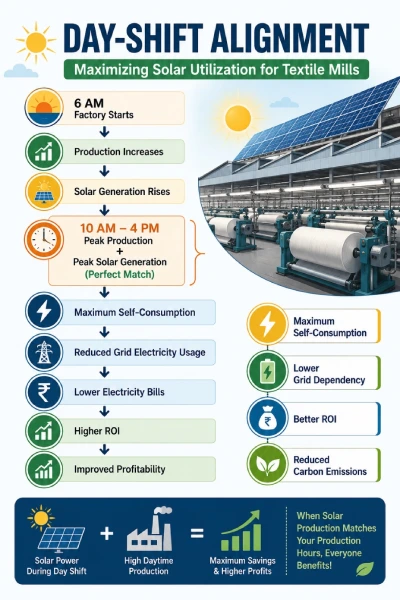
One of the biggest advantages of solar energy for textile manufacturers is the excellent alignment between production schedules and solar power generation. Most textile mills operate primarily during daylight hours when solar panels generate their highest output — maximizing self-consumption without relying on battery storage.
Daytime Production Means Higher Solar Utilization
Solar power generation typically peaks between 9:00 AM and 4:00 PM — coincidentally the busiest production hours for spinning mills, weaving units, garment factories, textile processing plants, and dyeing units. This overlap enables textile businesses to utilize solar electricity immediately, reducing dependence on grid power during periods of maximum energy demand. This high level of direct consumption improves project economics and enhances overall return on investment.
Maximum Self-Consumption
Most of the solar energy generated is consumed instantly by factory operations, minimizing energy wastage and maximizing the financial value of every unit produced.
Lower Grid Dependency
Reduced dependence on utility electricity helps businesses control operating expenses and manage future tariff increases effectively.
Better Return on Investment
Higher self-consumption generally improves the financial performance of industrial solar projects by maximizing the value of each unit of electricity generated.
Stable Energy Costs
Unlike grid electricity tariffs that may change over time, solar systems provide a long-term source of predictable energy, making production cost planning easier.
Improved Sustainability
Solar adoption supports corporate sustainability initiatives by reducing carbon emissions and promoting cleaner manufacturing practices.
Long Asset Life
High-quality industrial solar systems deliver reliable performance for 25+ years with proper operation and maintenance support.
| Time | Factory Activity | Solar Output |
|---|---|---|
| 6:00 AM | Startup | Low |
| 8:00 AM | Production Begins | Increasing |
| 10:00 AM | Full Production | High ☀ |
| 12:00 PM | Peak Operations | Peak Generation ☀☀ |
| 2:00 PM | Continuous Production | High ☀ |
| 4:00 PM | Production Continues | Moderate |
| 6:00 PM | Shift Ends | Low |
Solar Solutions for Textile Mills
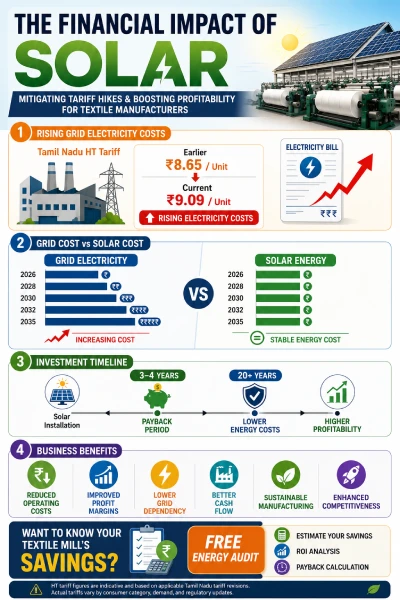
Textile manufacturers have different infrastructure, land availability, energy consumption patterns, and investment goals. NST Global Solar designs customized solutions based on your factory's energy profile, electricity tariff, available installation area, and future expansion plans.
Rooftop Solar for Textile Mills
The most popular choice for textile industries with large factory buildings. Unused roof area becomes a valuable asset generating electricity throughout the day without affecting production.
- Utilizes existing roof space — no additional land required
- Lower electricity bills with faster installation
- Minimal disruption to ongoing operations
- Easy maintenance & excellent ROI
- Environmentally friendly
Ground Mounted Solar Systems
Ideal for textile companies with available land near their manufacturing facilities. Allows larger installation capacities and provides easier maintenance access.
- Suitable for large MW-scale projects
- Higher generation potential
- Easier cleaning and maintenance
- Flexible panel orientation
- Future expansion possibilities
Open Access Solar
Enables textile industries to source renewable energy from an off-site solar power plant without installing panels at the factory — especially attractive for factories with limited rooftop space.
- No rooftop limitations
- Large-scale energy procurement
- Competitive energy costs
- Reduced dependence on conventional power
- Long-term tariff stability
Captive Solar Power Plants
Developed specifically for the electricity consumption of a single industrial consumer or a group of associated consumers, offering greater control over energy costs.
- Dedicated renewable power source
- Greater control over energy costs
- Ideal for large spinning mills
- Suitable for multi-unit industrial groups
- Best for high-consumption textile parks
| Requirement | Recommended Solution |
|---|---|
| Large Rooftop Available | Rooftop Solar |
| Vacant Industrial Land | Ground Mounted Solar |
| Very High Electricity Consumption | Open Access Solar |
| Multiple Factory Locations | Open Access Solar |
| Large Manufacturing Campus | Captive Solar |
| Future Capacity Expansion | Ground Mounted or Open Access |
Financial Benefits & ROI for Textile Industries
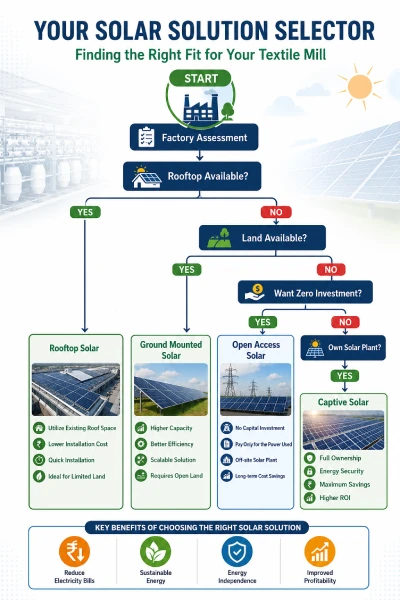
Solar energy is not merely an environmental initiative — it is a strategic financial investment that can significantly reduce long-term operating costs. Electricity accounts for a major share of textile production expenses. By generating power on-site, businesses can improve profitability while protecting themselves from future tariff increases.
Lower Monthly Electricity Bills
Generating electricity through solar reduces dependence on utility power during daytime operations, substantially cutting monthly electricity expenses while maintaining uninterrupted production.
25-Year Price Protection
Electricity tariffs generally rise over time. Solar power provides a predictable source of energy for 25 years or more, helping businesses stabilize production costs and improve financial planning.
Increased Profitability
Lower operating costs directly improve profit margins. Savings generated through solar can be redirected toward production expansion, new machinery, automation, R&D, and working capital.
Better Cash Flow
Lower electricity expenses improve monthly cash flow, allowing businesses to invest in growth rather than recurring utility costs.
ROI for Textile Mills
Industrial solar projects are among the most attractive long-term investments for textile manufacturers because of their consistent daytime electricity consumption. Actual returns depend on plant size, electricity tariff, consumption pattern, financing model, and solar generation — well-designed systems deliver strong long-term financial value through sustained reductions in energy costs.
Typical Factors Influencing ROI
- Current electricity tariff
- Connected load & maximum demand
- Annual energy consumption
- Available rooftop or land area
- Solar irradiation at site
- Plant performance ratio (PR)
- Operation and maintenance practices
- Self-consumption percentage
Why ROI Is Strong in Textile Industries
Unlike many businesses with variable energy usage, textile factories typically maintain steady daytime operations. This means: higher solar utilization, lower export of excess power, better energy offset, faster realization of savings, and improved long-term project economics.
Factors That Influence Solar Savings
Several operational factors determine the overall savings achieved from a solar installation:
💸 Electricity Tariff
Higher industrial tariffs generally increase the financial benefit of solar power.
⏱ Operating Hours
Factories operating primarily during daylight hours maximize direct solar consumption.
🏗 Available Installation Area
Larger rooftop or ground space enables greater solar capacity and increased energy generation.
⚙ Equipment Efficiency
High-quality solar modules, inverters, and mounting structures improve system performance over the project's lifetime.
🔧 Maintenance Quality
Regular cleaning, inspections, and preventive maintenance help maintain optimal energy production.
📡 SCADA Monitoring
Real-time monitoring allows rapid identification and correction of performance issues, minimizing energy losses.
| Factory Size | Suggested Evaluation |
|---|---|
| Small Textile Unit | Rooftop feasibility assessment |
| Medium Manufacturing Unit | Detailed energy audit and customized sizing |
| Large Textile Mill | Hybrid evaluation including rooftop, ground-mounted, or open-access options |
| Integrated Textile Park | Multi-MW renewable energy strategy |
The final system capacity should always be determined through a professional site survey and energy analysis.
Our Solar Installation Process
A structured installation process ensures safe execution, reliable performance, and long-term system efficiency for your textile facility.
Energy Audit
We analyze your electricity bills, connected load, maximum demand, production schedule, and existing electrical infrastructure to identify the most suitable solar capacity and solution.
Site Survey
Our engineering team conducts a comprehensive site inspection to evaluate roof condition, structural strength, available installation area, shading analysis, cable routing, and electrical integration points.
System Design
Based on the survey, we prepare a customized engineering design covering solar capacity, module layout, inverter sizing, cable routing, mounting structure, safety systems, and SCADA integration.
Commercial Proposal
A detailed proposal outlines project scope, estimated generation, technical specifications, financial analysis, implementation schedule, and warranty information.
Engineering & Procurement
Once approved, we procure high-quality components from trusted manufacturers and prepare the site for installation.
Professional Installation
Experienced engineers install solar modules, inverters, mounting structures, AC/DC protection systems, monitoring equipment, and earthing & lightning protection — all following applicable electrical and safety standards.
Testing & Commissioning
Before handover, we perform comprehensive testing to verify electrical safety, system performance, inverter operation, monitoring functionality, grid synchronization, and generation output.
SCADA Integration
The solar plant is integrated with a SCADA monitoring platform, enabling real-time visibility into energy generation, plant performance, equipment status, fault alerts, and historical trends.
Training & Handover
Our team provides operational training to your staff and hands over all relevant documentation, including system manuals, warranties, and maintenance guidelines.
SCADA Monitoring for Textile Solar Plants
SCADA (Supervisory Control and Data Acquisition) enables textile manufacturers to monitor their solar power plant in real time, helping maximize energy generation, detect faults early, and improve long-term plant performance. Even minor issues like inverter faults, module soiling, or communication errors can reduce generation and impact financial returns.
What Does SCADA Monitor?
Our SCADA platform tracks every critical parameter of your solar plant:
⚡ Energy Generation
- Daily generation
- Monthly generation
- Annual generation
- Lifetime energy production
🔧 Inverter Performance
- AC Output
- DC Input
- Conversion Efficiency
- Operating Status
- Fault Codes & Temperature
🔌 Solar String Performance
- Underperforming strings
- Cable faults
- Module mismatch
- Voltage variations
- Current imbalance
🌤 Environmental Data
- Solar Irradiance
- Ambient Temperature
- Module Temperature
- Weather Conditions
🔔 Plant Health Alerts
- Communication failures
- Inverter shutdowns
- Grid interruptions
- Low generation alarms
- Performance deviations
Energy Generation Monitoring
Track daily, monthly, annual, and lifetime energy production in real time. Compare actual generation against targets and historical benchmarks.
Inverter Performance Tracking
Monitor AC output, DC input, conversion efficiency, operating status, fault codes, and temperature for every inverter in the plant.
String-Level Monitoring
Identify underperforming strings, cable faults, module mismatch, voltage variations, and current imbalance at the individual string level.
Weather Station Integration
Monitor solar irradiance, ambient temperature, module temperature, and weather conditions to accurately evaluate plant performance against available energy.
Instant Fault Alerts
Receive immediate notifications for communication failures, inverter shutdowns, grid interruptions, low generation, equipment alarms, and performance deviations.
Remote Access on Any Device
Authorized users can access complete plant performance data via desktop, laptop, tablet, or mobile phone — from anywhere, at any time.
| SCADA Benefit | Business Impact |
|---|---|
| Early Fault Detection | Minor issues identified before they become major failures |
| Reduced Downtime | Immediate notifications enable faster maintenance response |
| Better Performance Analysis | Historical data identifies seasonal trends & optimization opportunities |
| Higher Plant Availability | Continuous monitoring maximizes operational uptime |
| Improved Decision Making | Performance reports support management evaluation of ROI |
Preventive Maintenance for Textile Solar Plants
Preventive maintenance keeps industrial solar plants operating safely and efficiently by identifying potential issues before they affect energy generation. A well-maintained solar plant produces more energy, experiences fewer failures, and provides better long-term financial returns.
Visual Inspection
- Solar modules & mounting structures
- Fasteners & junction boxes
- Cable trays & earthing systems
Module Cleaning
Professional cleaning schedules customized for local weather, dust conditions, industrial pollution, and seasonal factors to maximize light absorption and daily energy production.
Electrical Inspection
- Cable connections & AC/DC panels
- Inverters & earthing
- Surge protection devices & isolators
Thermal Scanning
Infrared inspections identify loose electrical connections, hotspots, overheated components, and potential failures before they cause energy losses or equipment damage.
Torque Tightening
Mechanical fasteners are checked and tightened according to manufacturer specifications to maintain structural stability through all weather conditions.
Performance Verification
Our engineers compare actual plant generation against expected performance to identify deviations requiring corrective action before significant losses occur.
Corrective Maintenance Services
When faults occur, prompt corrective maintenance minimizes downtime and protects energy generation. Our corrective maintenance services include:
- Inverter troubleshooting & repair
- Module replacement
- Fuse & cable repairs
- Junction box repairs
- Connector replacement
- Communication troubleshooting
- SCADA fault rectification
- Earthing repairs
Performance Ratio (PR) Monitoring
Performance Ratio (PR) is one of the most important indicators of a solar power plant's operational efficiency. It compares the actual energy generated with the theoretical energy that could have been produced under ideal conditions — providing a standardized way to evaluate system performance while accounting for environmental variations.
Why Performance Ratio Matters
Monitoring PR helps identify equipment degradation, inverter inefficiencies, module soiling, shading issues, electrical losses, and maintenance requirements before significant generation losses occur.
Factors Affecting PR
- Solar irradiance — available sunlight directly impacts energy generation
- Module temperature — higher temperatures can reduce module efficiency
- Dust and soiling — accumulated dirt reduces sunlight reaching solar cells
- Partial shading — nearby structures or equipment can decrease output
- Inverter efficiency — efficient power conversion minimizes electrical losses
- Cable losses — proper system design helps reduce transmission losses
- Equipment age — regular inspections monitor gradual performance changes over the system's operational life
O&M Services Included
- Preventive & corrective maintenance
- 24×7 SCADA monitoring
- Performance analysis & reporting
- Remote diagnostics
- Module cleaning & thermal imaging
- Inverter servicing & electrical testing
- Performance reporting
Benefits of Professional O&M
Improved plant reliability · Higher annual energy generation · Longer equipment life · Reduced operational risk · Better financial returns · Lower unexpected maintenance costs
Solar Plant Operation & Maintenance (O&M)
Industrial solar installations require ongoing technical support to maintain high performance over their operational lifespan. NST Global Solar provides comprehensive O&M services covering inspection, monitoring, maintenance, reporting, and technical support.
Our O&M Services Include
- Preventive Maintenance
- Corrective Maintenance
- SCADA Monitoring
- Performance Analysis
- Remote Diagnostics
- Module Cleaning
- Thermal Imaging
- Inverter Servicing
- Electrical Testing
- Performance Reporting
Benefits of Professional O&M
- Improved plant reliability
- Higher annual energy generation
- Longer equipment life
- Reduced operational risk
- Better financial returns
- Lower unexpected maintenance costs
Remote Monitoring Capabilities
Authorized users can access complete plant performance data from anywhere using:
- Desktop computer
- Laptop
- Tablet
- Mobile Phone
This enables plant managers and facility teams to monitor solar generation remotely at any time.
Why Choose NST Global Solar & Wind Energy?
NST Global Solar combines engineering expertise, industry knowledge, and comprehensive lifecycle support to deliver reliable solar solutions for textile manufacturers across Tamil Nadu. Our approach focuses on designing systems that align with each client's operational needs, energy profile, and long-term business objectives.
Industrial Solar Expertise
We specialize in commercial and industrial solar projects for energy-intensive sectors, including textile manufacturing across Tamil Nadu.
Customized Engineering
Every project begins with a detailed assessment of energy consumption, available installation space, operational requirements, and future expansion plans.
End-to-End EPC Services
Our team manages the complete project lifecycle from energy audit and site survey through to engineering, installation, commissioning, SCADA integration, and O&M.
Quality Components
We use high-quality components selected for long-term reliability, performance, and compatibility with industrial operating conditions.
Dedicated Technical Support
Our support team assists clients with remote monitoring, technical guidance, preventive maintenance, corrective maintenance, and performance optimization.
Transparent Project Execution
We maintain clear communication throughout the project, providing regular updates and detailed documentation at every stage.
Industries We Serve
Our industrial solar solutions are suitable for a wide range of textile and manufacturing businesses across Tamil Nadu.
Spinning Mills
High daytime load
Weaving Mills
Continuous operations
Knitting Units
Large floor area
Dyeing Plants
Process heat & power
Textile Processing
Multi-system loads
Garment Factories
Rooftop solar ideal
Integrated Parks
MW-scale potential
Yarn Manufacturers
Energy-intensive
Engineering Industries
Industrial load
Food Processing
Daytime operations
Packaging & Pharma
Roof & ground solar
Service Areas
NST Global Solar serves industrial clients across Tamil Nadu, with a strong focus on the state's major textile manufacturing regions. We also undertake industrial solar projects throughout Tamil Nadu based on project requirements.
- Coimbatore
- Tiruppur
- Erode
- Karur
- Palladam
- Avinashi
- Pollachi
- Salem
- Namakkal
- Dindigul
- Madurai
- Hosur
- Trichy
- Chennai
- Ranipet
- Vellore
- Sivakasi
- Virudhunagar
- Tirunelveli
- Tuticorin
- Cuddalore
- Villupuram
- Thanjavur
- Kumbakonam
Ready to Reduce Your Textile Mill's Electricity Costs?
Whether you operate a spinning mill, weaving unit, dyeing plant, or integrated textile manufacturing facility, our team can help you evaluate the right solar solution for your business.
Request a Free Energy Audit
Request a free energy audit to understand your current power consumption, identify the most suitable solar configuration, and receive a customized proposal tailored to your operational requirements. Contact our team to schedule your assessment — we'll review your electricity consumption, conduct a site survey, evaluate suitable solar options, and prepare a customized proposal aligned with your business requirements.