Introduction: The Contract That Will Govern Your Energy Costs for the Next 20 Years
Most industrial energy buyers in India think of a Power Purchase Agreement the way they think of a mobile phone plan — you pick a tariff, sign a form, and electricity arrives. If something goes wrong, you call customer service.
That instinct is dangerously wrong.
A Power Purchase Agreement is not a utility subscription. It is a long-term financial contract — typically 20 to 25 years in duration — that specifies in precise legal language how much electricity will be generated, at what price it will be sold, who bears the risk when generation falls short, what happens when the grid fails, how disputes are resolved, and under what conditions either party can exit.
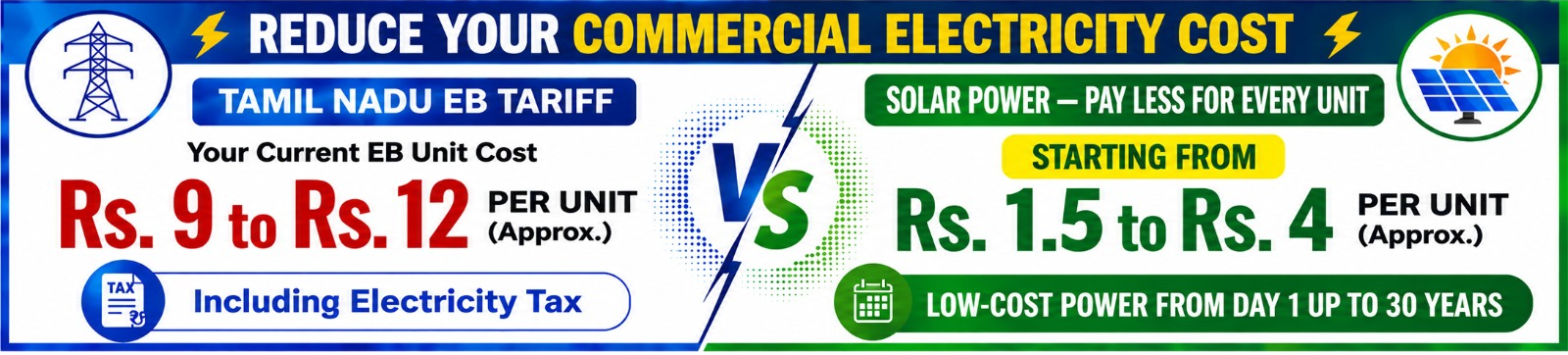
Get a PPA right, and your business locks in electricity at ₹3–₹5/kWh for two decades while your competitors continue paying ₹9–₹12/kWh to TANGEDCO or MSEDCL and absorbing every tariff revision the regulator approves. Get it wrong — with a poorly structured tariff escalation clause, an undefined curtailment compensation provision, or an unrealistic CUF guarantee — and you may find yourself either overpaying, under-supplied, or legally bound to a contract that no longer serves your interests.
This guide is for the CFO who needs to understand what their legal team is reviewing, the plant manager who needs to know what they are committing to operationally, and the finance controller who needs to model the savings accurately over a 20-year horizon.
We cover everything: the five parties in a PPA transaction, the seven sections every contract must contain, tariff structures with worked examples, take-or-pay mechanics, Tamil Nadu-specific banking and wheeling rules, risk allocation frameworks, eight clauses every offtaker must negotiate, and a clear decision framework for choosing between a PPA, outright ownership, and a BOOT arrangement.
What you will learn in this guide:
- Who the five parties in a PPA transaction are and what each one does
- The seven essential sections of every PPA contract
- How tariff structures work — with a ₹ worked example over 20 years
- Take-or-pay mechanics and what happens when your factory shuts down
- Tamil Nadu-specific banking, wheeling, and open access rules
- The complete risk allocation matrix for C&I PPAs in India
- Eight contract clauses every offtaker must negotiate before signing
- On-site vs off-site (open access) PPA: which is right for you
- Virtual PPAs and why Indian corporates are starting to use them
- PPA vs CAPEX vs BOOT: a practical decision framework
What Is a Power Purchase Agreement? The Plain-Language Definition
A Power Purchase Agreement (PPA) is a contract between an electricity generator (an IPP, a RESCO, or a solar developer) and an electricity buyer (an industrial company, a commercial building, a housing society, or a government utility) that establishes the terms under which the generator will supply electricity and the buyer will purchase it over a defined period.
The generator agrees to build, own, and operate a power plant — solar, wind, or hybrid — and supply electricity from that plant to the buyer. The buyer agrees to pay a specified tariff per unit (₹/kWh) for the electricity consumed, for the duration of the contract.
Neither party changes ownership of the electricity infrastructure during the PPA. The generator owns the plant throughout. The buyer owns nothing — but receives affordable, clean electricity without having to invest capital or manage a power plant. This is the fundamental economic exchange at the heart of every PPA.
Why PPAs exist: They solve a fundamental mismatch. Renewable energy plants require enormous upfront capital (₹3.5–₹7.5 crore per MW for solar and wind respectively in India today). Industrial companies need electricity, not power plants. They do not want to invest ₹10 crore in a solar farm and manage it for 25 years — they want to run a textile mill or a pharmaceutical plant. The PPA bridges this gap: the developer raises the capital and takes the construction risk; the buyer provides the revenue certainty that makes the developer’s financing possible.
Calculate Your Industry’s Savings Potential
Request a customized industrial electricity savings analysis from our renewable energy experts.
The Five Parties in a PPA Transaction
A PPA is often described as a two-party contract between a generator and a buyer. In reality, a fully structured C&I or open access PPA typically involves five distinct parties, each with specific roles and obligations:
Party 1 — The IPP/Generator/RESCO: The company that develops, builds, owns, and operates the power plant. This is the electricity seller. In the Indian C&I and rooftop solar context, this is typically a RESCO or C&I-focused IPP like NST Solar & Wind Energy. The generator’s obligations under the PPA include delivering the agreed capacity, maintaining the plant, meeting performance guarantees, and managing all regulatory approvals related to the generation asset.
Party 2 — The Offtaker/Consumer: The industrial or commercial company that purchases the electricity. This party’s obligations include paying the PPA tariff on schedule, allowing the generator access to the premises (for on-site PPAs), maintaining the internal electrical infrastructure on the consumer side, and in some cases providing a security deposit or bank guarantee to underwrite their payment obligations.
Party 3 — The Project Lender: The bank or NBFC (IREDA, PFC, REC, SBI, or a commercial bank) that provides the debt financing for the power plant. The lender is not a named party in the PPA itself, but its requirements fundamentally shape the PPA’s structure — because the PPA’s contracted revenue is the primary security for the project loan. Lenders will typically review and approve the draft PPA before providing a sanction letter; they may require specific provisions (such as step-in rights — discussed below) to be included.
Party 4 — The State DISCOM (for banking and wheeling): For open access PPAs, where the power plant is located at a site different from the consumer’s premises, the state electricity distribution company — TANGEDCO in Tamil Nadu — acts as the intermediary through whose grid the power flows. The DISCOM is not a party to the PPA itself, but the consumer and generator must separately comply with the DISCOM’s open access regulations, pay wheeling charges and banking charges, and obtain the necessary open access consents.
Party 5 — The State Electricity Regulatory Commission (SERC): The regulatory body — TNERC in Tamil Nadu, MERC in Maharashtra, MSEDCL in other states — that sets the framework within which PPAs operate. The SERC determines wheeling charges, banking rules, cross-subsidy surcharges, RPO obligations, and the framework tariff that governs captive and open access transactions. Changes in SERC regulations can materially affect PPA economics — a risk that must be addressed in the contract through change-in-law provisions.
The Seven Essential Sections of Every PPA Contract
A well-drafted PPA is a lengthy, detailed document — often 60 to 120 pages including schedules. But its substance is organised around seven essential sections that every offtaker and their legal team must understand before signing.
Section 1: Definitions and Interpretation
Every PPA begins with a definitions section that establishes the precise meaning of terms used throughout the contract. This section may seem routine, but it is actually one of the most consequential parts of the document.
Definitions determine everything. How “Contracted Capacity” is defined determines how much power the generator is obligated to supply — and how much the consumer is obligated to pay for, whether or not they use it. How “Force Majeure” is defined determines which events excuse non-performance. How “Grid Curtailment” is defined determines whether the consumer pays for electricity the generator was prevented from supplying by grid conditions outside both parties’ control.
Terms to scrutinise closely in the definitions section: Contracted Capacity, Contracted Energy, Scheduled Generation, Actual Generation, Capacity Utilisation Factor (CUF), Commercial Operation Date (COD), Force Majeure Event, Grid Curtailment, Change in Law, Interconnection Facilities, and Billing Period.
Section 2: Capacity and Energy Obligations
This section specifies the scale of the commitment: how much generating capacity the IPP will install (in kW or MW), when that capacity will be available (the Commercial Operation Date), and how much energy the generator commits to supply annually or over the contract term.
For solar projects, energy commitments are typically expressed as a minimum CUF (Capacity Utilisation Factor) — the ratio of actual energy generated to the maximum theoretically possible energy if the plant ran at full capacity 24 hours a day, 365 days a year. A CUF guarantee of 19–22% is typical for solar plants in Tamil Nadu, reflecting the realistic generation potential given the state’s solar irradiance levels.
The CUF guarantee is the generator’s performance commitment. If the plant consistently underperforms its guaranteed CUF (due to poor equipment, inadequate maintenance, or design errors), the generator is liable. If it underperforms due to grid curtailment or force majeure, the generator is typically excused.
Section 3: Tariff and Payment Terms
This is the financial heart of the PPA. It specifies the tariff (₹/kWh) the consumer pays, the tariff structure (fixed, escalating, or levelised — detailed in the next section of this guide), the billing cycle (monthly is standard), payment terms (typically net 7 to 30 days from invoice), and the consequences of late payment (interest on overdue amounts, usually at SBI MCLR + 2–3%).
The payment section will also address: how energy is metered (typically by a DISCOM-approved or jointly calibrated revenue-grade meter), how disputes about metered units are resolved, and what happens if the consumer’s load drops significantly (addressed through take-or-pay provisions).
Section 4: Dispatch, Scheduling, and Curtailment
For open access PPAs, this section governs the complex logistics of scheduling power delivery through the state grid. Solar and wind generation is variable — it does not follow a fixed schedule. The generator must submit day-ahead and intra-day generation schedules to the DISCOM’s load despatch centre (SLDC in Tamil Nadu). The consumer’s actual consumption must be matched (as closely as possible) to the generator’s schedule; deviations are settled financially through the state’s deviation settlement mechanism (DSM).
This section also addresses curtailment — what happens when the grid operator instructs the generator to reduce or stop output. As discussed in our IPP Business Model guide, renewable plants have must-run status in India, meaning curtailment should only occur for genuine grid stability reasons. The PPA must specify clearly: when curtailment occurs, is the consumer excused from paying for the energy they did not receive? Is the generator entitled to compensation? Who bears the regulatory risk of curtailment becoming more frequent as the grid fills with renewable capacity?
Section 5: Performance Guarantees and Liquidated Damages
This section establishes the generator’s quantified performance obligations and the financial consequences of failing to meet them.
The standard performance metric is the CUF guarantee. If the generator’s actual annual CUF falls below the guaranteed threshold, the generator must pay the consumer liquidated damages (LDs) — a pre-agreed compensation calculated as the shortfall in energy units multiplied by the difference between the PPA tariff and the consumer’s applicable grid tariff (representing the cost the consumer incurred by having to source replacement power from the grid).
LD provisions protect the consumer. But they must be carefully calibrated — an LD rate that is too punitive may make the project unfinanceable (lenders will be uncomfortable with unlimited downside exposure), while an LD rate that is too low will not adequately compensate the consumer for their loss.
Section 6: Force Majeure
Force majeure provisions excuse both parties from their obligations when performance becomes impossible due to extraordinary events beyond their control — floods, cyclones, earthquakes, wars, pandemics, or government actions that directly prevent project construction or operation.
Two things to watch carefully in force majeure clauses in Indian PPAs: First, the definition must not be too broad. Some generator-drafted PPAs define force majeure to include “grid unavailability” or “equipment delivery delays” — events that are actually the generator’s operational risk, not acts of God. Consumers should push back on these. Second, the duration and consequences must be clear — how long can force majeure continue before either party can terminate the PPA? What happens to the consumer’s energy supply during an extended force majeure period?
Section 7: Termination, Exit, and Transfer Provisions
This section governs how the PPA ends — either at the natural conclusion of the contract term, through early termination by either party, or through a forced transfer event.
Natural termination: At the end of the PPA term (say, 25 years), the generator typically either removes the plant, extends the PPA at renegotiated terms, or (in BOOT structures) transfers the plant to the consumer.
Early termination by the consumer (voluntary): The most contentious clause in most C&I PPAs. If the consumer wants to exit before the contract end — because the business closes, relocates, or changes its energy strategy — they typically must pay a termination payment to the generator. This payment compensates the generator for the contracted revenue it will no longer receive. Termination payments in Indian C&I PPAs are typically calculated as the net present value of the remaining contracted payments, discounted at an agreed rate — which means early exit in the first 5 years of a 20-year PPA can be extremely expensive.
Early termination by the generator: The generator can typically terminate (and seek compensation) if the consumer fails to pay invoices for extended periods, breaches fundamental contractual obligations, or undergoes an insolvency event.
Lender step-in rights: This provision — required by project finance lenders — gives the lender the right to “step in” to the PPA if the generator defaults on its loan obligations. The lender can effectively take control of the generator’s position in the PPA (ensuring the consumer continues receiving power and the revenue stream continues flowing to service the debt) even while the generator entity faces financial difficulties. From the consumer’s perspective, step-in rights provide comfort — they ensure supply continuity even if their generator faces financial stress.
Tariff Structures Decoded: Fixed, Escalating, and Levelised — With a Worked Example
The single most important financial decision in a PPA negotiation is the tariff structure. This choice will determine how much your business pays for electricity over two decades. Yet most offtakers sign PPAs without fully understanding the long-term implications of each structure.
Here is how each structure works — and a worked numerical example that makes the difference concrete.
Fixed Tariff: The tariff is locked at the signing date — say, ₹4.00/kWh — and does not change for the entire PPA term. The consumer pays ₹4.00/kWh in Year 1, Year 10, and Year 20.
Advantage for the consumer: Complete cost certainty. No exposure to tariff escalation. Easiest to budget and model.
Advantage for the generator: Simple to administer. No annual tariff revision calculations.
Risk for the consumer: If grid tariffs fall significantly over 20 years (unlikely given India’s historical trajectory, but theoretically possible), the fixed PPA tariff may eventually look expensive relative to the alternative.
Risk for the generator: Cost inflation (O&M costs, land lease) is not passed through to the consumer. The generator absorbs all inflation risk.
Escalating Tariff: The tariff starts lower (say, ₹3.60/kWh) and escalates by a fixed percentage each year (say, 3% per annum). Year 1: ₹3.60, Year 5: ₹4.05, Year 10: ₹4.84, Year 20: ₹6.49.
Advantage for the consumer: Lower tariff in the early years when the investment needs to be proven. Matches the fact that grid tariffs themselves typically escalate, so the relative savings remain relatively stable.
Advantage for the generator: Provides partial protection against cost inflation. Improves early-year cash flow for debt service.
Risk for the consumer: If the escalation rate is high (4–5% per year), the PPA tariff may eventually approach or exceed the grid tariff in the later years of the contract, eroding savings.
Levelised Tariff: A single flat tariff calculated such that the net present value of all payments over the contract term equals the generator’s required project revenue. Economically equivalent to an escalating tariff, but expressed as a single flat rate for simplicity. Common in government tenders.
Worked Example — Fixed vs Escalating: Which Saves More Over 20 Years?
Assumptions: 1 MW solar plant, 19% CUF (annual generation: 1,664,400 kWh), current TANGEDCO HT tariff: ₹9.50/kWh escalating at 4% per year.
| Year | Grid Tariff (₹/kWh) | Fixed PPA (₹4.00) — Annual Cost | Escalating PPA (₹3.50 + 3%) — Annual Cost | Fixed PPA Saving vs Grid | Escalating PPA Saving vs Grid |
|---|---|---|---|---|---|
| 1 | ₹9.50 | ₹66.6L | ₹58.3L | ₹91.5L | ₹99.8L |
| 5 | ₹11.55 | ₹66.6L | ₹67.4L | ₹125.7L | ₹124.9L |
| 10 | ₹14.05 | ₹66.6L | ₹78.1L | ₹167.0L | ₹155.5L |
| 15 | ₹17.09 | ₹66.6L | ₹90.6L | ₹218.4L | ₹193.8L |
| 20 | ₹20.79 | ₹66.6L | ₹105.1L | ₹279.5L | ₹240.8L |
| Total | — | ₹13.3 Cr | ₹15.8 Cr | ₹38.4 Cr | ₹35.9 Cr |
Note: All figures are illustrative approximations for a 1 MW plant at 19% CUF. Actual savings depend on your specific consumption, contracted capacity, applicable grid tariff category, and open access charges.
What this example shows: In the early years, the escalating tariff appears more attractive. But as the escalation compounds, the fixed tariff becomes cheaper in absolute terms by Year 5 in this example. Over 20 years, the fixed tariff consumer pays ₹2.5 crore less in PPA payments. Both structures deliver substantial savings versus the grid — ₹35–38 crore over 20 years for a 1 MW plant in this scenario.
The right choice depends on your cost of capital (a business with expensive working capital financing may prefer lower early payments), your view on grid tariff escalation, and your CFO’s preference for certainty vs. optimisation.
Take-or-Pay vs Pay-as-Produced: The Clause That Matters Most When Your Factory Shuts Down
One of the most misunderstood — and most consequential — provisions in a PPA is the take-or-pay obligation.
In a take-or-pay PPA, the consumer commits to pay for a minimum volume of electricity each year — the “contracted energy” — regardless of whether they actually consume that much. If a factory shuts for a month due to a market downturn, a labour dispute, or planned maintenance, and the solar plant continues to generate electricity during that period, the consumer still owes the generator for the contracted units.
This is not exploitation by the generator. It is a commercial necessity. The generator has structured its financing around the assumption that contracted revenue will be received. Its lenders require this certainty. Without a take-or-pay obligation, the generator cannot achieve financial close, which means the plant cannot be built, which means the consumer gets no PPA at all.
How take-or-pay is calculated: Typically, the annual contracted energy is set at approximately 80–90% of the plant’s expected annual generation at the guaranteed CUF. The consumer pays for this volume at the contracted tariff, regardless of actual consumption. Any generation above this floor is paid for at the contracted tariff when actually consumed (or may be banked, depending on state regulations).
Shadow tariff: Some PPAs use a “shadow tariff” mechanism where the take-or-pay obligation is expressed not as energy units but as a minimum annual payment. If the consumer’s actual consumption generates less than this payment, they pay the difference as a capacity charge. This is common in complex PPA structures and requires careful legal drafting.
What happens if your factory shuts for an extended period: This is the scenario that most offtakers fail to model before signing. If your factory closes for 3 months (say, during a COVID-style shutdown, or a major renovation), and the PPA has a take-or-pay clause, you owe the contracted energy payment for those months even though you consumed nothing. Mitigations to negotiate: a grace period (30–60 days of non-consumption without penalty), a force majeure carve-out for extended operational shutdowns, or a cap on annual take-or-pay liability.
Pay-as-produced PPAs: Some RESCO developers — particularly for smaller rooftop installations — offer purely pay-as-produced structures where the consumer pays only for what they consume. This eliminates take-or-pay risk for the consumer but typically results in a higher tariff, since the generator absorbs more revenue risk. Pay-as-produced PPAs are also harder to finance through project debt, which is why this structure is less common for larger installations.

Banking and Wheeling in Tamil Nadu: How Open Access PPAs Actually Work on the Ground
For industrial consumers in Tamil Nadu sourcing solar power from an off-site plant through open access — the fastest-growing PPA segment in the state — the economics are determined not just by the PPA tariff, but by the additional charges TANGEDCO levies on every unit of power wheeled through its grid.
Understanding these charges is essential to calculating your true effective cost of solar power under an open access PPA.
Wheeling Charges: The fee paid to TANGEDCO for using its transmission and distribution infrastructure to carry electricity from the solar plant to the consumer’s premises. Wheeling charges in Tamil Nadu are revised periodically by TNERC. As of the most recent TNERC tariff order, wheeling charges for HT consumers accessing power through 33 kV and above infrastructure are in the range of ₹0.70–₹1.20/kWh (depending on voltage level). These charges are paid by the consumer.
Banking Charges: Tamil Nadu’s open access regulations permit solar generators to “bank” surplus generation with TANGEDCO — effectively storing excess units in a virtual account when generation exceeds consumption, and drawing them down when consumption exceeds generation (at night or on cloudy days). Banking charges apply on the units banked, typically 2% of banked units (i.e., TANGEDCO retains 2 units for every 100 units banked, as a service fee). Banking is subject to specific rules: banking periods (typically monthly or annually), voltage-level eligibility, and limits on the total banked quantum.
Cross-Subsidy Surcharge (CSS): This is the most significant additional charge for open access consumers in Tamil Nadu. It is levied to compensate TANGEDCO for the cross-subsidy it provides to lower-tariff consumer categories (agricultural, domestic) that would otherwise need to be recovered from HT industrial consumers. CSS in Tamil Nadu for HT consumers has historically been a significant component of the effective cost of open access power. However, under the Green Energy Open Access Rules 2022, renewable energy open access consumers are entitled to a concession on CSS, making green open access more attractive relative to conventional open access.
Additional Surcharge (AS): A further charge that some states levy to cover the fixed cost obligations of DISCOMs to their contracted generating stations (fixed costs that they still incur even when HT consumers move to open access). The applicability and quantum of AS in Tamil Nadu has been a contested regulatory issue.
Transmission and Distribution (T&D) Losses: When calculating the units the consumer can consume from an open access solar plant, a percentage deduction for T&D losses must be applied. This means the generator must produce slightly more than the consumer’s demand to net the consumer’s full contracted units after loss deductions. T&D loss percentages are determined by TNERC for each voltage level and location.
The effective open access cost equation:
Effective cost (₹/kWh) = PPA tariff + Wheeling charge + Banking charge (amortised) + CSS + AS + T&D loss adjustment
For a Tamil Nadu HT consumer, the effective cost of solar power under a well-structured open access PPA — inclusive of all charges — typically works out to ₹5.50–₹7.00/kWh, compared to the applicable TANGEDCO HT tariff of ₹9.00–₹11.50/kWh. The savings are real and substantial, but they are smaller than the raw PPA tariff comparison would suggest. This is why having an energy advisor who can model the full open access cost stack for your specific consumer category, voltage level, and consumption profile is essential before signing.
Calculate Your Industry’s Savings Potential
NST’s team provides detailed open access cost modelling for Tamil Nadu industrial consumers as part of our consultation process.
The Risk Allocation Matrix for C&I PPAs in India
A PPA is fundamentally a contract about risk allocation. Every risk that exists in a 20-year electricity supply arrangement must land somewhere — on the generator, the consumer, or be shared between them. The table below summarises how major risks are typically allocated in Indian C&I solar PPAs.
| Risk Category | Who Typically Bears It | Notes |
|---|---|---|
| Generation performance below CUF guarantee | Generator | Generator pays LDs for shortfall |
| Grid curtailment (must-run breach) | Typically shared | Consumer excused from payment; generator seeks SERC recourse |
| Equipment failure (within warranty) | Generator (via EPC warranty) | Typically 2–5 years on major components |
| Equipment failure (post-warranty) | Generator | Generator’s O&M obligation and insurance |
| Module degradation beyond guaranteed rate | Generator | Annual CUF guarantee accounts for degradation |
| Transmission/evacuation failure (grid side) | Consumer/DISCOM | Consumer cannot claim LD for grid-side failure |
| Change in law — new taxes/levies on generator | Generator (unless pass-through clause) | Negotiate pass-through for material changes |
| Change in law — new open access regulations | Consumer (with notification right) | Consumer must absorb regulatory charge changes |
| DISCOM financial failure / delayed banking settlement | Consumer | Consumer cannot stop PPA payments due to DISCOM delays |
| Force majeure — natural disasters | Neither party (excused) | Both excused; long-term FM may trigger termination rights |
| Consumer load falling below contracted offtake | Consumer | Take-or-pay obligation applies |
| Consumer premises closure / relocation | Consumer | Termination payment applies unless negotiated |
| Currency risk (for ECB-financed projects) | Generator (unless tariff linked to USD) | Negotiate INR-denominated tariffs to eliminate currency exposure |
| Inflation on generator’s O&M costs | Generator (fixed tariff) or Shared (escalating tariff) | Tariff structure determines risk allocation |
| Land acquisition / lease expiry | Generator | Generator must maintain land rights for full PPA term |
| Counterparty default by consumer | Generator (bears credit risk) | Mitigated by security deposit / bank guarantee |
This matrix is a negotiating tool. Before signing any PPA, your team should go through each risk category, identify where it has been allocated in the draft contract, and assess whether that allocation is fair and manageable for your business.
Eight Clauses Every Offtaker Must Negotiate Before Signing
Most PPA negotiations in India’s C&I segment are driven by the generator’s standard template. The generator’s legal team has drafted hundreds of these; the consumer’s team may be seeing the first one. This power asymmetry means that without proactive negotiation, the standard template will be signed — and the standard template is, predictably, more favourable to the generator.
Here are the eight clauses where negotiation effort yields the highest return for the consumer:
Clause 1 — Tariff escalation cap: If you are accepting an escalating tariff, insist on a cap (say, maximum 3% per year, regardless of the generator’s proposed schedule). An uncapped escalating tariff can become genuinely expensive in later years.
Clause 2 — Minimum CUF guarantee level: Push the generator to a higher CUF commitment than their initial proposal. Generators will propose conservative CUF guarantees to minimise their LD exposure; consumers benefit from pushing these higher (with appropriate LD consequences for shortfall). Request historical CUF data for comparable projects in the same region.
Clause 3 — Termination liability cap: The generator’s template will typically expose you to the full NPV of remaining contracted payments if you terminate early. Negotiate a declining termination payment schedule (higher in early years when the generator has more debt outstanding, declining to near-zero in the final years of the contract when debt is repaid and capital is recovered).
Clause 4 — Step-in rights for lenders: These are required by the generator’s lenders and protect your supply continuity. Ensure the step-in provision is structured so that the incoming lender (stepping into the generator’s role) inherits all of the generator’s obligations — not just its rights.
Clause 5 — Change-in-law pass-through: Negotiate clearly which regulatory changes can be passed through to your tariff. Generators typically want to pass through any increase in their costs arising from regulatory change. Consumers should push for: a materiality threshold (only changes above a specified ₹/kWh impact get passed through), a cap on total pass-through, and a corresponding benefit-pass-through (if regulations change in a way that reduces the generator’s costs, those savings must also flow through to the consumer’s tariff).
Clause 6 — Grid curtailment compensation: If the grid curtails the solar plant’s output, the consumer does not receive the energy they expected. The contract must specify clearly: the consumer is not obligated to pay for curtailed energy, and the generator’s take-or-pay entitlement adjusts downward by the curtailed volume. Without this explicit language, take-or-pay liability can persist even during curtailment periods.
Clause 7 — Force majeure — operational shutdown carve-out: Negotiate a specific carve-out that suspends the consumer’s take-or-pay obligations during periods when the consumer’s premises are closed due to events beyond the consumer’s control (natural disasters, government-mandated closures, severe economic conditions leading to temporary plant closure). Without this, the consumer pays for energy they physically cannot consume.
Clause 8 — Dispute resolution mechanism: Indian contract law allows parties to agree on arbitration as the dispute resolution mechanism (faster and more private than courts). Ensure the PPA specifies: the seat of arbitration (Chennai or another specified city), the governing law (Indian law), the arbitration rules (typically ICADR or ad hoc under the Arbitration and Conciliation Act 1996), and the number of arbitrators (one or three). A PPA with a vague dispute resolution clause will end up in court — a slow, expensive, and unpredictable process for both parties.
On-Site PPA vs Off-Site (Open Access) PPA: Which Is Right for You?
Not all solar PPAs work the same way physically. The two primary structural options are on-site and off-site (open access) PPAs, and they differ significantly in regulatory requirements, cost structure, and who they are suitable for.
On-Site PPA (Rooftop or Ground-Mount on Consumer Premises):
The solar plant is installed on the consumer’s rooftop, carport, or unused land within the factory premises. Power flows directly from the panels to the consumer’s internal electrical system — no TANGEDCO grid is involved for the primary energy supply (though a net metering or grid backup connection typically exists).
Regulatory requirements: Net metering registration with TANGEDCO (straightforward for most installations under 1 MW); no open access application required; no wheeling, CSS, or AS charges apply to the direct-consumed units.
Best for: Factories, warehouses, or commercial buildings with sufficient rooftop or land area relative to their daytime electricity consumption, and where the building owner is willing to allow the RESCO/IPP to install and own equipment on their premises for 20+ years.
Limitation: The solar generation cannot exceed the consumer’s own daytime consumption in any practical PPA sense (excess generation may be exported to the grid at a low feed-in tariff, but this does not drive PPA economics). Large-scale energy consumers (MW-scale) may not have sufficient on-site area to meet all their electricity needs from on-site solar alone.
Off-Site Open Access PPA:
The solar plant is installed at a location separate from the consumer’s premises — typically a ground-mounted farm in a high-irradiance location. Power is wheeled through TANGEDCO’s grid under an open access arrangement.
Regulatory requirements: Open access application to TANGEDCO (eligibility: typically 100 kW and above for renewable energy consumers under the Green Energy Open Access Rules 2022); SLDC scheduling obligations; payment of wheeling, banking, CSS, and AS charges as applicable; adherence to deviation settlement mechanism rules.
Best for: Large energy consumers (typically 500 kW and above) who want to source renewable energy in quantities larger than their on-site infrastructure can accommodate, or who are in leased premises where on-site installation is not feasible.
Advantage: Access to utility-scale solar sites with higher CUF (due to optimal orientation and tilt, no shading) and lower capex per MW (economies of scale). Also allows the consumer to diversify their sourcing — combining on-site and off-site solar, or solar and wind, for better hourly generation profiles.
Limitation: The full open access charge stack (wheeling + CSS + AS + losses) reduces the net savings versus on-site solar. Regulatory risk (charge changes by TNERC) can affect economics over the PPA term.
The hybrid approach: Many large industrial consumers in Tamil Nadu run both — an on-site rooftop or small ground-mount PPA for day-load matching (no grid charges), and a larger off-site open access PPA for the bulk of their energy needs. This combination optimises savings across the regulatory cost structure.
Virtual PPAs: What They Are and Why Indian Corporates Are Starting to Use Them
A Virtual PPA (VPPA) — also called a Financial PPA or Contract for Differences — is a fundamentally different structure from the physical PPAs described so far. In a VPPA, no electricity actually flows from the generator to the consumer. Instead, the two parties enter into a purely financial contract.
Here is how it works: The generator sells its electricity to the market (a DISCOM or the IEX) at the prevailing spot price. Simultaneously, under the VPPA, if the market price is above a pre-agreed “strike price,” the generator pays the difference to the consumer; if the market price is below the strike price, the consumer pays the difference to the generator. The net result is that both parties achieve price certainty — the consumer pays an effective fixed price for green electricity, and the generator receives a predictable revenue stream — without any physical electricity flowing between them.
Why would a consumer enter a VPPA instead of a physical PPA?
The primary reason is geographic flexibility. A physical PPA requires the consumer and generator to be connected (directly or via the grid) in the same state. VPPAs are purely financial — the generator can be in Rajasthan, the consumer in Chennai, and the VPPA can be structured under Indian contract law without any open access regulatory compliance.
VPPAs are particularly relevant for large corporates with multiple facilities across different states, who want to meet their national renewable energy targets (for ESG reporting, RE100 commitments, or BRSR disclosure) through a single agreement with a large renewable generator, rather than negotiating separate physical PPAs for each facility location.
Current status in India: VPPAs remain relatively uncommon in India compared to the US and European markets, where they are the dominant large-corporate renewable energy procurement mechanism. However, as Indian companies face increasing pressure from international customers and investors around Scope 2 emissions, and as the regulatory framework for cross-border power trading matures, VPPAs are gaining traction among large Indian conglomerates, IT companies, and export-oriented manufacturers.
PPA vs CAPEX Ownership vs BOOT: A Practical Decision Framework
A solar PPA is not the only way for an industrial business to access solar energy. The same 1 MW solar plant can be structured in three fundamentally different ways, with very different financial and operational implications.
Option 1 — Long-Term PPA (Zero Capex, Fixed Tariff):
You pay nothing upfront. The RESCO/IPP builds, owns, and operates the plant. You pay a fixed or escalating tariff per unit consumed. At the end of the PPA term, the generator either removes the plant or offers a new contract.
Best for: Businesses that want to preserve capital for their core operations, do not have the in-house capability to manage a power asset, and are comfortable with a 20-year contractual commitment. Also ideal for businesses in leased premises who cannot make capital investments in the landlord’s property.
Option 2 — CAPEX Ownership (Full Ownership, No PPA):
You invest the capital yourself (₹3.5–₹4.5 crore per MW for solar), own the plant outright, and benefit from all generation at zero marginal cost (after the initial investment). You are responsible for O&M, insurance, and regulatory compliance.
Best for: Businesses with available capital (or access to cheap institutional financing), a long-term presence at their premises, and the management bandwidth to oversee a power asset. The returns can be excellent — a well-designed solar plant delivers an internal rate of return of 15–22% on the CAPEX investment, payback in 4–6 years at current Tamil Nadu HT tariffs.
Option 3 — BOOT (Build-Own-Operate-Transfer):
A hybrid structure. The developer builds and owns the plant under a PPA for an agreed period (say, 15 or 25 years), then transfers full ownership to the consumer at the end of that period — typically at zero or nominal cost, since the plant’s value has been recovered through PPA revenue. During the BOOT period, the consumer pays a PPA tariff (as in Option 1). At the end, they own a fully depreciated, O&M-proven power plant.
Best for: Businesses that want the zero-capex benefit of a PPA in the short term but want eventual ownership of their energy infrastructure — particularly relevant for companies that plan to be at their current location for 25+ years and want to retire with a free energy asset.
Quick decision framework:
| Factor | PPA | CAPEX | BOOT |
|---|---|---|---|
| Available capital | Not required | Required | Not required upfront |
| Want plant ownership | No | Yes — immediately | Yes — after BOOT period |
| Lease / owned premises | Both work | Owned premises preferred | Owned premises preferred |
| Internal O&M capability | Not needed | Needed (or outsource) | Not needed during BOOT |
| Certainty of long-term presence | Needed (for term) | Needed | Needed (for full BOOT period) |
| Fastest path to savings | PPA | CAPEX (post-payback) | PPA (then free energy) |
For a detailed comparison of all procurement structures including Group Captive, see our guide on [which renewable model maximises savings for Indian industries](#).
How NST Structures PPAs for Tamil Nadu Industrial Consumers
NST Solar & Wind Energy develops, owns, and operates solar and wind plants across Tamil Nadu and South India, supplying electricity to industrial consumers under transparent, performance-backed PPAs, BOOT agreements, and group captive structures.
What distinguishes our PPA approach:
Tariff transparency: We present clients with a full open access cost model — PPA tariff plus wheeling, banking, CSS, and applicable surcharges — so the effective cost of energy is clear from Day 1, not discovered later. We believe an informed client is the best kind of client.
Performance guarantees with teeth: Our PPAs include CUF-based performance guarantees backed by meaningful liquidated damages — not symbolic LD provisions designed to look good in the contract but have no practical consequence. Because we own and operate the plant ourselves, we stand behind our performance numbers.
Customised tariff structures: We offer fixed, moderately escalating, and levelised tariff structures depending on the client’s financial modelling preferences. We do not force a standard structure on every client.
Tamil Nadu regulatory expertise: Our team has navigated TANGEDCO open access approvals, TNERC regulatory proceedings, and net metering filings across dozens of projects in the state. We understand the practical compliance requirements — and the pitfalls — that general-purpose solar companies from other states often miss.
Flexible term structures: Depending on the client’s tenure, capital position, and long-term strategy, we can structure engagements as 10, 15, or 25-year PPAs, or as BOOT arrangements with a transfer at the client’s preferred horizon.
Request Your Free PPA Assessment
If you would like NST to model the PPA economics for your specific facility — your consumption profile, tariff category, and location in Tamil Nadu — we are happy to provide a detailed, no-obligation assessment.
FAQ’s
Yes, PPAs can be terminated early by either party, but early termination by the consumer almost always involves a termination payment. The quantum varies by contract, but typically represents the net present value of the contracted revenue the generator would lose — meaning early exit in the first 5 years of a 20-year PPA is very expensive, while exit in Year 18 of a 20-year PPA is relatively affordable. Always model your early termination liability before signing, and negotiate a declining termination schedule.
There is no formal credit rating requirement for C&I PPAs in India. However, the generator (and their project lenders) will conduct a credit assessment of the offtaker before finalising the PPA. Indicators they review include: audited financial statements (3 years), profitability and revenue track record, bank references, and existing debt commitments. Businesses with strong, stable financials can typically sign PPAs with minimal security requirements. Less established businesses may be asked for a security deposit (typically 3–6 months of PPA revenue) or a bank guarantee.
Physical PPAs (where electricity actually flows from generator to consumer) are subject to state-specific open access regulations and can only function where the generator’s state grid and the consumer’s state grid are interconnected, and where the relevant SERCs permit the arrangement. Inter-state open access exists under CERC’s interstate transmission framework, but involves additional complexity. Virtual PPAs have no geographic limitation since no physical electricity flows. For most C&I consumers in Tamil Nadu, intra-state PPAs (generator and consumer both in Tamil Nadu) are the simplest and most cost-effective structure.
Yes. The Green Energy Open Access Rules 2022 reduced the minimum open access threshold to 100 kW for renewable energy, making open access PPAs accessible to a much wider range of businesses including MSMEs. For smaller MSMEs with consumption below 100 kW, on-site rooftop PPAs (with no open access requirements) are the appropriate structure. NST works with clients across the MSME spectrum.
In a RESCO or IPP PPA (where the generator owns the plant), the generator handles all regulatory approvals, filings, and compliance related to the generation asset — including open access applications, SLDC scheduling registration, and plant-side metering. The consumer handles their own TANGEDCO HT service connection compliance. Our NST team manages the complete regulatory process for our PPA clients in Tamil Nadu.
This is a legitimate concern, and it is addressed through the lender step-in rights provision described earlier in this guide. If the generator defaults on its project loan, the lender can step in to assume the generator’s position in the PPA, ensuring continued energy supply. Additionally, in the worst case, the consumer may be able to purchase the plant from the lender/insolvency administrator. To protect against this risk: check the financial strength of your PPA counterparty before signing, ensure the PPA includes robust step-in provisions, and verify that the project has been financed by a reputable lender (whose own due diligence provides an additional layer of project quality assurance).
In on-site PPAs, energy is typically metered by a revenue-grade meter installed at the interconnection point between the solar plant’s output and the consumer’s internal distribution system. In open access PPAs, TANGEDCO’s existing HT metering at the consumer’s premises measures total consumption; the open access power is accounted for through the scheduling and deviation settlement mechanism, with the TANGEDCO meter tracking the net consumption from the grid. The PPA should specify the metering arrangement, the meter reading process, how disputes about meter readings are resolved (re-testing, independent calibration), and who bears the cost of meter replacement.
Under a fixed tariff PPA, the tariff cannot increase except through valid change-in-law pass-through provisions. Under an escalating tariff PPA, it increases at the pre-agreed escalation rate each year — but only by that rate, which is fixed at signing. The generator cannot unilaterally increase the tariff. This protection is fundamental to the PPA’s value proposition — cost certainty is the point. However, additional charges levied by TANGEDCO (wheeling, CSS) can change over the PPA term based on TNERC orders, which is why effective open access cost projections should build in conservative assumptions about regulatory charge escalation.
A bank guarantee under a PPA is a financial instrument provided by the consumer’s bank, guaranteeing to the generator that the consumer will meet their payment obligations under the PPA. It is essentially a payment security mechanism. Bank guarantees in Indian C&I PPAs are typically sized at 3–6 months of contracted PPA revenue. Not all PPAs require bank guarantees — financially strong, well-established offtakers may negotiate their way out of this requirement. Bank guarantees have a cost (the bank charges the consumer a guarantee fee, typically 1–2% per annum on the guarantee amount), which should be factored into your effective cost of solar power.
A PPA — whether on-site or open access — supplements your TANGEDCO supply, not replaces it (except in very rare full-supply cases). Your TANGEDCO HT connection remains active for consumption that exceeds your PPA allocation, for night-time consumption (when the solar plant is not generating), and as a backup supply. You continue to pay TANGEDCO’s fixed charges and any applicable demand charges on your HT connection. Your TANGEDCO bill will reflect reduced units consumed from the grid (and therefore lower variable charges), but fixed charges may remain. A complete energy cost model must account for both the PPA savings and the residual TANGEDCO obligations.
Conclusion: A PPA Is a Strategic Decision, Not a Procurement Transaction
An industrial company that signs a well-structured PPA with a credible generator in Tamil Nadu today is locking in electricity at roughly half the current grid tariff — for 20 years, while grid tariffs continue their historical upward march. The financial case is compelling, and for most energy-intensive manufacturers, it is one of the highest-return decisions available in the current business environment.
But a PPA signed without understanding its contract mechanics — its take-or-pay provisions, its change-in-law exposure, its termination payment schedule, its performance guarantee structure — can create obligations that constrain the business for decades.
The purpose of this guide is to ensure that when you sit across the table from a solar energy developer, you understand every provision they are proposing, you know which clauses matter most, and you go into the negotiation with a clear view of what you need to protect.
NST Solar & Wind Energy has structured PPAs and BOOT agreements for industrial clients across Tamil Nadu. Our team can model the full economics of a PPA for your specific situation — tariff, open access charges, take-or-pay mechanics, and 20-year NPV savings — and help you negotiate a contract that genuinely serves your interests.
Get Your Free PPA Assessmen →
The first step is a conversation. Let us model the numbers for your facility.