1. Clear Definition
A Power Purchase Agreement (PPA) in the Indian renewable energy sector is a long-term contract between an electricity generator (the provider) and a Commercial or Industrial (C&I) consumer (the buyer). Under this arrangement, the generator installs, owns, and operates a solar or wind power project, while the consumer agrees to purchase the generated electricity at a pre-determined tariff—typically lower than the prevailing grid utility rate—for a period of 10 to 25 years.
2. Key Facts
- What is it? A financial and operational framework for businesses to transition to green energy with zero upfront capital expenditure (CAPEX).
- Why it matters? It shields businesses from volatile grid electricity price hikes while significantly reducing carbon footprints and meeting ESG (Environmental, Social, and Governance) mandates.
- Who needs it? Large-scale manufacturing units, data centers, hospitals, textile mills, and commercial real-resale assets with high energy loads.
- Key Benefits: Zero investment costs, immediate savings on energy bills, predictable long-term energy pricing, and seamless progress toward net-zero targets.
3. The Changing Landscape of Indian Energy Procurement (2026)
As of 2026, the Indian energy market has shifted from simple rooftop installations to sophisticated “Open Access” and “Virtual” models. The primary driver is the Green EnGreen Energy Open Access Ruleshave lowered the threshold for consumers to access the interstate and intrastate transmission systems. For a C&I consumer, the choice of procurement model depends on available space, load requirements, and the desired level of equity participation.
Understanding the OPEX vs. CAPEX Model
Historically, businesses purchased solar panels outright (CAPEX). Today, the OPEX (Operating Expenditure) model, facilitated through a PPA, is the dominant choice. NST Global Solar & Wind Energy helps businesses leverage this model to avoid the technical risks of maintenance and the high initial costs of hardware.
4. The Group Captive Model: A Strategic Deep-Dive
The Group Captive model is one of the most efficient procurement methods under Indian Electricity Rules. It allows a developer to set up a collective power plant for a group of consumers.
The 26/51 Rule
To qualify as a “Group Captive” user and avail of exemptions from Cross-Subsidy Surcharge (CSS) and Additional Surcharge (AS), the following criteria must be met:
- Equity Participation: The consumer(s) must collectively hold at least 26% of the equity in the generating plant.
- Consumption Mandate: The captive users must consume at least 51% of the energy generated by the plant annually.
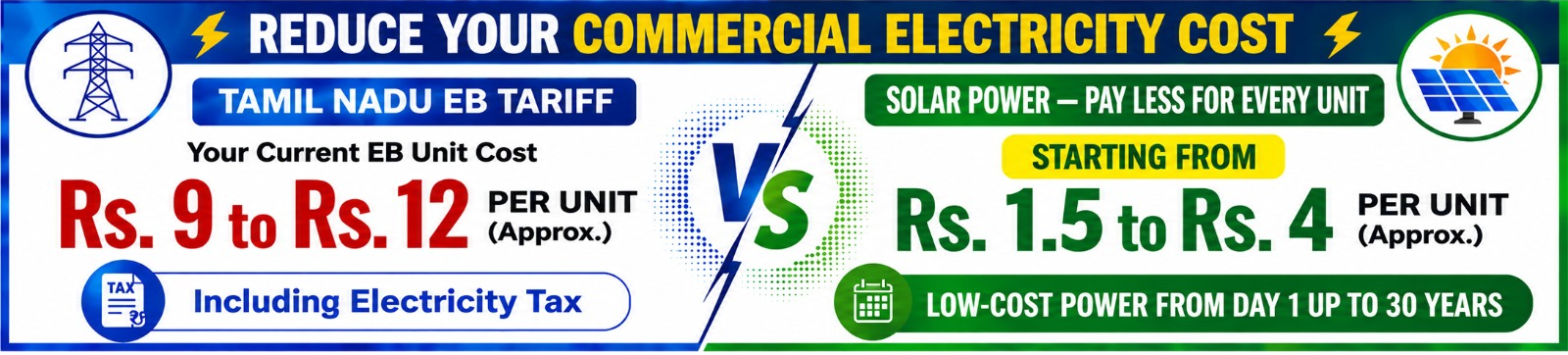
By participating in a Group Captive project, C&I consumers in states like Tamil Nadu can achieve the lowest possible per-unit cost of electricity, often saving 30% to 50% compared to standard DISCOM tariffs.

5. The Rise of the Virtual PPA (VPPA)
A Virtual Power Purchase Agreement is a purely financial contract. Unlike a physical PPA, the “green” electricity does not flow directly to the consumer’s facility. Instead, the consumer pays a fixed price for the power produced by a renewable project, and the project sells that power into the open market (the grid).
Virtual Power Purchase Agreement Example
If a corporation agrees to a VPPA price of ₹4.00/kWh and the market price is ₹4.50/kWh, the generator pays the difference to the corporation. If the market price drops to ₹3.50/kWh, the corporation pays the generator the difference.
VPPA Accounting and Tax Treatment
VPPAs are often treated as derivative financial instruments. For C&I consumers, they provide “Renewable Energy Certificates” (RECs) or “Green Attributes,” which are essential for global sustainability reporting and Carbon Disclosure Project (CDP) scores without requiring physical proximity to the power plant.
6. Hybrid Solar-Wind PPAs: 24/7 Green Energy
Solar power is limited by daylight, and wind power fluctuates seasonally. Hybrid systems combine both technologies into a single PPA. This “smoothing” effect of the generation profile allows industries to meet a higher percentage of their base load with renewable energy. For a 24/7 manufacturing unit, a hybrid PPA reduces the reliance on expensive peak-hour grid power.
7. Step-by-Step Framework for PPA Adoption
- Load Profile Analysis: Analyze 12 months of electricity bills to determine peak and off-peak requirements.
- Feasibility Study: Assess rooftop space for On-Site PPAs or grid connectivity for Off-Site/Open Access.
- Model Selection: Choose between Physical PPA, Group Captive, or Virtual PPA based on tax and balance sheet preferences.
- Contract Negotiation: Finalize the tariff, escalation clauses (if any), and “buy-out” options.
- Commissioning & Monitoring: The developer installs the plant, and energy flow is tracked via net metering or open access meters.
8. Use Cases and Real-World Examples
- Textile Industry (Tamil Nadu): A spinning mill utilizes a 5MW Wind-Solar Hybrid Group Captive model to offset 80% of its energy needs, bypassing the high industrial tariffs of the state utility.
- IT Parks (Bangalore/Chennai): Utilizing Virtual PPAs to claim 100% renewable energy usage for global clients while continuing to draw physical power from the local grid for stability.
9. FAQ
In a Solar PPA, the consumer pays for the actual energy (kWh) generated. In a Solar Lease, the consumer pays a fixed monthly “rent” for the equipment regardless of how much energy it produces.
No, a standard Solar PPA is an OPEX model with zero upfront investment. The developer bears all costs for equipment, installation, and maintenance.
An escalation clause is a pre-agreed annual percentage increase in the tariff (e.g., 2% per year) to account for inflation and O&M costs. However, many modern PPAs offer “Fixed Tariffs” for 25 years.
Yes, most PPA contracts include a “Buy-out” clause. After a certain period (usually 5 to 7 years), the consumer has the option to purchase the system at a depreciated value.
In a PPA, you only pay for the units generated. If the system underperforms due to technical issues, the developer loses revenue, not the consumer. Most PPAs also include a “Minimum Guaranteed Generation” clause.
Yes, while relatively new compared to physical PPAs, VPPAs are increasingly used by large corporations to meet national and international sustainability goals through the settlement of green attributes.
10. Summary
- Diversified Models: C&I consumers can choose from On-Site, Off-Site, Group Captive, or Virtual PPAs depending on their specific load and space.
- Financial Advantage: PPAs offer a “hedge” against rising grid tariffs, ensuring long-term price certainty.
- Regulatory Support: The 2026 landscape is highly favorable for Open Access and Group Captive models due to streamlined government approvals.
- Zero Risk: Under the PPA/OPEX model, the technical and financial risks of power plant operation remain with the developer, allowing the business to focus on its core operations.