
Introduction
In every high-performing solar plant, there is an invisible system that determines whether the project runs smoothly, produces reliable data, and stays ready for long-term operation. That system is Instrumentation & Control, or I&C.
At NST GLOBAL SOLAR & WIND ENERGY, we understand that ground mount solar plants are more than rows of modules and inverters. They are complex operational environments where measurement accuracy, communication reliability, automation logic, and commissioning discipline directly impact plant performance, safety, and return on investment.
I&C is the nervous system of a solar plant. It connects field devices to control systems, pushes data to SCADA platforms, triggers alarms, supports remote monitoring, and ensures that every component behaves as intended. When I&C is engineered well, the plant becomes visible, controllable, and easy to maintain. When it is poorly executed, the consequences often appear later as delayed commissioning, inaccurate reporting, communication failures, or hidden operational losses.
This guide from NST GLOBAL SOLAR & WIND ENERGY walks you through the complete scope of Ground Mount Solar I&C services, the major components involved, the architecture behind them, the commissioning process, and the best practices that help ensure smooth handover and long-term reliability.
What Is Ground Mount Solar I&C?
Instrumentation & Control in a ground mount solar plant refers to the full framework of devices, systems, and logic used to measure, monitor, automate, and supervise plant operations.
In practical terms, NST GLOBAL SOLAR & WIND ENERGY treats I&C as the layer that makes the plant intelligent. It includes:
- field instrumentation,
- controllers such as PLCs and RTUs,
- communication networks,
- SCADA systems,
- alarm and event handling,
- data acquisition,
- and integration across multiple plant subsystems.
Instrumentation, Control, and SCADA: What’s the Difference?
These terms are closely related, but each has a distinct function.
- Instrumentation is the measurement layer. It captures values such as irradiance, temperature, wind speed, voltage, current, and energy.
- Control is the logic layer. It governs how equipment responds based on inputs, alarms, or command signals.
- SCADA is the supervisory layer. It displays the plant, logs data, stores events, and allows operators to monitor and interact with the system.
At NST GLOBAL SOLAR & WIND ENERGY, we see the best project outcomes when these layers are designed as one integrated system, not as separate disciplines working in isolation.
Why I&C Matters in Ground Mount Solar Projects
A solar plant may be mechanically complete and electrically energized, but without strong I&C, it is still vulnerable to blind spots and operational inefficiencies.
1. Better performance visibility
I&C makes it possible to see what is happening in real time across the plant. This includes inverter performance, weather conditions, meter values, tracker positions, alarm conditions, and communication health.
2. Faster fault detection
Small I&C issues can create large operational problems if they go unnoticed. A communication fault, incorrect scaling, or hidden sensor failure may not stop generation immediately, but it can distort data and delay response times.
3. Improved safety and compliance
Ground mount solar plants must meet grid, protection, and operational requirements. I&C supports alarm logic, interlocks, trip status visibility, and safe control sequences.
4. Accurate reporting and revenue assurance
When the monitoring architecture is strong, the plant generates reliable data for energy reporting, performance analysis, and commercial validation.
5. Lower O&M cost
Well-implemented I&C helps operators diagnose faults faster, reduce manual inspections, and make better maintenance decisions.
6. Smoother commissioning
Many commissioning delays come from avoidable I&C issues such as wiring mismatch, missing tags, communication conflicts, or incomplete integration. That is why NST GLOBAL SOLAR & WIND ENERGY emphasizes commissioning readiness from the design stage itself.
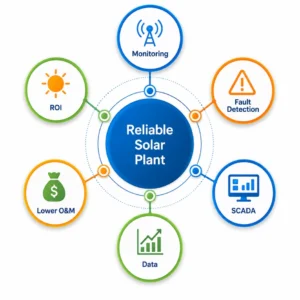
Ensure Your Solar Plant Delivers Reliable Data, Faster Commissioning & Long-Term Performance
From engineering design and field instrumentation to SCADA integration, PLC programming, communication networks, testing and commissioning, NST GLOBAL SOLAR & WIND ENERGY provides complete Instrumentation & Control (I&C) solutions for utility-scale and industrial ground mount solar projects.
Talk to our engineering team before your next solar project begins. Early I&C planning reduces commissioning delays, communication failures, and costly rework.
Complete Scope of Ground Mount Solar I&C Services
A professional I&C scope covers far more than just installing a few sensors. It spans the full lifecycle from design to final handover.
Engineering and design scope
This stage defines the architecture and operating logic before equipment is procured or installed.
Typical deliverables include:
- I&C architecture drawings
- I/O list
- signal list
- control philosophy
- network topology
- cable schedule
- interface matrix
- alarm philosophy
- cause-and-effect matrix
- protocol mapping
- SCADA display philosophy
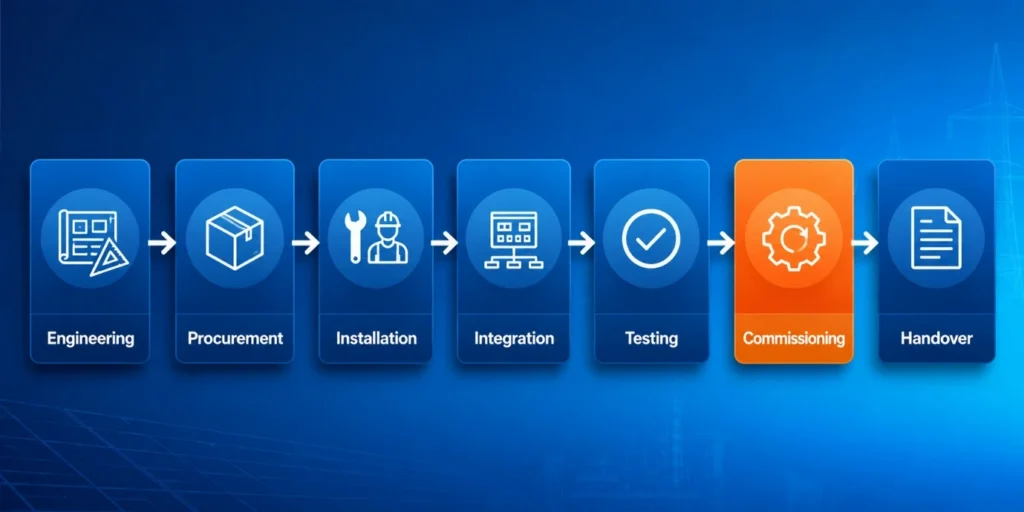
At NST GLOBAL SOLAR & WIND ENERGY, engineering clarity at this stage helps reduce avoidable rework during execution and commissioning.
Procurement and material supply
The right devices must be selected for reliability, compatibility, and site conditions.
Typical procurement items include:
- weather sensors
- irradiance sensors
- energy meters
- PLCs
- RTUs
- industrial switches
- routers
- fiber optic components
- control panels
- junction boxes
- UPS systems
- surge protection devices
Every component must match the system requirements, communication standards, environmental conditions, and project specifications.
Installation scope
Installation is where the design becomes physical.
This includes:
- mounting instruments and panels
- laying and terminating cables
- connecting communication lines
- installing enclosures
- grounding and bonding
- labeling and ferruling
- fiber termination
- cable management and identification
Quality installation matters because many commissioning issues begin with small field mistakes that are easy to miss but expensive to troubleshoot later.
Integration scope
Solar plants often combine equipment from multiple vendors, which makes integration one of the most demanding parts of the project.
Common integration points include:
- inverters
- tracker systems
- weather stations
- meters
- protection relays
- substation interfaces
- utility communication links
- remote monitoring platforms
NST GLOBAL SOLAR & WIND ENERGY approaches integration with a focus on compatibility, traceability, and end-to-end data reliability.
Testing and commissioning scope
Before handover, every signal and function must be verified. This includes:
- continuity testing
- insulation testing
- loop checks
- calibration
- functional testing
- alarm verification
- integrated testing
- trial operation
Documentation and handover scope
A complete I&C service should end with a clean, organized handover package.
This usually includes:
- as-built drawings
- commissioning reports
- calibration certificates
- software backups
- O&M manuals
- training records
- spare parts list
- final punch list closure
Key Components in a Ground Mount Solar I&C System
Understanding the system components helps project teams define scope more clearly and commission more efficiently.
Field instruments and sensors
These are the devices that measure conditions in the field.
Common examples include:
- Pyranometer – measures solar irradiance
- Reference cell – captures solar input for performance analysis
- Ambient temperature sensor
- Module temperature sensor
- Anemometer – measures wind speed
- Wind vane – measures wind direction
- Rain sensor
- Energy meter
- Current and voltage transducers
These devices are essential because the quality of plant intelligence depends on the quality of the data they collect.
Controllers and data acquisition devices
Controllers process signals and manage communication.
Typical devices include:
- PLCs
- RTUs
- data loggers
- local control panels
- marshalling cabinets
These devices execute the logic that makes the system responsive, structured, and reliable.
SCADA and supervisory systems
SCADA gives operators the visibility they need to manage the plant effectively.
It usually includes:
- HMI screens
- dashboards
- alarm notifications
- event logs
- trend charts
- reporting tools
- remote access functionality
For NST GLOBAL SOLAR & WIND ENERGY, SCADA is not just a display layer. It is the operational interface that supports decisions, diagnostics, and performance tracking.
Communication network components
A strong communication backbone is essential for reliable data transfer.
Common components include:
- fiber optic cables
- Ethernet switches
- industrial routers
- gateways
- protocol converters
- patch panels
- communication cabinets
Without a dependable network, even the best field devices cannot deliver useful information.
Power supply and backup systems
The I&C layer needs clean, stable power.
This often includes:
- UPS units
- battery backup
- DC power supplies
- surge protection devices
- breakers
- fuses
These components help protect the system from interruptions and transient electrical events.
Enclosures and support hardware
Outdoor solar sites expose equipment to dust, heat, moisture, and vibration.
That is why I&C systems also rely on:
- weatherproof enclosures
- junction boxes
- control cabinets
- mounting hardware
- cable glands
- terminal blocks
- thermal management accessories
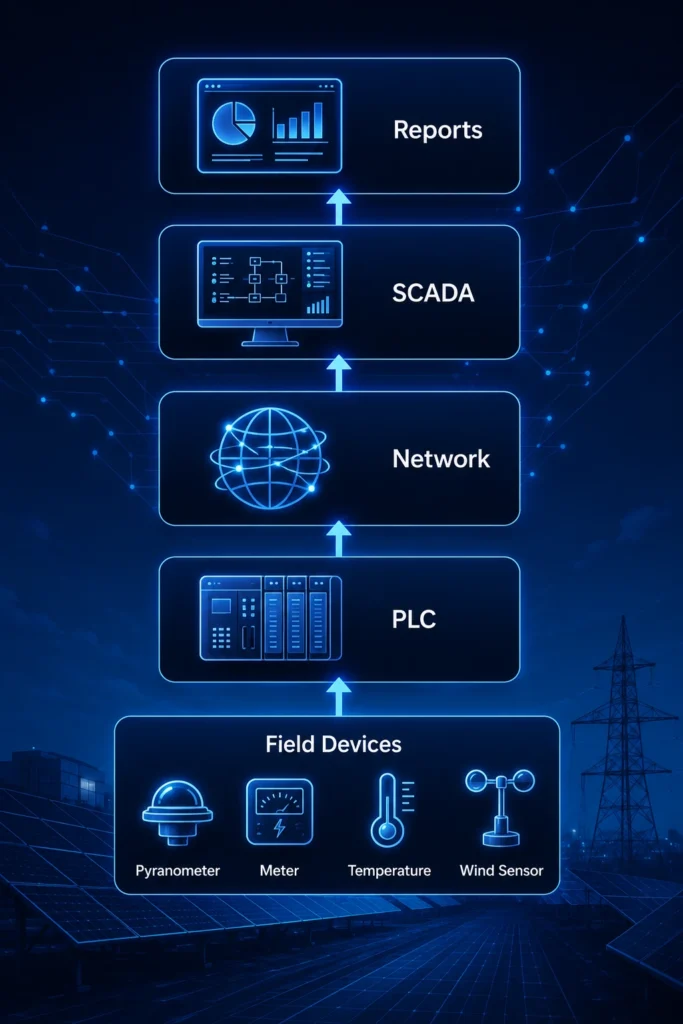
Typical I&C Architecture in a Ground Mount Solar Plant
A modern ground mount solar project usually follows a layered architecture.
Layer 1: Field layer
This is where the measurement begins. Sensors, meters, inverters, tracker devices, and relays collect real-time values.
Layer 2: Control layer
PLCs, RTUs, and local controllers process incoming signals and execute logic.
Layer 3: Communication layer
Switches, routers, gateways, and fiber optic links carry the information across the plant.
Layer 4: Supervisory layer
SCADA servers, HMIs, and historian platforms display and archive the data.
Layer 5: Reporting layer
This is where plant data is turned into actionable reports, analytics, and operational insights.
The flow is simple in principle:
Field Devices → Controllers → Network → SCADA → Reports / Remote Monitoring
But in practice, each connection point must be designed and tested carefully. This is where the engineering depth of NST GLOBAL SOLAR & WIND ENERGY adds real value.
Need Help with SCADA, PLC, Instrumentation or Solar Plant Commissioning?
Every day of commissioning delay increases project costs and impacts plant availability. Connect directly with our engineering team to discuss your Ground Mount Solar I&C requirements, review your project scope, and receive practical technical guidance.
- ✔ Instrumentation & Sensor Selection
- ✔ PLC & RTU Architecture Review
- ✔ SCADA Integration Support
- ✔ Communication Network Design
- ✔ Commissioning & Loop Check Assistance
- ✔ Multi-Vendor Integration Expertise
Get Expert Advice on WhatsApp
Share your project drawings, SLDs, BOQ, I/O list or commissioning issues. Our engineers will guide you with the right I&C solution.
Chat on WhatsApp → Fast Response • Technical Support • No ObligationCommissioning Process: From Pre-Checks to Final Handover
Commissioning is where design intent is proven in the field. It is also where many hidden issues first become visible.
Pre-commissioning checks
Before any functional tests begin, the team must confirm that the system is ready.
This includes:
- reviewing approved drawings
- verifying installed materials
- checking tagging and labeling
- confirming mechanical completeness
- identifying missing items
- ensuring test instruments are calibrated
Mechanical completion checks
This stage confirms that all hardware is installed correctly.
Typical checks include:
- stable mounting
- sealed enclosures
- proper routing
- clear identification
- termination readiness
- correct clearances
- proper grounding and bonding
Electrical testing
The next step is to ensure the circuits are electrically sound.
Common tests include:
- continuity testing
- insulation resistance testing
- polarity verification
- grounding checks
- power supply verification
- fuse and breaker inspection
Calibration of instruments
Calibration is critical for accuracy.
Devices such as irradiance sensors, temperature sensors, meters, and transducers must be checked against known standards. Calibration records should be traceable, signed, and included in the handover documentation.
Loop checks and point-to-point testing
Loop checks verify that every signal travels correctly from the field device to the control system and to SCADA.
This stage checks:
- correct tag mapping
- correct wiring
- correct scaling
- correct engineering units
- correct alarm behavior
- correct display on the HMI
Functional testing
Functional testing verifies how the system behaves under real operating conditions.
This may include:
- alarm trigger tests
- interlock validation
- control sequence verification
- fail-safe response checks
- local/remote mode checks
- communication loss scenarios
Integrated system testing
At this stage, the individual parts are tested as a complete system.
This includes:
- inverter-to-SCADA communication
- tracker status visibility
- weather station telemetry
- meter data transmission
- alarm and event logging
- report generation
- remote access verification
Trial operation
Once the system is live, the team monitors it during trial operation.
This helps validate:
- signal stability
- communication reliability
- data consistency
- alarm frequency
- reporting accuracy
- operator response workflow
Final acceptance and handover
The final step includes:
- punch list closure
- documentation submission
- training completion
- backup transfer
- final sign-off
At NST GLOBAL SOLAR & WIND ENERGY, we view commissioning not as a final task, but as the proof of engineering quality across the entire project.
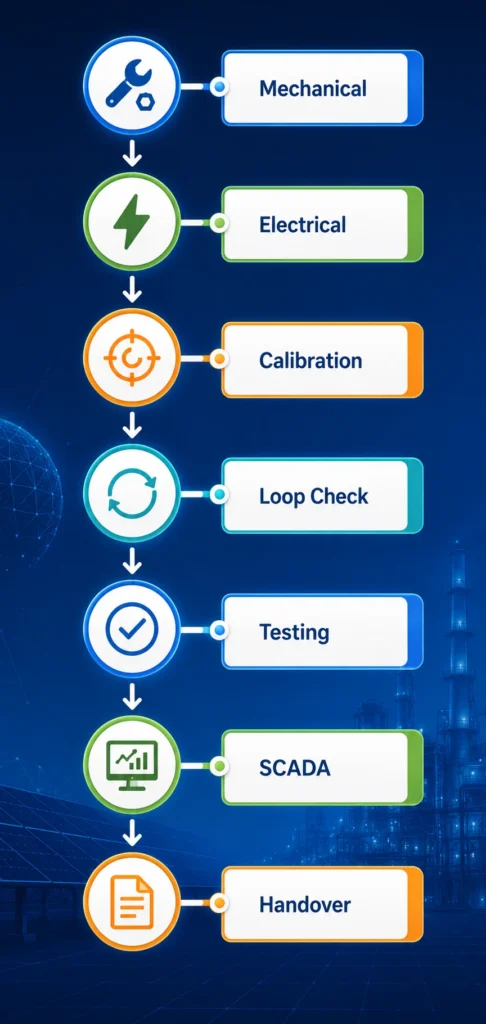
Commissioning Checklist for Ground Mount Solar I&C
A well-structured checklist helps prevent missed steps and rework.
Typical checklist items
- approved drawings available
- devices installed and tagged
- cable terminations complete
- panels energized and tested
- communication verified
- SCADA screens loaded
- alarms configured
- time synchronization checked
- calibration certificates available
- backup and restore tested
- access permissions configured
- reports signed and archived
Common I&C Issues That Delay Commissioning
Even strong projects can face avoidable delays if I&C is not handled carefully.
Wiring and termination errors
Incorrect connections, loose terminals, or poor ferruling can cause false readings or communication failures.
Communication and configuration problems
IP conflicts, unsupported register mapping, wrong baud rates, or gateway issues can disrupt data transfer.
Calibration and scaling issues
A sensor may be physically installed correctly but still report incorrect values if scaling or calibration is not aligned with the system configuration.
Documentation gaps
If drawings, I/O lists, or as-built records are incomplete, troubleshooting becomes slower and handover becomes more difficult.
Software mismatch
SCADA screens, firmware versions, and logic files must all align. Otherwise, data may not display accurately or commands may fail.
Don’t Let Small I&C Problems Become Costly Commissioning Delays
Incorrect wiring, communication failures, SCADA integration issues, calibration errors, or incomplete documentation can delay project handover and impact long-term plant performance.
Whether you’re building a new ground mount solar plant or resolving commissioning challenges, our experienced engineers are ready to help you complete your project efficiently and with confidence.
Speak Directly with Our Solar I&C Engineers
Get immediate guidance on engineering design, PLCs, RTUs, SCADA, communication protocols, testing, commissioning and troubleshooting.
SCADA and Monitoring in Solar Plant Operations
SCADA is the operator’s window into the plant. It allows teams to supervise, diagnose, and optimize performance in real time.
What SCADA typically monitors
- inverter status
- energy generation
- irradiance
- temperature
- breaker states
- tracker positions
- alarms and warnings
- communication health
- performance indicators
How monitoring improves operations
SCADA helps with:
- fault detection
- maintenance planning
- trend analysis
- downtime reduction
- reporting and compliance
- remote diagnostics
For NST GLOBAL SOLAR & WIND ENERGY, SCADA is one of the most valuable tools for long-term plant efficiency because it turns raw plant data into operational intelligence.
Communication Protocols and Integration Challenges
Ground mount solar projects often use multiple communication protocols.
Common protocols
- Modbus RTU
- Modbus TCP
- OPC UA
- IEC 60870-5-104
- SNMP
Common integration challenges
- register mapping errors
- protocol mismatch
- communication latency
- gateway misconfiguration
- device naming inconsistency
- network congestion
Successful integration depends on planning, verification, and disciplined documentation.
Best Practices for Successful I&C Execution
A high-quality I&C implementation is built on process discipline.
Start with a clear control philosophy
Define how the plant should respond in normal, abnormal, and fault conditions before procurement begins.
Standardize naming and tagging
Uniform naming conventions reduce confusion across design, installation, commissioning, and O&M.
Validate the I/O database early
The I/O list should be reviewed and frozen as early as possible.
Separate power and signal routing
This reduces interference, improves signal quality, and simplifies troubleshooting.
Test in phases
Do not wait until the end of the project to discover defects. Verify systems progressively.
Document every change
As-built accuracy is critical for handover and future maintenance.
Train the O&M team
A successful handover includes practical knowledge transfer, not just files and certificates.
Maintain critical spares
Spare sensors, communication devices, and controller parts can reduce downtime later.
Deliverables from a Professional I&C Service Provider
A credible provider should deliver a complete and traceable package.
Engineering deliverables
- control philosophy
- I/O list
- signal list
- cause-and-effect matrix
- architecture drawings
- network diagrams
- cable schedules
- interface documents
- protocol mapping
Testing deliverables
- FAT records
- SAT records
- loop check sheets
- calibration certificates
- functional test reports
- integrated test results
- punch list and closure reports
Handover deliverables
- as-built drawings
- software backups
- SCADA backups
- O&M manuals
- training records
- spare parts list
- warranty documents
- final acceptance certificate
How to Choose the Right Solar I&C Partner
Selecting the right partner can make the difference between a smooth project and a difficult one.
Evaluate the following:
- experience with ground mount solar projects
- integration capability across multiple vendors
- commissioning execution strength
- documentation quality
- support responsiveness
- understanding of grid and utility requirements
- familiarity with solar plant automation and SCADA systems
Questions to ask before award:
- How do you validate protocol and point mapping?
- What is your loop check process?
- How do you manage SCADA version control?
- How do you handle design changes during commissioning?
- What handover package do you deliver?
- What support do you provide after final acceptance?
With NST GLOBAL SOLAR & WIND ENERGY, the focus is always on reducing project risk while improving long-term operational confidence.
Build a Smarter, Safer & More Reliable Solar Plant with Expert I&C Engineering
A successful solar project depends on more than quality panels and inverters. Accurate instrumentation, reliable communication, seamless SCADA integration, and disciplined commissioning are essential for long-term operational success.
100%
Engineering-Focused Execution
End-to-End
I&C Lifecycle Support
24×7
Monitoring & SCADA Readiness
Zero Guesswork
Structured Documentation
Let’s review your project scope, identify potential risks early, and help you deliver a reliable, performance-ready solar plant.
Frequently Asked Questions
It measures conditions, supports automation, enables communication, and helps operators monitor and control the plant.
Yes. SCADA is a core part of the broader I&C ecosystem.
Weather instruments, meters, PLCs/RTUs, communication switches, and SCADA servers are among the most important.
Delays often result from wiring issues, communication mismatches, calibration errors, or incomplete documentation.
FAT is the factory-level verification stage. SAT is the site-level verification stage after installation.
Conclusion
Ground mount solar Instrumentation & Control is far more than a support function. It is the operational backbone that connects physical assets, control logic, communications, SCADA, and long-term plant management.
When I&C is engineered and commissioned properly, the result is a plant that is visible, reliable, maintainable, and performance-ready. When it is not, problems often remain hidden until they affect uptime, data quality, or revenue.
At NST GLOBAL SOLAR & WIND ENERGY, we believe that strong I&C execution is one of the most important investments a solar project can make. It improves commissioning outcomes, strengthens operational visibility, and lays the foundation for better long-term plant performance.