

Introduction: The Energy Crisis Behind the AI Boom
The artificial intelligence revolution is no longer a future concept—it is a present-day infrastructure challenge. From generative AI models to real-time analytics and autonomous systems, data centers are expanding at an unprecedented pace. But behind this explosive growth lies a less visible issue: energy.
Modern AI workloads are extraordinarily power-hungry. Training a single large-scale AI model can consume as much electricity as thousands of households. Multiply that across hyperscale data centers, and the result is a surge in AI energy consumption that is pushing global power systems to their limits.
Traditionally, data centers have relied on a combination of:
- Grid electricity
- Uninterruptible Power Supply (UPS) systems
- Diesel generators for backup
But this legacy setup is rapidly becoming outdated. Diesel generators are slow, carbon-intensive, and increasingly incompatible with sustainability goals.
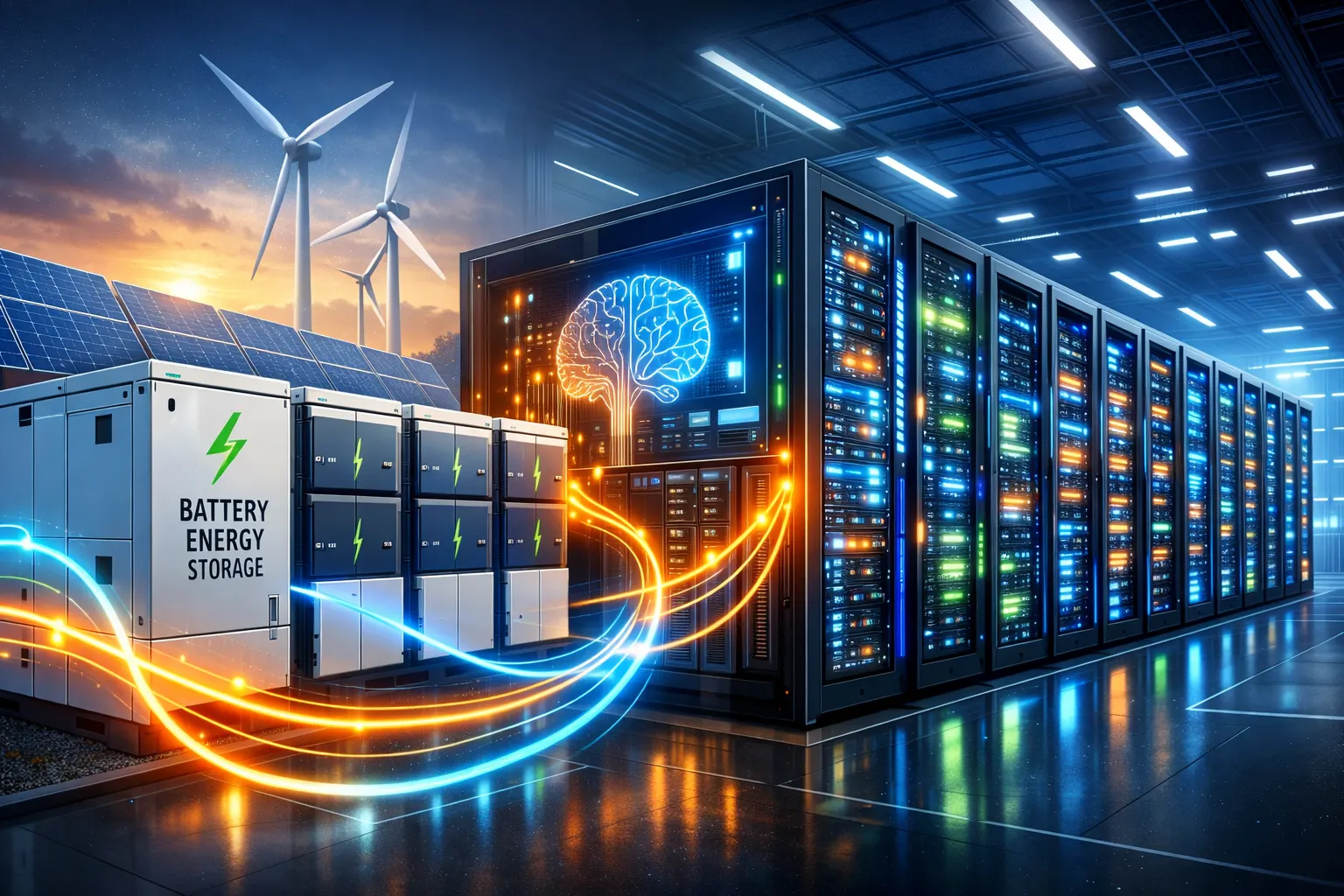
Enter BESS for data centers—Battery Energy Storage Systems that are redefining how digital infrastructure is powered. These systems are not just backup solutions; they are intelligent, modular energy platforms designed for speed, efficiency, and flexibility.
In this article, we explore how BESS is transforming data center energy architecture, why it is replacing diesel and traditional UPS systems, and how it is enabling the next phase of the AI revolution.

The AI Energy Explosion: A New Kind of Demand
Why AI Is Different
Unlike traditional computing workloads, AI operations are:
- Compute-intensive
- Continuous
- Highly scalable
Training and inference workloads require massive GPU clusters running at full capacity for extended periods. This leads to:
- High peak loads
- Constant power draw
- Increased cooling requirements
The Scale of the Challenge
Recent estimates suggest:
- AI-driven data centers can consume 10–50x more power than traditional enterprise facilities
- Hyperscale campuses now demand hundreds of megawatts of capacity
- Global data center electricity consumption is projected to double by the end of the decade
This surge in demand is forcing operators to rethink not just how they source energy—but how they manage, store, and deploy it in real time.
Why Diesel Generators Are No Longer Viable
For decades, diesel generators have been the backbone of data center backup power. But in the AI era, their limitations are becoming impossible to ignore.
1. Slow Response Times
- Diesel generators take seconds to minutes to ramp up
- AI workloads require instantaneous power continuity
2. Environmental Impact
- High carbon emissions
- Increasing regulatory pressure
- Misalignment with corporate ESG goals
Major tech companies have committed to:
- Net-zero targets
- 24/7 carbon-free energy
Diesel simply does not fit this future.
3. Operational Complexity
- Fuel logistics and storage
- Maintenance requirements
- Noise and space constraints
4. Inefficiency in Modern Grids
- Idle most of the time
- Provide no value beyond emergency backup
In short, diesel generators are reactive assets in a world that demands proactive energy systems.
BESS for Data Centers: A Paradigm Shift
Battery Energy Storage Systems (BESS) are emerging as a superior alternative—offering speed, intelligence, and sustainability in a single solution.
What Is BESS?
BESS consists of:
- Advanced lithium-ion or next-gen batteries
- Power conversion systems (PCS)
- Energy management software
Together, these components create a system capable of:
- Storing energy
- Delivering power instantly
- Optimizing energy usage dynamically
Why BESS Is Ideal for Data Centers
1. Instantaneous Response
- Delivers power in milliseconds
- Eliminates downtime risks
2. Modular and Scalable
- Can be deployed in containerized units
- Easily scaled as data center capacity grows
3. Clean and Silent Operation
- Zero on-site emissions
- Minimal noise footprint
4. Multi-Functional Capability
Unlike diesel, BESS is not just backup—it is an active energy asset.
UPS Replacement BESS: Redefining Reliability
One of the most significant shifts is the rise of UPS replacement BESS.
Traditional UPS Systems: Limitations
- Short-duration backup (typically minutes)
- Separate from long-duration backup (diesel)
- Limited flexibility
How BESS Replaces UPS
BESS can:
- Provide instant backup power (like UPS)
- Sustain power for extended durations
- Seamlessly integrate with grid and renewable sources
Key Advantages
- Unified system (no need for separate UPS + diesel)
- Reduced infrastructure complexity
- Lower lifecycle costs
Always-On Energy Architecture
With BESS:
- Power is continuously managed—not just during outages
- Systems can transition smoothly between:
- Grid supply
- Stored energy
- Renewable sources
This creates a truly resilient, always-on data center.
Beyond Backup: The Strategic Value of BESS
BESS unlocks new operational and financial benefits that go far beyond reliability.
1. Peak Shaving and Load Management
- Reduce peak demand charges
- Smooth power consumption profiles
2. Energy Arbitrage
- Store electricity when prices are low
- Use or sell when prices are high
3. Renewable Integration
BESS enables data centers to:
- Store solar and wind energy
- Use clean energy during peak demand
This is critical for achieving:
- 24/7 carbon-free operations
4. Grid Services and Revenue Streams
Data centers with BESS can:
- Provide frequency regulation
- Offer demand response services
This transforms energy infrastructure into a revenue-generating asset.
Supporting the AI Infrastructure Boom
The rise of AI is driving a new wave of data center construction—often in regions where grid capacity is limited.
The Grid Constraint Problem
- Transmission infrastructure is struggling to keep up
- New connections face multi-year delays
How BESS Solves It
- Reduces reliance on grid during peak times
- Enables behind-the-meter energy optimization
- Supports microgrid and islanding capabilities
Edge and Modular Data Centers
BESS is particularly valuable for:
- Remote deployments
- Edge computing nodes
- Rapidly deployable AI clusters
Its modular nature allows operators to:
- Deploy power infrastructure alongside compute capacity
Sustainability: From Compliance to Competitive Advantage
Sustainability is no longer optional—it is a core business requirement.
Corporate Pressure
Tech giants are committing to:
- Net-zero emissions
- 100% renewable energy
Regulatory Landscape
Governments are introducing:
- Carbon pricing
- Emissions limits
- Clean energy mandates
BESS as a Sustainability Enabler
- Eliminates diesel emissions
- Enables renewable energy utilization
- Supports carbon-free energy goals
Brand and Market Impact
Data centers powered by clean, reliable energy gain:
- Competitive advantage
- Investor confidence
- Customer trust
Challenges and Considerations
While BESS offers significant advantages, deployment requires careful planning.
1. Initial Capital Costs
- High upfront investment
- Requires long-term ROI analysis
2. Safety and Thermal Management
- Advanced cooling and monitoring required
- Compliance with safety standards
3. Lifecycle Management
- Battery degradation over time
- Recycling and disposal considerations
4. Integration Complexity
- Requires advanced energy management systems
- Coordination with grid and on-site generation
The Future: Data Centers as Energy Hubs
The role of data centers is evolving. They are no longer just consumers of electricity—they are becoming active participants in the energy ecosystem.
What the Future Looks Like
- Hybrid energy systems (solar + wind + BESS)
- Grid-interactive data centers
- AI-driven energy optimization
The Convergence of AI and Energy
Ironically, AI itself is now being used to:
- Optimize energy usage
- Predict demand
- Improve battery performance
A New Infrastructure Paradigm
In the coming decade, the most successful data centers will be those that:
- Integrate compute and energy seamlessly
- Leverage BESS as a core component
- Operate as intelligent, adaptive systems
Conclusion: Powering the AI Revolution
The AI revolution is fundamentally an energy revolution.
As AI energy consumption continues to rise, traditional power architectures are reaching their limits. Diesel generators and legacy UPS systems can no longer meet the demands of speed, sustainability, and scalability.
BESS for data centers offers a transformative solution.
By replacing outdated backup systems with intelligent, modular storage, data centers can:
- Achieve true reliability
- Reduce emissions
- Unlock new revenue streams
- Support the exponential growth of AI
The shift is already underway—and it is accelerating.